India’s Military Satellites Keep Failing: Experts Flag "Sabotage" After 5th Strategic ISRO Failure
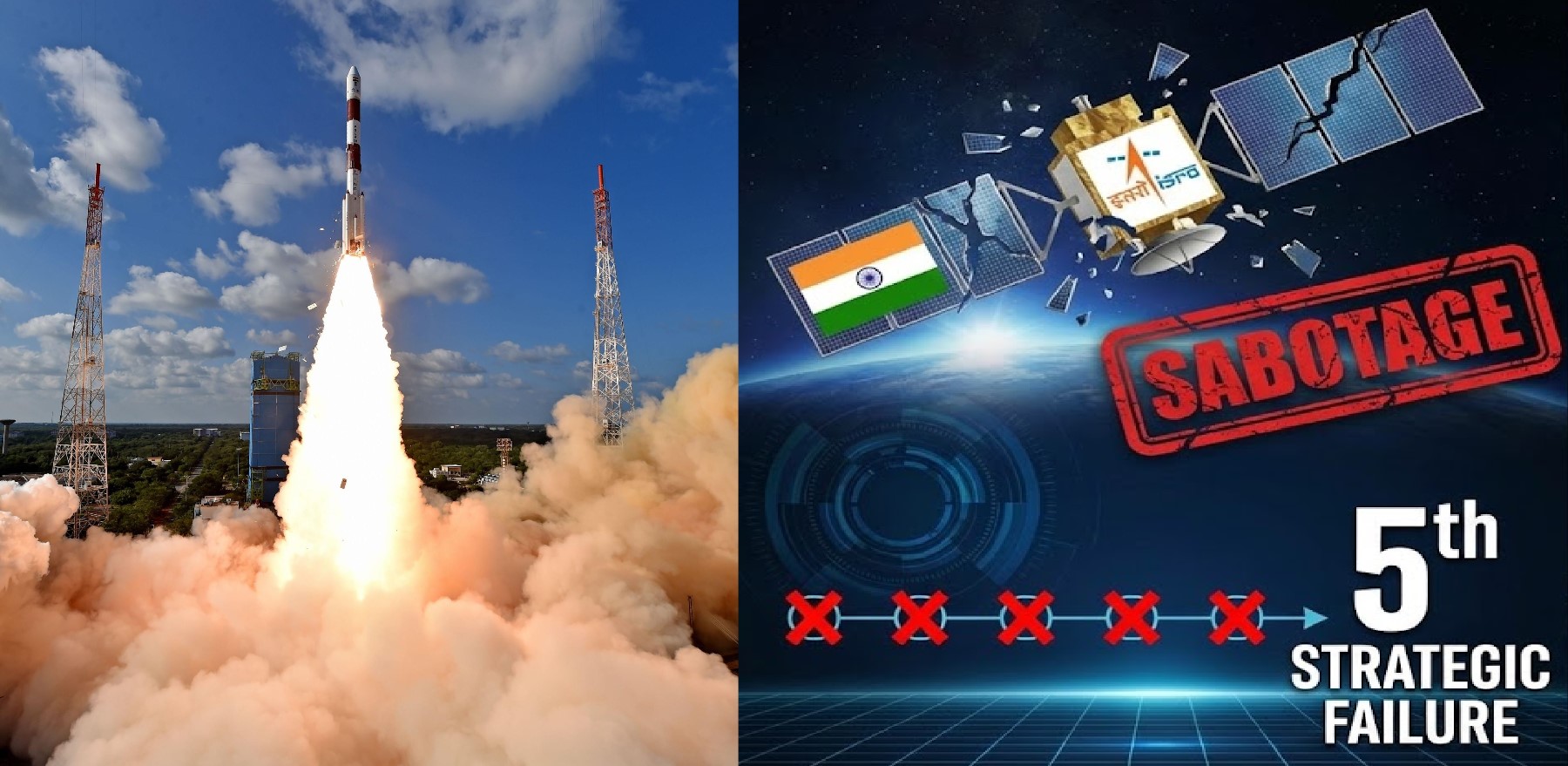
Sriharikota, India : The Indian Space Research Organisation (ISRO) is facing an unprecedented crisis following the failure of the PSLV-C62 mission earlier today. The Polar Satellite Launch Vehicle, a rocket once celebrated for its near-perfect reliability, failed to place the strategic EOS-N1 (Anvesha) satellite into orbit, marking its second consecutive failure in just eight months.
While official statements cite a "third-stage deviation," defense analysts and cyber-security experts are raising a more alarming possibility: that India’s strategic space program may be the target of sophisticated, coordinated sabotage.
The "Third Stage" Anomaly: A Statistical Impossibility?
Today’s failure of the PSLV-C62 eerily mirrors the loss of the PSLV-C61 mission in May 2025. In both instances, the rocket performed flawlessly during the initial stages, only to experience a catastrophic anomaly in the third stage (PS3)—a solid rocket motor that has been reliable for decades.
-
May 2025 (PSLV-C61): The mission carrying EOS-09 (a radar imaging satellite) failed due to a sudden "pressure drop" in the third stage motor.
-
January 12, 2026 (PSLV-C62): The mission carrying EOS-N1 (a DRDO hyperspectral spy satellite) reported a "deviation in flight path" and "disturbance in roll rates" during the same third-stage burn.
"The probability of the same proven component failing twice in a row, exclusively on strategic missions, is statistically negligible," said a senior analyst at Intelegrid, a firm specializing in critical infrastructure security. "This suggests a repeatable failure mode—a signature of intentional interference rather than random bad luck."
The Pattern: Only Strategic Missions are Failing
A forensic review of ISRO’s launch history since the 2017 Doklam standoff reveals a chilling pattern. While commercial and scientific missions like Chandrayaan-3 and Aditya-L1 have largely succeeded, missions carrying payloads critical to India's national security have faced a 100% failure rate in major anomalies.
The "Strategic Curse" Timeline:
-
Aug 2017 (PSLV-C39): IRNSS-1H (Military GPS/NavIC) – Failed. (Heat shield did not separate).
-
Aug 2021 (GSLV-F10): EOS-03 (Real-time Border Surveillance) – Failed. (Cryogenic stage valve leak).
-
Aug 2022 (SSLV-D1): EOS-02 (Micro-surveillance) – Failed. (Sensor logic error injected satellite into wrong orbit).
-
May 2025 (PSLV-C61): EOS-09 (Cloud-penetrating Spy Radar) – Failed. (3rd stage pressure drop).
-
Jan 2026 (PSLV-C62): EOS-N1 (Hyperspectral Tracking) – Failed. (3rd stage deviation).
This selective targeting has delayed India’s "eye in the sky" capabilities by over five years, leaving critical gaps in border monitoring.
The Invisible Hand: Cyber and Electronic Sabotage
Experts are urging the Prime Minister’s Office (PMO) to look beyond mechanical faults and investigate "Non-Kinetic" sabotage—methods that destroy a rocket without explosives.
1. GPS Spoofing & Telemetry Corruption : Intelegrid experts have called for a forensic audit of the ground stations and antennas used during the launch. "If the telemetry data fed to the rocket’s guidance computer is spoofed or corrupted by an external cyber-actor, the rocket will 'think' it is off-course and 'correct' itself into a crash," the firm noted. This matches the "deviation in flight path" reported in today's C62 mission.
2. The "Logic Bomb" : The SSLV-D1 failure in 2022 was caused by a software logic error that triggered a salvage action unnecessarily. Cyber-security insiders warn that malware, similar to the "Dtrack" virus used by the Lazarus Group (which targeted ISRO in 2019), could be planted in the guidance software to trigger failures only under specific orbital conditions—making them undetectable during ground tests.
3. Supply Chain "Poisoning" : The recurrence of third-stage failures points to potential deep-level supply chain sabotage. Defense experts recall historical precedents where imported microprocessors and DSPs (Digital Signal Processors) were found to contain hardware "backdoors."
"Decades ago, Russian defense establishments discovered that Western-imported chips were deliberately engineered to degrade prematurely," noted a former defense consultant. "A chip designed to last ten years would fail in three, or succumb to solar radiation because the shielding was intentionally compromised. If ISRO is importing sensitive electronics for its stage controllers without end-to-end fabrication control, we are vulnerable to 'Electronic Time Bombs' that no physical inspection can detect."
The Call for a "Red Team" Investigation
The consensus among security hawks is that the standard Failure Analysis Committee (FAC) is ill-equipped to detect malicious intent. By design, an FAC looks for a broken valve; it does not look for a bad actor who broke the valve. Consequently, there is a growing demand for a high-level "Red Team" investigation—one that moves beyond standard technical diagnostics to include intelligence officers, cyber-warfare experts, and propulsion scientists. Such a probe would be tasked with auditing the failure from a counter-intelligence perspective, specifically scrutinizing source codes for dormant "logic bombs" and rigorously vetting the supply chain for compromised imported electronics.
As India stands on the cusp of becoming a true space power, the repeated loss of its military satellites serves as a stark warning. If these "anomalies" are indeed acts of invisible warfare, the cost of inaction will be measured not just in lost rupees, but in compromised national security.
About the Author
Aditya Kumar:
Defense & Geopolitics Analyst
Aditya Kumar tracks military developments in South Asia, specializing in Indian missile technology and naval strategy.