India’s Indigenous HALE Drone to Use TPE-331-10 Engine
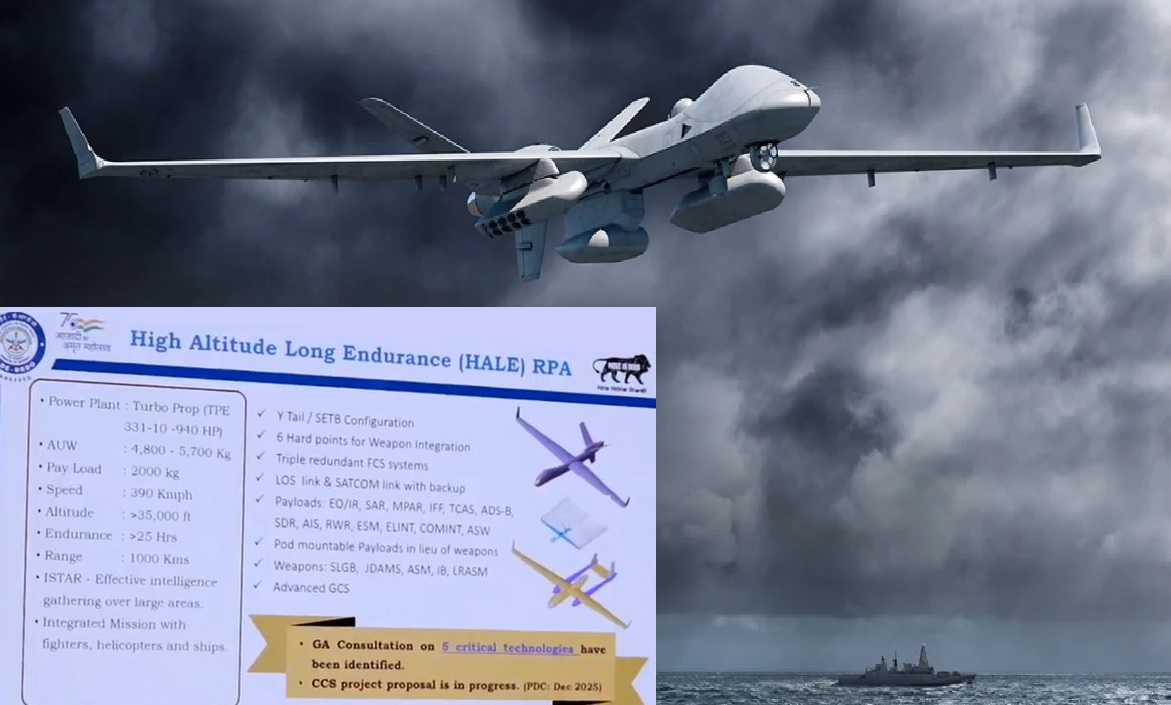
India is steadily advancing its unmanned aerial warfare capabilities with the development of a state-of-the-art High Altitude Long Endurance (HALE) drone, designed by the Aeronautical Development Establishment (ADE) under the Defence Research and Development Organisation (DRDO). The platform is expected to serve both surveillance and strike roles, and a recent presentation has confirmed that it will be powered by the Honeywell TPE-331-10 turboprop engine—a globally proven propulsion system used in several high-end UAVs including the MQ-9 Reaper.
This marks a critical step in India's roadmap for autonomous aerial platforms, enhancing capabilities in border surveillance, maritime patrol, and deep-strike operations.
Powerplant and Payload Capacity
The HALE drone will be equipped with the TPE-331-10 engine, capable of delivering between 940 horsepower, enabling long-endurance missions at high altitudes. This engine family is known for its fuel efficiency, compact design, and digital control features, which allow for better performance and easier integration with modern UAV systems.
-
All-Up Weight (AUW): 4,800 to 5,700 kg
-
Maximum Payload: 2,000 kg
The drone’s heavy-lift capacity allows it to carry a mix of sensors, communication systems, and precision-guided munitions on a single sortie.
Key Performance Features
Designed for long-range strategic missions, the HALE drone offers:
-
Cruising Speed: 390 km/h
-
Service Ceiling: Over 35,000 feet
-
Endurance: More than 25 hours of continuous flight
-
Range: 1,000 km operational radius
Such specifications place it in the league of advanced HALE platforms globally, capable of providing 24x7 surveillance over India's vast land and maritime borders.
Surveillance and Strike Capabilities
The drone is equipped with a comprehensive range of ISR (Intelligence, Surveillance, Reconnaissance) and combat sensors:
-
EO/IR (Electro-Optical/Infrared) Cameras
-
Synthetic Aperture Radar (SAR)
-
Maritime Patrol Radar (MPAR)
-
ELINT/COMINT Modules
-
IFF, RWR, AIS, SDR, ADS-B, TCAS
This makes it ideal for multi-domain operations, including coastal surveillance, battlefield observation, electronic warfare, and target tracking.
For strike missions, the drone features six hardpoints for mounting advanced Indian and imported weaponry such as:
-
Smart Laser-Guided Bombs (SLGBs)
-
Joint Direct Attack Munitions (JDAMs)
-
Air-to-Surface Missiles (ASMs)
-
Long Range Anti-Ship Missiles (LRASMs)
This dual capability allows the HALE drone to play both defensive and offensive roles in a single mission—detecting, tracking, and destroying targets with precision.
Network-Centric Operations
The platform will support:
-
Line-of-Sight (LOS) Data Links
-
Satellite Communication (SATCOM) with Backup
-
Advanced Command Ground Stations (GCS)
-
Triple-Redundant Flight Control Systems (FCS)
These features enable seamless integration with fighter aircraft, naval warships, and ground forces, forming the backbone of network-centric warfare.
Development Timeline and Strategic Goals
According to official sources, the Cabinet Committee on Security (CCS) is currently reviewing the project proposal. The Planned Date of Completion (PDC) is December 2025, Five critical technologies have already been identified and are under consultation with key stakeholders.
The HALE drone is being developed under India’s Aatmanirbhar Bharat initiative and will be manufactured using largely indigenous components, supported by a domestic supply chain and future export potential.
India’s upcoming HALE drone, powered by the TPE-331-10 engine, represents a significant leap in the country’s quest for autonomous strategic platforms. With combat-ready payloads, deep surveillance capabilities, and interoperability with other military assets, this drone will be a critical force multiplier in India’s defence arsenal.
As the December 2025 deadline approaches, the world will be watching closely as India prepares to field one of its most advanced unmanned platforms yet—entirely designed, developed, and deployed on Indian soil.
✍️ This article is written by the team of The Defense News.