India’s Gridbots Develops Fully Autonomous Anti-Tank Minelaying Robot ‘Titan Fortifier’
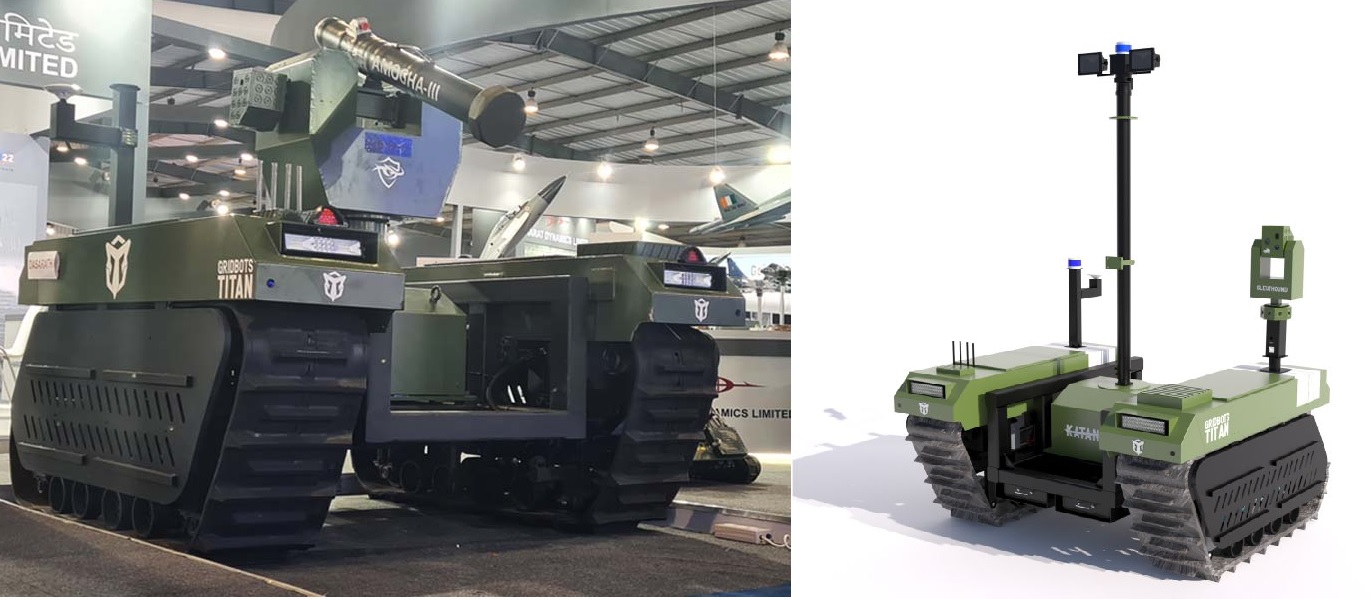
Gridbots Technologies Pvt. Ltd., an Ahmedabad-based robotics firm, has developed the ‘Titan Fortifier’, described as the world’s first fully autonomous anti-tank (AT) minelaying robot. The system is designed to carry up to 50 brick mines weighing a total of around 600 kilograms and can deploy them over a range of 50 kilometers on a single charge.
A New Step in Automated Engineering
The Titan Fortifier is a heavy-duty unmanned ground vehicle (UGV) developed for automated mine deployment in defensive operations. It can navigate and lay mines independently using onboard sensors, mapping systems, and AI-based route planning. Once programmed with a mission path, it can move through uneven terrain, identify suitable areas, and place mines according to pre-set instructions — all without direct human control during operation.
The system aims to improve the speed and safety of minefield deployment, reducing the need for human personnel in hazardous areas. According to Gridbots, the robot can also return to base or relocate after completing its mission, making it suitable for repetitive engineering tasks in field conditions.
Technical Overview
The Titan Fortifier is based on Gridbots’ Titan UGV platform, which has been used for industrial and defense applications. Its main features include:
-
Payload capacity: Up to 600 kg, allowing the transport of approximately 50 AT brick mines.
-
Operational range: Around 50 km per battery charge.
-
Autonomy: Equipped with LiDAR, GPS, and vision-based navigation for pathfinding and obstacle avoidance.
-
Deployment module: Automated mechanism for precise mine placement at programmed intervals.
The system’s chassis and suspension are designed for off-road terrain, allowing it to operate in desert, mountain, or semi-urban environments.
Global Context
While autonomous mine-clearing robots have existed for years, fully autonomous mine-laying systems are still rare. Globally, most systems remain semi-automated or remotely operated.
-
Russia has fielded engineering vehicles like the Uran-6 (for mine-clearing) and Uran-9 (for combat roles), but not fully autonomous minelayers.
-
China has reportedly tested UGVs capable of limited mine deployment under human supervision.
-
Ukraine and Turkey have experimented with remotely controlled engineering UGVs for minefield setup, but these are not autonomous.
This makes the Titan Fortifier one of the first publicly known systems to perform autonomous anti-tank mine deployment.
Operational Use and Implications
In defense operations, mine deployment is often time-consuming and dangerous, requiring engineers to work close to potential combat zones. The Titan Fortifier is designed to reduce that risk by performing these tasks autonomously.
The system could be useful for:
-
Area denial and border defense, especially in remote or rugged terrain.
-
Rapid fortification in defensive positions.
-
Support to engineering corps where manpower or access is limited.
The robot can also be integrated into battlefield management systems, enabling synchronized operation with surveillance drones or reconnaissance vehicles for coordinated defensive planning.
Legal and Safety Aspects
Mine deployment remains a sensitive area in international law. While anti-personnel mines are banned under the Ottawa Treaty, anti-tank mines remain permitted for defensive purposes under regulated conditions.
Gridbots has indicated that the Titan Fortifier is designed for compliance with international standards and can be equipped with self-neutralizing or self-deactivating mines, depending on operational requirements. Such features help reduce long-term risks associated with unexploded ordnance.
India’s Role in Defense Robotics
Gridbots has worked on several automation and robotics projects for defense, nuclear, and industrial applications. The company specializes in developing robotic platforms for hazardous environments, including bomb disposal robots, inspection crawlers, and industrial automation systems.
The Titan Fortifier expands Gridbots’ Titan series of UGVs, which includes platforms for logistics, surveillance, and reconnaissance. Its development aligns with India’s goals of enhancing indigenous defense production and adopting AI-driven automation in field operations.
The Titan Fortifier represents a significant step in automated military engineering. With its ability to carry a heavy payload, operate autonomously over long distances, and lay mines accurately, it introduces greater efficiency and safety to mine deployment tasks.
While similar systems are in early stages elsewhere, the Titan Fortifier stands out as one of the most advanced and field-ready platforms of its kind. Its development underlines how autonomous robotics are steadily becoming part of modern defense infrastructure — designed to make military operations safer, faster, and more reliable.
About the Author
Aditya Kumar:
Defense & Geopolitics Analyst
Aditya Kumar tracks military developments in South Asia, specializing in Indian missile technology and naval strategy.