Indian Navy’s MARCOS Induct High-Tech ‘Hoverbee’ Kamikaze Drones for Stealth Operations
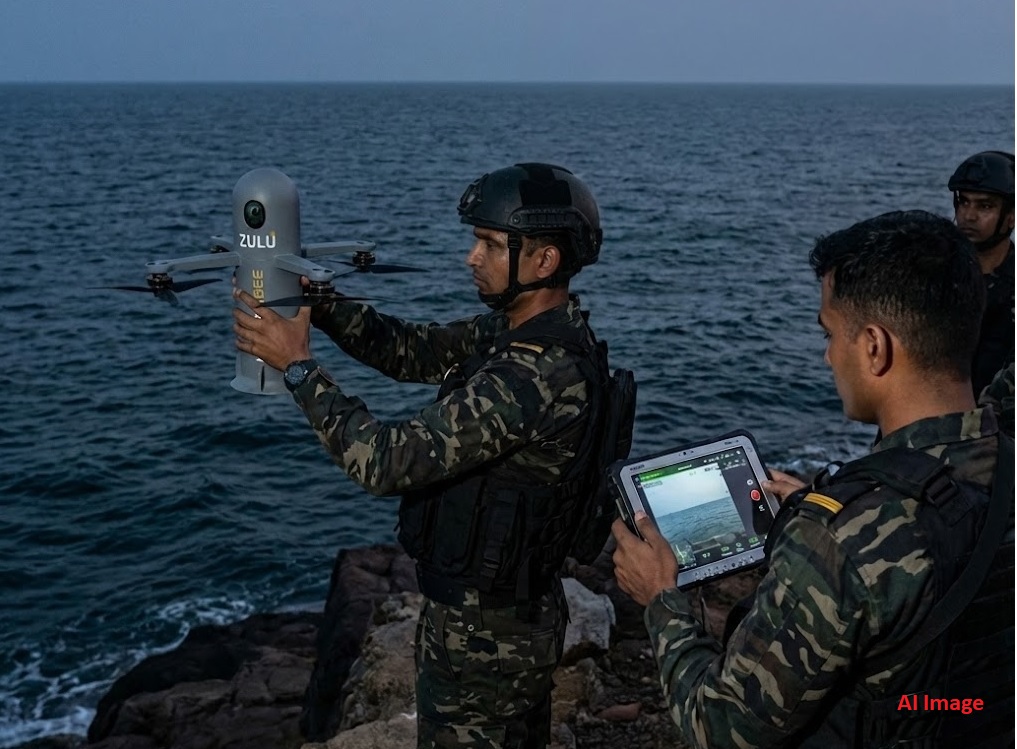
Zulu Defence Systems’ electrically powered Hoverbee kamikaze micro-drones have entered operational service with the Marine Commandos (MARCOS) of the Indian Navy, according to defence industry sources familiar with recent inductions. The development marks a significant step in the Navy’s effort to equip its special forces with indigenous, low-signature unmanned systems optimised for precision strikes and close-quarters missions.
The Hoverbee is designed as a highly portable, vertical take-off and landing (VTOL) micro-drone that can be carried and operated by a single commando. Its electric propulsion and compact airframe are intended to keep both acoustic and visual signatures extremely low, a critical requirement for covert maritime and littoral operations typically undertaken by MARCOS. Sources indicate the system has been cleared for operational use following evaluation cycles focused on urban, ship-borne, and coastal mission profiles.
A Drone Built For Surgical Missions
Zulu Defence Systems has positioned the Hoverbee as a platform for rapid, surgical engagements where speed, stealth, and precision matter more than range or payload size. For MARCOS teams, this translates into the ability to deploy a drone within seconds, manoeuvre it inside confined spaces such as ship compartments or coastal structures, and engage targets without exposing operators to direct fire.
The Hoverbee’s modular design allows it to function either as a reconnaissance asset or as a loitering munition. In its strike configuration, the drone carries a small explosive payload and is intended for one-way missions against personnel or lightly protected targets. The emphasis, according to officials familiar with the system, is on controlled effects and target discrimination, rather than area damage.
Reported Specifications And Capabilities
Available open-source and industry information suggest the Hoverbee is a sub-one-kilogram micro-UAS with a foldable frame that fits into a compact backpack. In its ISR (intelligence, surveillance and reconnaissance) configuration, it is equipped with an electro-optical (EO) camera capable of transmitting live video to a handheld controller, with an optional thermal imaging payload for night and low-visibility operations.
The system is reported to have an operational control range of up to 2 km, depending on terrain and electromagnetic conditions. Endurance figures cited by industry material indicate 30–45 minutes of flight time in surveillance mode, while the kamikaze variant trades endurance for payload.
In its strike role, the Hoverbee is reported to carry an explosive charge in the 400-gram class, with multiple detonation modes including operator command, impact, or proximity-based triggering. Onboard navigation, stabilised flight, and obstacle-avoidance features are designed to support operations in cluttered environments, including indoors.
The electric propulsion system enables near-silent flight at short ranges, a characteristic highlighted as one of the platform’s most important advantages for special operations forces conducting raids, counter-terror actions, or ship-clearing missions.
Indigenous Push And Operational Relevance
The reported induction of the Hoverbee with MARCOS aligns with a broader indigenous defence manufacturing push, as the Indian armed forces accelerate the adoption of small unmanned systems developed by domestic firms. Recent conflicts worldwide have demonstrated the tactical value of loitering munitions and micro-drones, particularly in urban warfare and special operations.
For the Indian Navy, such systems are especially relevant for ship-boarding operations, counter-piracy missions, and coastal counter-terror roles, where the ability to neutralise threats inside tight, enclosed spaces without heavy weapons provides a clear tactical advantage.
Details Yet To Be Disclosed
Neither the Indian Navy nor Zulu Defence Systems has publicly released details on order quantities, delivery timelines, or the exact variant fielded by MARCOS. Information related to electronic counter-countermeasures, secure data links, and rules of engagement for the kamikaze configuration also remains undisclosed.
Even so, defence analysts note that the reported entry of the Hoverbee kamikaze drone into service reflects growing confidence in home-grown micro-UAS solutions. If formally confirmed, the system would rank among the smallest loitering munitions currently believed to be in operational use with Indian special forces, underlining a shift toward discreet, high-precision tools for modern maritime and littoral combat environments.
✍️ This article is written by the team of The Defense News.