Indian Astronomers Spot ‘Alaknanda’, a Milky Way-Like Spiral Galaxy From the Universe’s Youth Using JWST
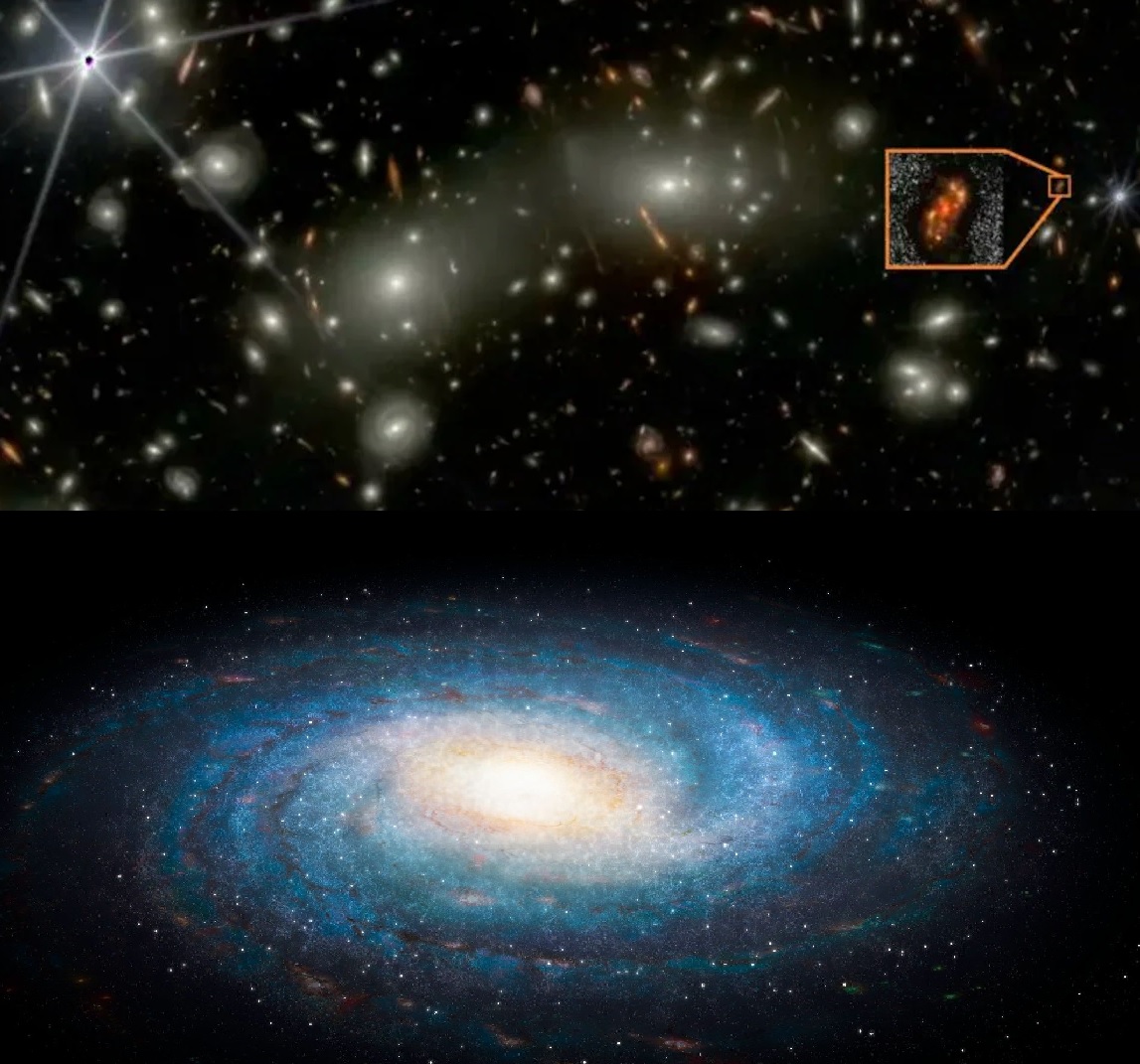
Indian astronomers have identified a striking spiral galaxy, named Alaknanda, in data from the James Webb Space Telescope (JWST), revealing a mature, Milky Way–style system from a time when the universe was still very young. The discovery, made by researchers at the National Centre for Radio Astrophysics – Tata Institute of Fundamental Research (NCRA–TIFR), Pune, is already forcing scientists to rethink how quickly galaxies can form and organize themselves after the Big Bang.
A Well-Formed Spiral in a “Baby Universe”
Alaknanda lies about 12 billion light-years away and is seen as it existed when the universe was roughly 1.5 billion years old—about one-tenth of its current age of 13.8 billion years.
Unlike the chaotic, clumpy shapes astronomers usually expect in such an early era, Alaknanda shows a textbook spiral structure: a bright central bulge with two clearly defined spiral arms wrapping around it, much like our own Milky Way.
Estimates based on JWST data suggest that the galaxy spans roughly 30,000 light-years in diameter—about half the size of the Milky Way—and is undergoing intense star formation, creating the equivalent of about 60 Sun-like stars every year. For comparison, the Milky Way forms only a few solar masses’ worth of stars per year, making Alaknanda a genuine “star factory” in the early cosmos.
Found in James Webb’s Deep View of a Galaxy Cluster
The galaxy was picked out in JWST images targeting the massive galaxy cluster Abell 2744, also known as Pandora’s Cluster, a region often used as a gravitational lens to study extremely distant objects. In shorter-wavelength JWST bands, Alaknanda appears as a small but sharply defined spiral amid many foreground galaxies and cluster members.
Using this deep imaging, Indian astronomers Rashi Jain and Yogesh Wadadekar analyzed the galaxy’s light and structure, identifying it as a grand-design spiral—a category reserved for galaxies with prominent, symmetric arms. Their findings have been reported in the peer-reviewed journal Astronomy & Astrophysics, putting Alaknanda firmly on the global astronomy map.
The galaxy’s name, Alaknanda, draws on Indian heritage: it references the Alaknanda river in the Himalayas, and also echoes traditional Indian references to the Milky Way, underlining the link between this distant object and our home galaxy.
Why Alaknanda is a Problem for Existing Galaxy Theories
For decades, standard models suggested that large, ordered spirals like the Milky Way take three billion years or more to settle into stable disks with clear spiral arms. In the very early universe, galaxies were expected to be small, irregular, and frequently disturbed by mergers and violent inflows of gas.
Alaknanda appears to break those rules. It shows:
-
A well-organized disk rather than a chaotic clump.
-
Symmetric, two-armed spiral structure.
-
High but coherent star-formation activity, rather than a brief, explosive burst.
Together, these features indicate that at least some galaxies managed to settle into mature configurations far earlier than theory allowed. If more such objects are found in JWST data, astronomers may have to revise key aspects of galaxy formation models, including how quickly dark-matter halos grow, how gas cools and settles into disks, and how frequently early galaxies collide and merge.
Part of a New Trend in James Webb Discoveries
Alaknanda is not an isolated case. Over the past few years, JWST has revealed surprisingly evolved galaxies at high redshifts, including massive disk galaxies and spirals like the so-called “Big Wheel” galaxy and other early Milky Way–like systems. Together, these discoveries suggest that the early universe may have been more mature, more quickly than astronomers previously believed.
However, Alaknanda stands out because:
-
It is relatively compact but strongly organized.
-
It was discovered and characterized by an Indian team, using data from one of the world’s most advanced observatories.
-
Its spiral arms are especially clean and prominent for such an early epoch.
This combination makes the galaxy an important test case for the next generation of computer simulations and theoretical work on cosmic structure formation.
A Milestone for Indian Astronomy
The discovery is being hailed as a landmark achievement for Indian astronomy. NCRA–TIFR has long been associated with cutting-edge radio astronomy, including work on the Giant Metrewave Radio Telescope (GMRT), but Alaknanda showcases the country’s growing role in deep-space optical and infrared cosmology using international facilities like JWST.
Scientists say that the find will:
-
Strengthen India’s participation in major international space missions.
-
Attract more young researchers into observational cosmology and galaxy evolution.
-
Provide a rich data set for follow-up studies across multiple wavelengths, including future radio and X-ray observations to probe its gas, dust and central region in more detail.
Further analysis of Alaknanda’s rotation, mass distribution and chemical composition is expected to reveal how such an orderly galaxy assembled so early in cosmic history—and whether it is a rare outlier or part of a much larger hidden population that JWST is only now beginning to uncover.
✍️ This article is written by the team of The Defense News.