Indian Army Examines Germany’s ‘Sky Shield’ SHORAD to Counter Drone Swarm and Low-Flying Threats
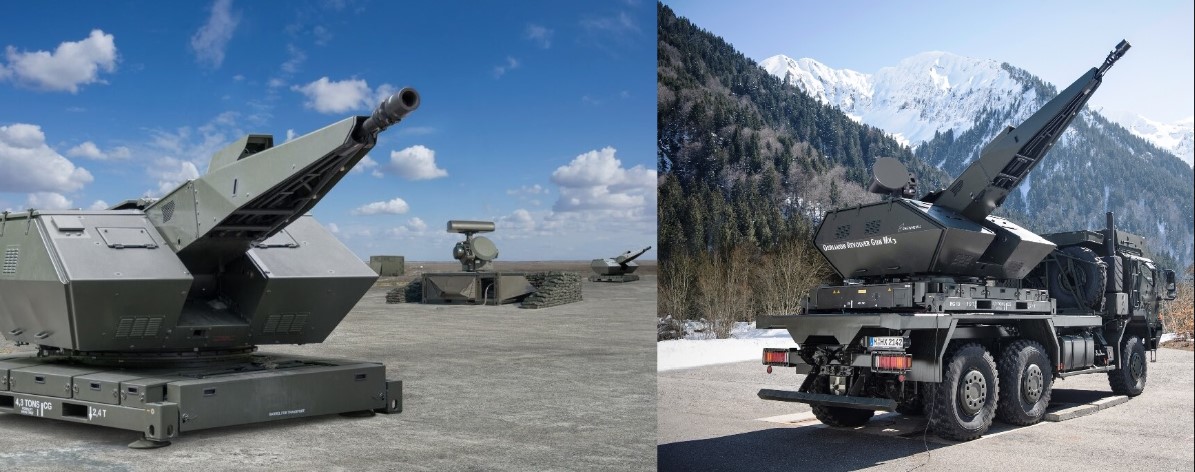
The Indian Army has begun a detailed evaluation of Germany’s Sky Shield next-generation short-range air defence (SHORAD) system, looking to plug a critical gap against drone swarms, cruise missiles, helicopters and low-flying fighter aircraft around high-value military and strategic assets. The system – essentially the Oerlikon Skyshield / Skynex family from Rheinmetall – combines a high-rate 35 mm gun, AHEAD programmable ammunition, a 50 km-class radar, and the Skymaster battle management system (BMS), with the added possibility of integration into India’s existing Akash-NG and QRSAM surface-to-air missile network.
Indian industry sources indicate that talks are centred on a minimum 60% indigenization level, with Tata Advanced Systems and BEML emerging as potential prime manufacturing partners for local assembly, integration and life-cycle support. If concluded, the deal would give India a proven, cannon-based anti-drone shield while keeping most of the value chain within the country under Make in India.
What Exactly Is ‘Sky Shield’?
The system the Army is looking at is part of Rheinmetall’s Skyshield / Skynex family – a modular, lightweight SHORAD system originally developed by Oerlikon Contraves (now Rheinmetall Air Defence). Skyshield was conceived as the successor to the older Skyguard system, with roles ranging from classic anti-aircraft defence to counter-rocket, artillery and mortar (C-RAM) missions.
At its core, a typical Skyshield / Skynex fire unit combines:
-
35 mm Revolver Gun (Mk2 / Mk3) firing up to 1,000 rounds per minute
-
X-TAR3D X-band tactical acquisition radar, with instrumented ranges of 25, 35 or 50 km depending on configuration
-
A command node running Oerlikon Skymaster BMS (also known as CN-1 in Skynex batteries), which fuses sensor data and assigns targets
-
Optional add-ons such as missile launchers, additional radars, or even high-energy lasers in the latest Skynex architecture
India’s “Sky Shield Next-Gen SHORAD” references this ecosystem: the gun-based Skyshield 35/1000 effectors controlled and networked through the newer Skynex/Skymaster architecture, giving a flexible, plug-and-play air-defence layer around airbases, ammunition depots, command posts and critical infrastructure.
How the System Works: From Detection to Kill
The concept is straightforward: use relatively cheap gun rounds with smart fuzes to kill expensive or numerous aerial threats before they reach the target.
-
Detection and tracking
A 3D X-TAR3D radar scans airspace out to roughly 50 km, detecting and tracking low-flying fighters, helicopters, drones, loitering munitions and incoming cruise missiles. The radar feeds a local air picture into the Skymaster BMS, which can also ingest feeds from other radars and sensors in the wider integrated air defence network. -
Battle management and engagement decision
Within Skymaster, operators (or automated algorithms) prioritise threats, assign them to individual guns or missile launchers, and coordinate engagements to avoid overlap. The system is designed to handle saturation and swarm attacks, a key concern for India given the proliferation of small, cheap drones in the region. -
Gun and AHEAD ammunition effectors
The Oerlikon 35 mm Revolver Gun Mk3 is an unmanned, remotely operated gun mount. It combines a 35 mm revolver cannon, its own tracking radar and electro-optical sensor unit, and a fire-control computer on a single platform. The gun can fire 1,000 rounds per minute, has 252 ready-to-fire rounds, and supports a rapid single-shot mode when precise, low-volume fire is needed.The real killer is the AHEAD programmable air-burst ammunition. Each round is programmed in flight to burst just ahead of the target, releasing a cloud of dense sub-projectiles that create a lethal wall. This is particularly effective against small drones, cruise missiles and guided munitions, where a direct hit is difficult but fragment density is decisive.
-
Ultra-short reaction time
In the classic Skyshield 35/1000 configuration, reaction time from detection to firing can be under 4.5 seconds, allowing the system to defeat fast, low-flying threats and even perform a C-RAM role against rockets and artillery shells.
In Indian service, the system could sit as an inner gun layer underneath Akash-NG and QRSAM, which provide medium-range missile protection against aircraft and larger missiles. QRSAM has already undergone user evaluation trials with the Army as an indigenous quick-reaction system.
Configuration: How Many Parts, What Does a Battery Look Like?
While configurations can be customised, a typical Skynex / Skyshield-based battery – and likely what India is evaluating – would include:
-
One Skymaster-equipped command node (CN-1): the brain of the system, hosting the battle management software and controlling multiple effectors and sensors.
-
One primary 3D X-TAR3D acquisition radar, with 25–50 km range modes depending on mission.
-
Four 35 mm Revolver Gun Mk3 mounts, each with its own tracking radar and EO/IR sensors, typically mounted on 6×6 trucks or trailers, providing the actual firepower and forming the effector layer.
-
Communication links to higher-level air defence command and any outer-layer missile systems (such as Akash-NG and QRSAM) that India may wish to pair.
-
Optional effectors like missile launchers (e.g., SkyKnight) or high-energy lasers, which the architecture is already designed to host for future growth.
In India’s case, much of this hardware could be locally produced or assembled: guns and turrets under licence, locally fabricated chassis from BEML, indigenous communication and C2 interfaces, and possibly Indian-made radars if the Army chooses to mix and match.
How Many Countries Operate Skyshield / Skynex Today?
Although the Indian evaluation is new, the Skyshield / Skynex family is already in use with several countries, giving the system a meaningful operational pedigree:
-
Indonesia operates Skyshield gun systems, having first acquired four units and then ordering eleven more in a follow-on batch.
-
South Africa uses Skyshield fire control units and AHEAD ammunition to modernise its legacy twin-gun SHORAD systems.
-
Qatar quietly procured the Skynex architecture, with at least eight Revolver Gun Mk3s and one X-TAR3D radar shown in Qatari Ministry of Defence footage.
-
Ukraine has received two Skynex systems from Germany, which have been used in combat to protect against drones and other air threats during the ongoing war.
-
Italy became the first NATO country to formally order Skynex with the 35 mm Mk3 cannon in January 2025.
-
Romania has also opted for Skynex as its C-RAM / SHORAD architecture, pairing it with its existing GDF-009 twin guns.
Counting these, the Skyshield / Skynex family is fielded or on order in at least six named countries – Indonesia, South Africa, Qatar, Ukraine, Italy and Romania – plus at least one undisclosed European customer for additional Skynex batteries.
India would therefore be joining a small but growing club of operators using Rheinmetall’s cannon-based SHORAD systems, with the advantage of drawing lessons from combat usage in Ukraine and network-centric deployments in Qatar and Italy.
Indigenization, Tata/BEML and the Make in India Angle
The requirement for 60% or more indigenization is central to the Army’s evaluation. Under the emerging proposal, Tata Advanced Systems could become lead integrator for the guns, turrets, and command systems, while BEML – already a major producer of military trucks and chassis – is a natural fit for vehicle platforms and mechanical integration.
Local partners could also contribute Indian-made:
-
Command and control software linkages to existing IACCS and Army air-defence networks
-
Electronics, power systems and shelters
-
Maintenance, repair and overhaul (MRO) facilities for the guns, sensors and radars
If structured correctly, the project would not just give the Army a new SHORAD layer, but also build up domestic expertise in programmable ammunition, fire-control, and radar-gun integration – all crucial technologies as India moves toward indigenous gun-based C-RAM and anti-drone systems.
Why It Matters for India
The evaluation of the Sky Shield / Skyshield–Skynex system comes at a time when regional adversaries are rapidly fielding drones, loitering munitions and precision rockets, making mass, cheap aerial threats the new norm. Missile systems like Akash-NG and QRSAM are effective, but expensive to use against large numbers of small drones.
By employing relatively low-cost 35 mm AHEAD rounds guided by an advanced radar and BMS, the Indian Army could economically defeat swarms while preserving missiles for high-value targets. With proven users in six countries and ongoing combat validation in Ukraine, the German system offers India a fast-track route to credible, layered, point air defence – provided the indigenization and integration pieces fall into place.
About the Author
Aditya Kumar:
Defense & Geopolitics Analyst
Aditya Kumar tracks military developments in South Asia, specializing in Indian missile technology and naval strategy.