Indian Army Deploys Mobile Drone Lab in Jammu, Capable of Producing 100 FPV Drones Monthly
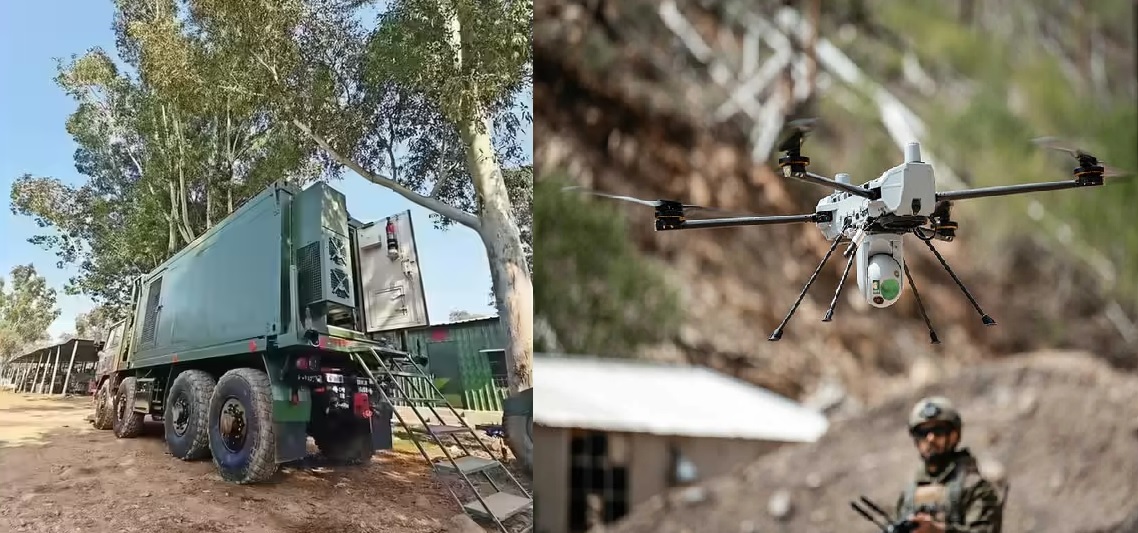
Hyderabad / Jammu : In a significant boost to India’s indigenous defence innovation ecosystem, Apollyon Dynamics, a startup founded by two 20-year-old student entrepreneurs, has successfully delivered a mobile drone manufacturing and repair laboratory to the Indian Army. The system, already deployed in Jammu, allows frontline units to assemble, repair and deploy FPV drones directly from a moving military vehicle, dramatically reducing dependence on rear-area supply chains.
A Drone Factory on Wheels
The newly inducted system—described as a “moving drone lab”—is built into a standard Army truck, converting it into a self-contained FPV drone workshop. Equipped with 3D printers, electronics assembly stations, soldering tools, flight-controller programming modules and testing equipment, the lab enables soldiers to manufacture drones within operational zones, sometimes just kilometres from active deployment areas.
Defence observers note that this capability mirrors battlefield innovations seen during the Russia–Ukraine conflict, where rapid drone attrition forced forces to adopt on-site manufacturing and repair models. With this deployment, India becomes only the third country—after Russia and Ukraine—to operationalise a mobile frontline drone factory.
Capacity: 100 FPV Drones a Month
According to Apollyon Dynamics, the mobile lab can produce more than 100 FPV (First-Person View) drones per month, depending on mission requirements and component availability. These FPV drones, often used for reconnaissance, precision strikes and kamikaze missions, have become central to modern low-cost, high-impact warfare.
Crucially, the system allows real-time design iteration, meaning soldiers can modify drone configurations—such as payload, range, or camera setup—based on immediate battlefield feedback, rather than waiting weeks for factory-level changes.
Training Soldiers, Not Just Supplying Hardware
A defining feature of the project is its soldier-centric approach. Rather than merely supplying finished drones, Apollyon Dynamics has trained Indian Army personnel to assemble, maintain and troubleshoot FPV drones independently. This ensures operational self-reliance, especially during high-tempo missions where drone losses can be frequent.
Alongside the mobile unit, the startup has also helped establish a permanent drone laboratory within the regiment’s Jammu base, which functions as a hub for storage, advanced repairs, training and scaling production, complementing the deployable lab.
Built by BITS Pilani Students
The company was founded by Jayant Khatri (CEO) and Sourya Choudhury (CTO), both students of BITS Pilani Hyderabad. Working initially from their university environment, the duo began building drones using basic prototyping tools such as 3D printers and soldering stations, before rapidly transitioning into military-grade systems.
Despite being in their early 20s, the founders reportedly delivered the mobile drone lab to the Army within just 15–20 days, even while managing academic commitments—an achievement that has drawn attention across India’s defence and startup communities.
From Campus Prototypes to Battlefield Deployment
Apollyon Dynamics has previously supplied the Army with indigenous kamikaze FPV drones, capable of high-speed flight and carrying payloads of around one kilogram. These drones are designed to be modular, allowing quick adaptation for different terrains and mission profiles, including mountainous regions like Jammu.
The Army has reportedly issued formal appreciation for the startup’s work, citing quality benchmarks, technical reliability and professional execution during training and deployment.
Strategic Significance for India
Military analysts view the induction of a mobile FPV drone lab as a strategic shift in how India approaches unmanned warfare. Instead of treating drones as limited, centrally produced assets, the Army is moving toward a distributed, battlefield-edge manufacturing model—one that prioritises speed, adaptability and resilience.
As global conflicts increasingly demonstrate that drones are expendable but decisive, India’s ability to build and rebuild them near the frontlines could prove critical in future contingencies.
For Apollyon Dynamics, the deployment marks a rare milestone: a student-founded Indian startup delivering frontline capability usually associated with active war zones, signalling a new phase in the country’s Atmanirbhar defence innovation drive.
About the Author
Aditya Kumar:
Defense & Geopolitics Analyst
Aditya Kumar tracks military developments in South Asia, specializing in Indian missile technology and naval strategy.