India to Induct 800-km BrahMos and 200-km Astra Missiles by 2027
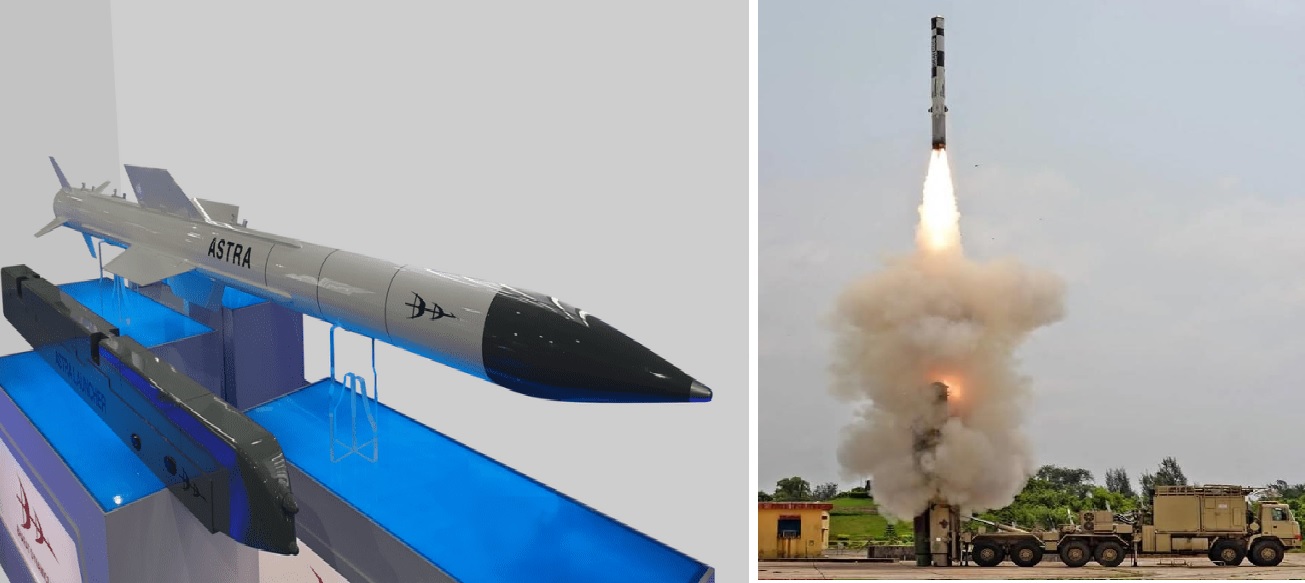
India’s missile arsenal is poised for a major leap in range, precision, and lethality. The country is set to induct the new 800-kilometre-range BrahMos supersonic cruise missile within the next two years, alongside the Astra Mark-2 beyond-visual-range (BVR) air-to-air missile, which will enter serial production by 2026–27. Together, these systems mark a decisive step toward India’s goal of strategic self-reliance and technological dominance in precision-guided weaponry.
The Next-Generation BrahMos: Doubling the Reach, Sharpening the Accuracy
According to top defence sources cited by The Times of India, developmental trials are currently underway for the 800-km BrahMos, featuring a modified ramjet engine and enhanced avionics. These upgrades aim to significantly extend range and improve precision, while maintaining the missile’s hallmark speed of Mach 2.8—nearly three times the speed of sound.
The missile, built jointly by India’s Defence Research and Development Organisation (DRDO) and Russia’s NPO Mashinostroyenia, has evolved from its original 290-km variant into a formidable multi-platform strike weapon. The current 450-km BrahMos already serves as the primary conventional precision-strike system across the Indian Armed Forces. It has reportedly been used in real combat conditions, including Operation Sindoor (May 2025), where Sukhoi-30MKI fighters carried out deep-penetration strikes inside Pakistan.
“The 800-km BrahMos is nearly ready, pending a few more tests to validate the combination of its inertial navigation system (INS) and external global navigation satellite systems (GNSS). These will ensure unmatched accuracy and resistance to electronic jamming,” a senior defence official said.
Software Upgrade to Extend Naval and Ground Versions
One of the major advantages of the 800-km variant is that existing BrahMos systems can be upgraded without major hardware changes. The missile’s airframe and launcher remain the same; only the software, fire-control interface, and guidance logic require modification.
This means that Indian Navy warships and Army mobile launch batteries, which currently field the 450-km version, can transition to the new variant with minimal downtime. Sources confirm that the Navy and Army will be the first to induct the extended-range BrahMos, with the air-launched version for the IAF following later.
At present, about 20 frontline warships, including the Visakhapatnam-class destroyers and Shivalik-class frigates, are equipped with vertical-launched BrahMos systems. The induction of the longer-range variant will extend India’s maritime strike envelope deep into the Indo-Pacific.
Astra Mark-2: Extending the IAF’s Beyond-Visual-Range Punch
Parallel to the BrahMos upgrade, DRDO is advancing the Astra Mark-2 air-to-air missile, extending its range to over 200 kilometres, up from the 160 km achieved during initial trials. The improvements are driven by trajectory shaping, enhanced propulsion systems, and refined guidance algorithms.
“The propulsion upgrade provides greater thrust and sustained burn time. If current trials succeed, production can begin within six months,” a source revealed.
The Indian Air Force has already placed orders for around 700 Astra Mark-2 missiles, which will equip its Sukhoi-30MKI and Tejas Mk1A fighters. Meanwhile, over 280 Astra Mark-1 missiles with 100-km range are in induction phase.
DRDO is also developing the Astra Mark-3, powered by a solid-fuel ducted ramjet (SFDR), which could reach ranges up to 350 km—placing it in the same class as China’s PL-15 and Europe’s Meteor missiles. The Astra-3 is expected to be operational by 2028.
Strategic Impact: A Step Toward Complete Missile Self-Reliance
The Astra missile family is designed to replace expensive imported beyond-visual-range missiles such as the Russian R-77, French MICA, and Israeli Derby. Once fully operational, the Astra series will become India’s standard BVR missile across all fighter platforms, reducing foreign dependence and cutting operational costs significantly.
The BrahMos program, meanwhile, has already become the cornerstone of India’s precision-strike capability. With contracts worth over ₹58,000 crore, the Indo-Russian joint venture BrahMos Aerospace has delivered missiles to the Army, Navy, and Air Force, as well as secured its first export orders—notably from the Philippines, which is inducting the shore-based coastal defence system.
In March 2024, the Defence Ministry inked a ₹19,519 crore contract for over 220 BrahMos missiles for the Indian Navy—the largest-ever such deal. Following Operation Sindoor, the Defence Acquisition Council (DAC), chaired by Defence Minister Rajnath Singh, also cleared procurement of 110 air-launched BrahMos missiles for the IAF, valued at around ₹10,800 crore.
2027 and Beyond
By 2027–28, India’s strike and air combat capabilities will look markedly different. The BrahMos 800-km variant will give India the ability to strike deep into adversary territory—from the Arabian Sea to the Tibetan plateau—without crossing the border. Meanwhile, the Astra Mk-2 and Mk-3 will allow Indian fighters to engage enemy aircraft long before they are detected by radar.
Together, these systems embody India’s “Long-Range Precision” doctrine, emphasizing deterrence, flexibility, and autonomy.
As Defence Minister Rajnath Singh recently remarked, “Every inch of Pakistan is within BrahMos range—and soon, every threat in the sky will be within Astra’s reach.”
About the Author
Aditya Kumar:
Defense & Geopolitics Analyst
Aditya Kumar tracks military developments in South Asia, specializing in Indian missile technology and naval strategy.