India Stays on Guard as China Strengthens Border Infrastructure Despite Talks of De-escalation
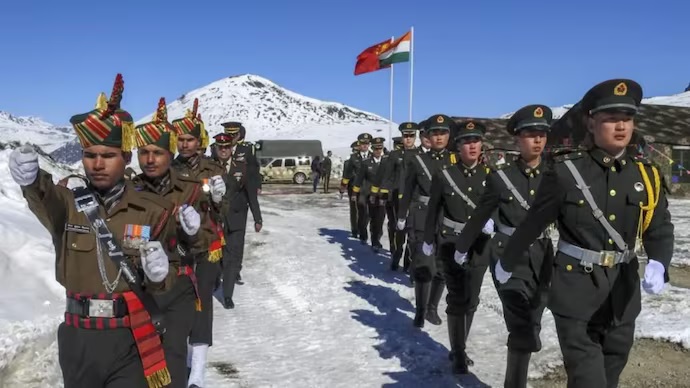
Even as signs of positive movement in Indo-China relations emerge through recent diplomatic engagements, Indian military planners are expected to remain on high alert along the Line of Actual Control (LAC). The underlying concern is China’s extensive border infrastructure build-up, which provides the People’s Liberation Army (PLA) with the ability to rapidly redeploy forces to forward positions despite any pullback agreements.
PLA’s Infrastructure Advantage
Over the past five years, the PLA has constructed an extensive network of roads, bridges, tunnels, helipads, and permanent habitats along the LAC stretching from eastern Ladakh to Arunachal Pradesh. This network allows Chinese troops to pull back 100–150 km and still return to forward posts within a few hours.
A senior Indian Army officer noted, “The way China has built roads, bridges, tunnels and habitats along the entire LAC, PLA troops can easily afford to pull back and then come back again in 2–3 hours.”
Although some Combined Arms Brigades (CABs) of the PLA have retreated about 100 km in recent months, many remain forward deployed. Each CAB typically consists of 4,500–5,000 troops, supported by tanks, armored vehicles, artillery and surface-to-air missile systems. This gives the PLA greater mobilisation flexibility compared to Indian forces, which face a longer response time to deploy equivalent strength in the same sectors.
Trust Deficit Persists Despite Stabilisation
Diplomatically, progress has been made. During Chinese Foreign Minister Wang Yi’s recent visit, both sides agreed to discuss a long-term de-escalation framework. On the ground, the situation has stabilised since troop disengagement at Depsang and Demchok in October 2024, but Indian officials underline that a deep trust deficit continues.
Another senior Army officer explained, “There is no disruption in coordinated patrolling by the rival soldiers. But we cannot let our guard down since there has been no let-up in the PLA’s military preparedness and infrastructure build-up.”
Both armies remain forward deployed across the 3,488-km-long LAC with tanks, artillery, air defence systems, and fighter aircraft support.
New Border Management Mechanisms
As part of ongoing efforts to manage tensions, both nations are now working on new military-to-military mechanisms beyond the existing Ladakh-level talks. These will include general-level discussions for the eastern sector (Sikkim and Arunachal Pradesh) and the middle sector (Uttarakhand and Himachal Pradesh).
From India’s side:
-
In the middle sector, the Lt-General commanding the Uttar Bharat Area (Bareilly) will likely be the key participant.
-
In the eastern sector, the Dimapur-based 3 Corps or the Tezpur-based 4 Corps will engage with the PLA counterparts.
Restoration of Patrolling Rights
A major unresolved issue for India remains the restoration of patrolling rights in areas where “no-patrol buffer zones” were created during disengagement rounds up to September 2022.
These buffer zones — ranging from 3 to 10 km — were established in sensitive areas such as Galwan Valley, Pangong Tso’s north bank, the Kailash Range, and Gogra-Hot Springs. Initially described as temporary moratoriums, they have continued to restrict Indian patrols in areas New Delhi considers part of its own territory.
Military planners view this as a loss of operational access, which India hopes to reverse in the next phase of talks.
Trade Channels Reopened
Adding a diplomatic layer to the developments, India and China recently agreed to resume border trade through three traditional routes: Lipulekh Pass (Uttarakhand), Shipki La Pass (Himachal Pradesh), and Nathu La Pass (Sikkim). The move is being seen as a step toward improving bilateral ties, though analysts caution that trade normalisation does not equate to resolution of military tensions.
Strategic Outlook
Experts highlight that the PLA’s rapid mobilisation advantage will remain a critical factor for Indian military planners. While India has accelerated infrastructure development in border areas in recent years — including all-weather roads, bridges, forward airstrips, and advanced logistics hubs — the time differential in mobilisation remains in Beijing’s favor.
In response, New Delhi continues to prioritise infrastructure upgrades, deployment of additional mountain strike formations, and integration of high-altitude surveillance systems to counterbalance China’s numerical and mobility advantages.
For now, even as diplomatic channels reopen and border trade resumes, the Indian Army remains on heightened alert, determined to avoid repeating past mistakes of underestimating the PLA’s preparedness.
✍️ This article is written by the team of The Defense News.