India Signs ₹7,995-Crore Support Pact With US for 24 MH-60R Helicopters Fleet
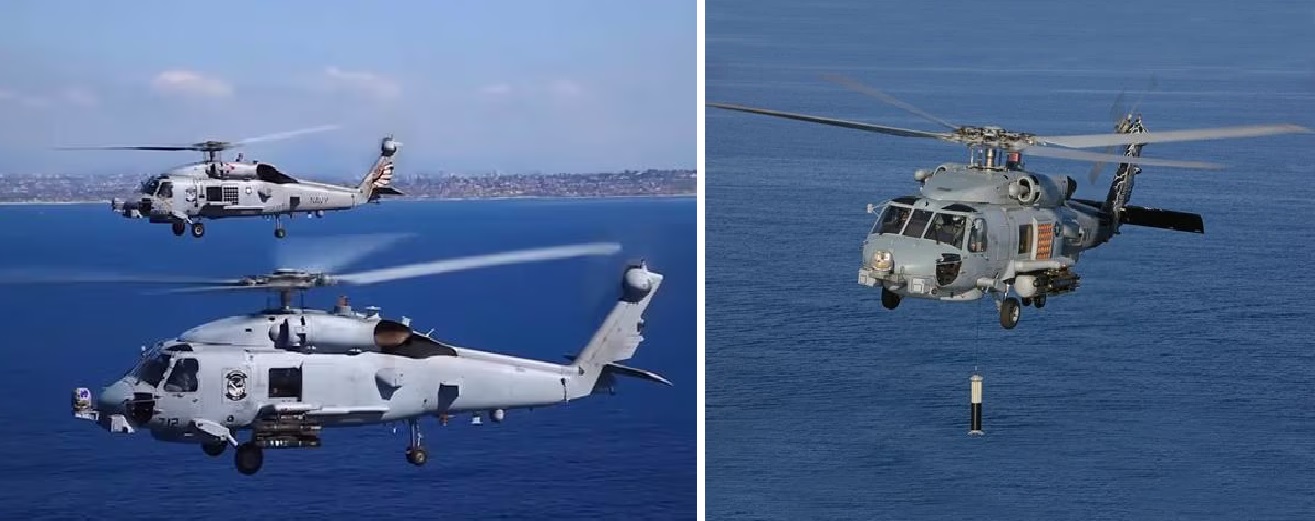
The Ministry of Defence (MoD) has signed Letters of Offer and Acceptance (LOA) with the United States, finalising a ₹7,995-crore ($895 million) multi-year support package for the Indian Navy’s MH-60R Seahawk multi-role helicopters. Concluded under the Foreign Military Sales (FMS) framework, the agreement secures spares, repairs, technical services, and logistics support for India’s most advanced anti-submarine helicopter fleet.
A Comprehensive Five-Year Support Package
Under the LOA, the U.S. government will supply Follow-on Support (FOS) and Follow-on Supply Support (FSS) for a period of five years. The package covers a full maintenance ecosystem—spares, rotables, ground support equipment, diagnostic tools, technical documentation, training modules, and U.S. Navy-certified assistance teams. It will also enable the creation of intermediate-level repair and periodic inspection facilities in India, allowing a larger proportion of servicing to be carried out domestically rather than routed to U.S. depots.
Officials noted that, as the MH-60R fleet is entering its full operational deployment phase, a structured sustainment programme is essential to avoid the chronic availability problems that plagued older naval helicopter types.
How the FMS Process Reached This Stage
India’s MH-60R programme has unfolded in several steps:
-
In 2020, India signed a $2.6-billion FMS contract for 24 MH-60Rs, including weapons, simulators, and initial support.
-
In 2024, the U.S. State Department cleared a $1.17-billion follow-on support and equipment roadmap for India’s Romeo fleet.
-
The newly signed ₹7,995-crore LOA formalises a significant chunk of that approved support, locking in supply chains for the next half-decade.
The financial outflow will occur annually across five years, with the bulk going to U.S. contractors such as Lockheed Martin/Sikorsky while a rising share flows to Indian PSUs and MSMEs as domestic MRO capability strengthens.
The MH-60R in Indian Navy Service
The MH-60R Seahawk, widely regarded as the world's most capable Anti-Submarine Warfare (ASW) helicopter, is progressively entering frontline Indian Navy units. Deliveries began in 2021, and India is expected to receive all 24 helicopters by 2026.
The Navy commissioned INAS 334—its first MH-60R squadron—at INS Garuda, Kochi, integrating the platform with major warships including INS Vikrant and Visakhapatnam-class destroyers.
The helicopter replaces ageing fleets of Sea King Mk 42B/42C and Ka-28 helicopters that have struggled with obsolescence and spares shortages.
Capabilities and Specifications
The MH-60R’s capability set represents a generational leap for India’s ship-borne aviation arm. Key specifications include:
-
Speed & Range: Up to 267–330 km/h, with a mission range between 450–830 km depending on payload.
-
Sensors: Advanced dipping sonar, sonobuoys, multi-mode maritime radar, EO/IR turret, and electronic support measures—allowing detection of submarines and surface threats in cluttered littoral environments.
-
Weapons: Mk-54 torpedoes, AGM-114 Hellfire missiles, precision rockets, and machine guns.
-
Crew & Payload: Operated by 3–4 crew, with a payload capacity around 3,000 kg for weapons, equipment, or rescue loads.
These systems together form a core of India’s expanding network-centric ASW capability, essential amid rising Chinese naval activity in the Indian Ocean.
Operational Impact and What India Gains
By securing long-term spares, technical services, and logistics support, the Indian Navy ensures high availability of its most modern helicopter fleet.
The agreement strengthens India’s ability to deploy fully mission-ready helicopters aboard warships during extended patrols across the Arabian Sea, Bay of Bengal, and the wider Indian Ocean Region (IOR).
The package also supports India’s goal of expanding domestic MRO capacity, lowering lifecycle costs, and reducing dependence on overseas repair depots.
Strengthening India’s Maritime Posture in the Indo-Pacific
As China’s naval presence expands in the Indo-Pacific, the MH-60R forms a central pillar of India’s maritime surveillance and ASW grid. With the new sustainment package, India ensures its frontline warships remain equipped with fully functional, advanced airborne ASW capability throughout deployments.
The deal further deepens India–U.S. defence cooperation, reinforcing shared interests in maintaining stability across the Indo-Pacific.
A Strategic Investment for Long-Term Readiness
The support package goes beyond logistics—it is a long-term readiness guarantee for a platform critical to India’s naval strategy. With assured spares, trained personnel, and in-country repair capacity, the Indian Navy is better prepared to maintain persistent ASW coverage and respond rapidly to emerging threats.
India’s MH-60R investment now stands not just as an acquisition of capability but as a commitment to keep that capability combat-ready for decades ahead.
About the Author
Aditya Kumar:
Defense & Geopolitics Analyst
Aditya Kumar tracks military developments in South Asia, specializing in Indian missile technology and naval strategy.