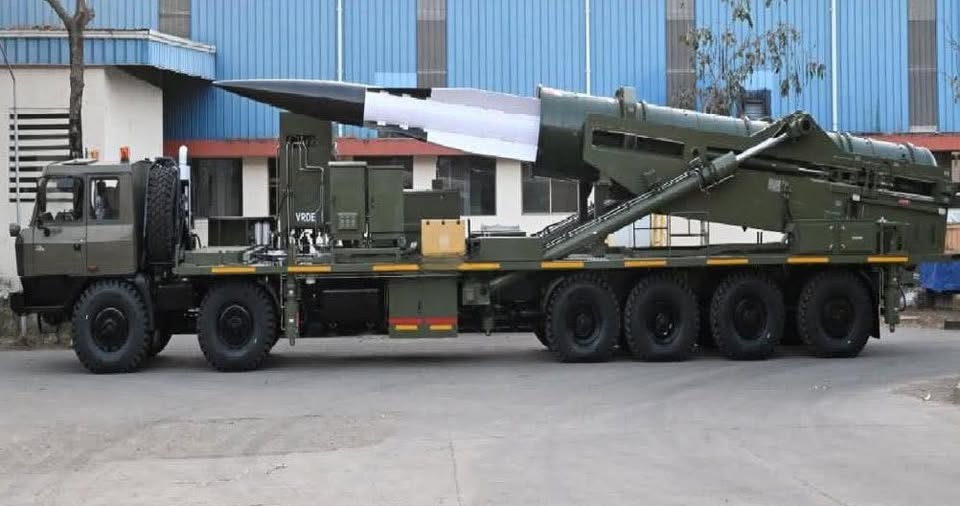
New Delhi : India will publicly unveil its Long-Range Anti-Ship Hypersonic Glide Missile, an advanced indigenous weapon system developed by the Defence Research and Development Organisation (DRDO), during the 77th Republic Day Parade on January 26. The appearance of the missile at the national event marks a significant milestone in India’s pursuit of next-generation strike capabilities and highlights a growing emphasis on maritime dominance in the Indian Ocean region.
The missile, developed by DRDO for operational use by the Indian Navy, is designed to engage high-value enemy warships at extreme ranges while evading modern air-defence systems. Officials familiar with the programme describe it as one of India’s most strategically consequential missile developments to date.
Hypersonic Capability and Naval Focus
According to DRDO officials, the weapon belongs to a new class of boost-glide hypersonic missiles. After launch, the missile ascends to high altitude before releasing a hypersonic glide vehicle, which travels through the upper atmosphere at speeds exceeding Mach 5, performing complex manoeuvres during flight. This flight profile significantly reduces detection time and complicates interception by shipborne radars and missile defence systems.
A. Prasad Goud, Project Director at DRDO’s Advanced Systems Laboratory, has said the missile’s primary advantage lies in its hypersonic speed combined with high aerodynamic efficiency. He noted that the system has an estimated range of about 1,500 kilometres and is capable of carrying different payload configurations, enabling it to neutralise heavily defended naval targets deployed far out at sea.
Strengthening Maritime Deterrence
Defence analysts say the missile is intended to substantially enhance India’s anti-access and sea-denial capabilities. With its long reach and high survivability, the system would allow India to hold hostile surface combatants, including aircraft carrier groups, at risk well beyond the range of conventional anti-ship missiles.
The development comes amid increasing strategic competition in the Indo-Pacific, where advanced naval platforms and layered air-defence systems are becoming central to power projection. Hypersonic anti-ship weapons are widely viewed as a game-changer in naval warfare, capable of compressing decision-making timelines and overwhelming existing defences.
Development Timeline and Testing
India’s work on hypersonic technologies has accelerated over the past decade, with DRDO simultaneously pursuing both hypersonic glide missile and hypersonic cruise missile programmes. The long-range anti-ship variant has reportedly undergone multiple developmental trials, including successful flight tests conducted from India’s eastern test ranges.
These tests validated key technologies such as thermal protection systems, guidance and navigation under extreme heat, and terminal manoeuvring against simulated maritime targets. Officials indicate that the programme is now moving through advanced development and user-evaluation phases, though timelines for full operational induction have not been publicly disclosed.
Republic Day Debut and Strategic Messaging
The missile’s display at the Republic Day Parade is expected to draw considerable attention from both domestic and international observers. Republic Day showcases traditionally feature systems that reflect a country’s current and emerging military capabilities, and the inclusion of a hypersonic anti-ship weapon underscores India’s intent to position itself among a small group of nations developing such technologies.
While the parade appearance does not signal immediate deployment, defence officials view it as a statement of technological maturity and strategic intent. As India continues to invest in indigenous weapons development, the hypersonic glide missile programme is expected to play a central role in shaping the future of the country’s naval deterrence and long-range strike doctrine.