India Prepares for Massive ₹80,000-Crore Destroyer Program as Navy Weighs P-15C vs NGD
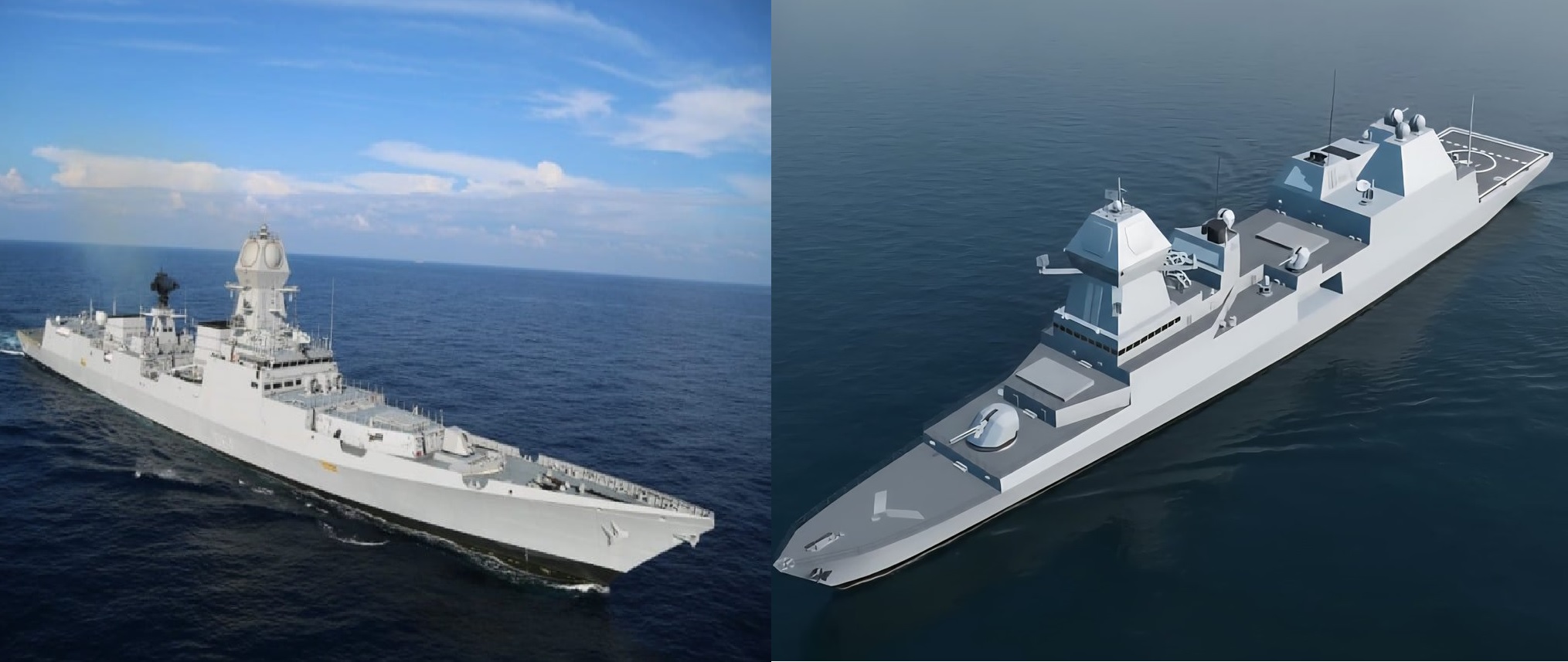
India’s naval modernisation drive is poised for a major leap as Mazagon Dock Shipbuilders Limited (MDL) confirmed that the Indian Navy is preparing to issue a new destroyer tender worth ₹70,000–80,000 crores ($8–9 billion). According to senior MDL officials, the long-awaited project could take the shape of either the Next-Generation Destroyer (NGD)—also known as Project-18—or an unexpected Project-15C class, a follow-on to the Visakhapatnam-class destroyers.
The revelation marks the first public acknowledgement of a possible Project-15C, a development that could reshape India’s destroyer roadmap. Officials explained that a P-15C class could serve as a technological bridge between today’s Visakhapatnam-class (Project-15B) and the much more complex NGD, helping reduce program risk and accelerate fleet intake.
Project-15C Surfaces as New Contender
The Project-15 family has defined India’s frontline destroyer capabilities for nearly three decades—beginning with the Delhi-class, followed by the Kolkata-class (P-15A), and the Visakhapatnam-class (P-15B). The newest ships incorporate advanced stealth shaping, long-range AESA radar suites, new-generation sonar, improved survivability, and expanded VLS-based missile firepower.
However, the Project-18 NGD aims to be an entirely new design featuring massive jumps in automation, survivability, integrated electric propulsion, multifunction radar masts, directed-energy weapon compatibility, and larger missile loadouts. With such complexity, timelines remain long.
A P-15C class, therefore, is emerging as a realistic interim solution. MDL officials said the Navy may pursue this option to maintain construction continuity while mitigating NGD risks.
How Project-15C Would Improve Over P-15B
Although formal design parameters remain undefined, naval planners and MDL engineers broadly expect P-15C to incorporate:
1. Larger Vertical Launch Capacity
-
Expanded VLS cells for Barak-8ER, BrahMos Block-II/III, and possibly Nirbhay or future Long-Range Land Attack Cruise Missiles (LR-LACMs).
-
Improved configuration for quad-packed short-range interceptors.
2. More Powerful Radar & Combat Systems
-
Upgraded MF-STAR derivative or new AESA radar with extended target tracking range.
-
Enhanced multi-threat processing (ballistic, hypersonic, saturation attacks).
-
Next-gen Combat Management System (CMS) designed to feed into NGD-level network warfare.
3. Better Stealth and Reduced Infra-Red Signature
-
Re-shaped superstructure and exhaust cooling systems based on lessons from NGD modelling.
-
Composite materials for masts and upper deck structures.
4. New-generation Electronic Warfare Suite
-
Indigenous EW/ESM/ECM system capable of countering modern electronic-attack aircraft, drones, and sea-skimming missiles.
-
Integration of DIRCM (Directional Infrared Countermeasures).
5. Multi-layered Anti-Submarine Warfare Upgrades
-
New towed-array sonars with wider bandwidth.
-
AI-aided submarine tracking algorithms.
-
Larger hangar/deck to operate future heavy ASW helicopters or UAVs.
6. Power and Space Margins for Directed-Energy Weapons
-
Higher electrical generation capacity for future:
-
Laser CIWS,
-
High-power jammers,
-
Railgun prototypes (NGD-compatible reserve space).
-
Next-Generation Destroyer (NGD): The End Goal
When the NGD is eventually cleared, it is expected to be India’s largest and most advanced surface combatant ever built.
Indicative NGD Features (Concept Design):
-
Displacement: 10,000–13,000 tonnes
-
Integrated Electric Propulsion (IEP)
-
Dual-band AESA radars rivaling USN DDG-1000/Arleigh Burke Flight III
-
128+ VLS cells
-
Laser-based CIWS
-
Autonomous unmanned wing (UAVs + USVs + UUVs)
-
Advanced stealth shaping
-
Bigger flight deck for multiple helicopters
A P-15C project thus acts as a stepping stone, proving technologies before NGD’s full-spectrum integration.
Why the Navy May Prefer a P-15C Before NGD
-
Shorter delivery timeline — P-15B’s design is mature, enabling rapid adaptation.
-
Lower risk and cost — NGD’s R&D budget and technical complexity are significantly higher.
-
Immediate fleet requirement — China’s naval expansion demands India maintain destroyer strength through the early–2030s.
-
Workforce & yard continuity — Keeps MDL production lines active until NGD is finalised.
India–Japan Design Link: Early but Significant
Responding to speculation surrounding a possible Indo-Japanese destroyer collaboration, MDL clarified that discussions are currently “very, very early stage.” No MoU has yet been signed for a joint destroyer design.
However, India and Japan have already progressed cooperation on the UNICORN integrated mast system, an advanced radar/communication mast installed on Japanese Mogami-class frigates. The agreement may require limited design exchange for future Indian warships, but officials stressed that complete shared destroyer designs remain unlikely.
The Warship Design Bureau (WDB)—the Navy's in-house design body—continues to lead Project-18 and all indigenous design lines.
Submarine Programs: P-75 and P-75I Move Forward
MDL confirmed that commercial negotiations for three additional P-75 Scorpene-class submarines were completed months ago and the project is now awaiting final approval.
Meanwhile, negotiations for the ambitious Project-75I air-independent-propulsion submarine series—to be built with Germany’s TKMS—are expected to finish by December, with contract signing targeted for March.
P-75I will feature more than 60 percent indigenous content, significantly higher than past submarine programs, paving the way for export opportunities and deep technical transfer.
MDL officials said the knowledge gained from P-75I would unlock decades of benefits including regional maintenance contracts and possible Asian and South American export orders.
LPD Project: India Eyes Large Amphibious Ships
MDL also confirmed an exclusive MoU with Swan Shipyard (SDHI) for the Indian Navy’s ₹40,000-crore Landing Platform Dock (LPD) program. SDHI’s Pipavav shipyard hosts India’s largest drydock—critical for constructing 200-metre-long amphibious assault vessels.
The four-ship LPD project is expected to select a winning bid in over 12 months, and the Navy may now drop its earlier mandate for a foreign design partner, favouring indigenous architecture.
Frigate Programs: Nilgiri-Class Deliveries Accelerate
MDL is preparing to deliver the third Nilgiri-class (P-17A) frigate later this year, with the fourth to follow in the next financial cycle. The remaining three P-17A frigates under GRSE are progressing in parallel.
A follow-on Project-17B frigate class is now approaching issuance of its Request for Proposal, likely within months.
Mine Countermeasure Vessels and Future Projects
The Navy’s long-delayed Mine Counter Measure Vessel (MCMV) program is expected to release an RFP in the next 3 to 4 months. The requirement includes 12 vessels worth ₹40,000 crores, to be constructed across two shipyards.
These programs join the ongoing Next-Generation Missile Vessels (NGMV) and Next-Generation Corvettes (NGC) initiative, forming the backbone of the Navy’s expansion under a rapidly evolving maritime security environment dominated by China’s naval rise and Indo-Pacific contestation.
A Defining Decade for Indian Naval Power
With destroyers, frigates, submarines, and amphibious ships all entering new procurement phases, the Indian Navy is embarking on one of the largest multi-platform expansion cycles in its history.
The upcoming decision on P-15C versus NGD will determine the trajectory of India’s surface combatant fleet for the next two decades. For MDL, which leads most major warship programs, the next few years are set to bring both record workloads and historic technological milestones.
About the Author
Aditya Kumar:
Defense & Geopolitics Analyst
Aditya Kumar tracks military developments in South Asia, specializing in Indian missile technology and naval strategy.