India Moves Closer to First Manned Deep Sea Mission with Success on Matsya-6000 Submarine
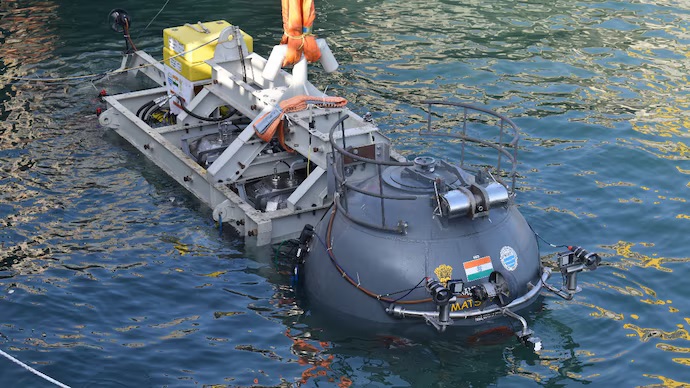
India has taken a significant step toward realizing its first crewed deep ocean exploration mission as scientists from the National Institute of Ocean Technology (NIOT) and the Indian Space Research Organisation (ISRO) successfully completed a critical welding process on the Matsya-6000, the country's first deep-sea manned submersible.
At the heart of this milestone is the welding of a titanium alloy crew sphere—a pressure-resistant chamber designed to carry three humans to depths of up to 6,000 meters (nearly 20,000 feet) below sea level. For the first time in India, such a thick titanium structure was electron beam welded, marking a technological breakthrough in India's deep-sea capabilities.
Matsya-6000: India's Gateway to the Deep Ocean
The Matsya-6000 is being developed under the Samudrayaan Mission, a flagship project of India’s Deep Ocean Mission spearheaded by the Ministry of Earth Sciences. The mission aims to explore untapped resources, biodiversity, and geological processes in the deep ocean, similar to how space agencies explore outer space.
-
The submersible will be capable of carrying three people and will be equipped with life support and safety systems for missions lasting up to 12 hours, with emergency support for up to 96 hours.
-
It is designed to withstand crushing pressures of nearly 600 times that at sea level, a feat achieved by constructing the pressure hull from titanium alloy Ti-6Al-4V, known for its high strength, corrosion resistance, and compatibility in deep-sea environments.
Electron Beam Welding: A First for India
The electron beam welding (EBW) technique used on the Matsya-6000’s spherical pressure hull is notable for its high precision and minimal thermal distortion—essential when working with thick titanium materials that must retain structural integrity under extreme pressure.
-
The welding was performed at the ISRO Inertial Systems Unit (IISU) in Thiruvananthapuram, a facility that specializes in advanced joining technologies.
-
Electron beam welding allows for deep penetration with clean, high-quality welds, making it ideal for aerospace, nuclear, and now deep-sea applications.
The weld has now passed non-destructive testing and radiographic evaluation, ensuring the hull's safety and reliability for human missions.
Why It Matters: India's Deep Ocean Ambitions
With this achievement, India joins a select group of nations—including the United States, Russia, France, Japan, and China—that have developed the capability for human-rated deep-sea submersibles. The project is aligned with India’s broader goals of blue economy development, which include:
-
Mapping and studying the ocean floor
-
Exploring polymetallic nodules, which contain rare earth elements
-
Understanding deep-sea biodiversity
-
Monitoring environmental changes and seismic activity
India’s exclusive economic zone (EEZ) spans over 2 million square kilometers, and the successful deployment of Matsya-6000 would greatly enhance the country’s scientific and strategic reach under the ocean surface.
What's Next
With the successful welding of the pressure hull complete, the focus will now shift to:
-
Integrating life support systems, control modules, and safety redundancies
-
Pressure testing the assembled submersible in hyperbaric chambers
-
Uncrewed test dives, likely in 2025–26
-
A crewed mission to the 6,000-meter depth is expected by 2026, depending on sea trial results
The submersible will be launched from NIOT's deep-sea research vessel, which will provide power, navigation, and recovery support.
The completion of the titanium sphere welding for Matsya-6000 marks a monumental step in India’s scientific and engineering journey into the deep ocean. It reflects India’s growing capabilities in complex undersea technology and aligns with the nation's aspirations to become a leader in ocean exploration, on par with its progress in space.
With the Samudrayaan Mission gaining momentum, India is not just looking up to the stars but also diving deep into the last great frontier on Earth — the ocean.
✍️ This article is written by the team of The Defense News.