India Expands Missile Test No-Fly Zone Range in Updated Notice to Airmen
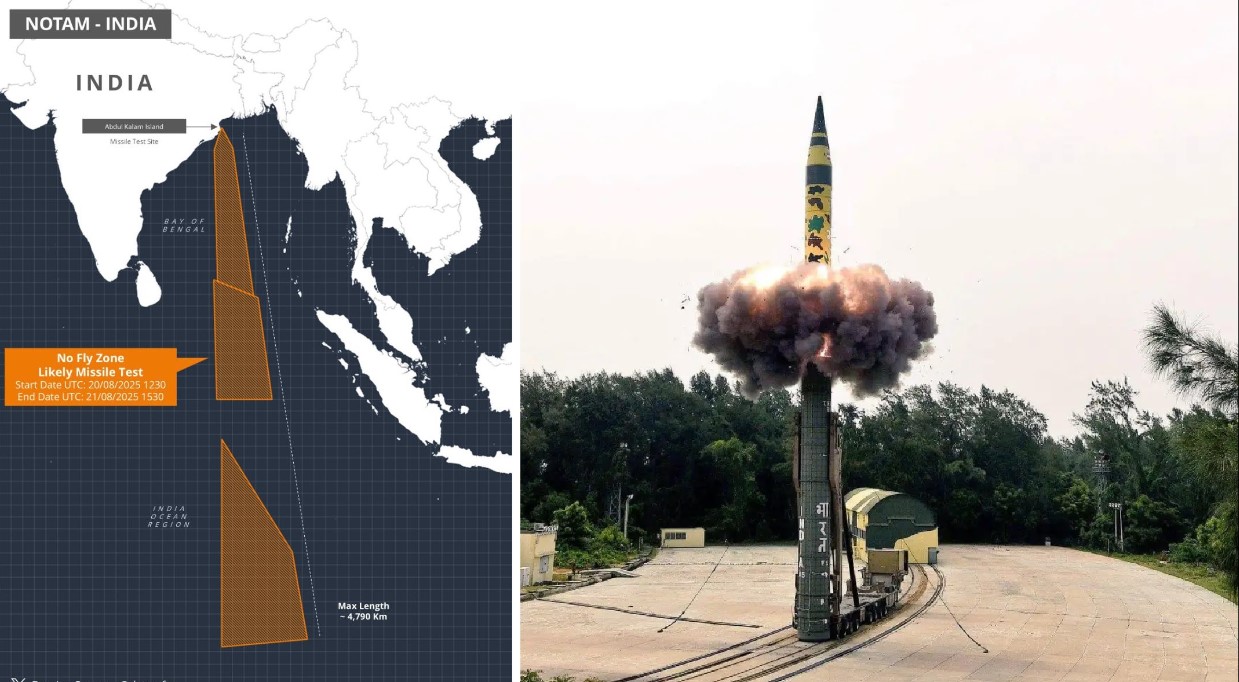
India has issued an updated Notice to Airmen (NOTAM) for a missile test scheduled between 20–21 August 2025 from the Integrated Test Range (ITR) at Dr APJ Abdul Kalam Island, off the Odisha coast. The initial warning, covering a 1,560 km range, was significantly extended—first to approximately 2,530 km, and now to an expansive 4,790 km into the Indian Ocean Region.
Evolving Danger Zones
-
1,560 km zone — Issued around 12 August 2025, marking the first safety perimeter for the test window.
-
2,530 km zone — Later expanded to enhance safety assurances over maritime and airspace.
-
4,790 km zone — The most recent and substantial extension, stretching deep into the Indian Ocean and issued around 15 August 2025.
Why the Expansion Matters
Such a massive test zone underscores a potential trial of next-generation missile systems—possibly a new variant of the Agni series, such as an Agni-V MK2, or even the advanced Agni-VI ICBM. The extended range hints at capabilities well beyond conventional missile reach, marking a significant stride in India’s long-range strike arsenal.
Agni-VI & Future Technologies
-
Agni-VI, still under development, is projected as a three-stage ICBM with an 8,000–12,000 km range and MIRV (Multiple Independently Targetable Re-entry Vehicles) capability.
-
Further development of Agni-V variants for conventional bunker-buster or airburst roles suggests enhanced precision and destructive capabilities at 2,500–3,000 km ranges, traveling at hypersonic speeds (Mach 8–20).
-
India is also pursuing hypersonic cruise missiles, but the current NOTAM range exceeds the reach of these systems, pointing towards a far more powerful platform.
Safety and Strategic Signaling
The escalating NOTAM range ensures civilian and maritime traffic safety across an increasingly vast swath of air- and seaways. But beyond safety, the move signals a strategic shift: India is bolstering long-range deterrence, reinforcing its second-strike capability, and asserting missile reach across the Indo-Pacific.
Possibilities: Agni-5 or Agni-6?
-
Agni-V (and its variants) is a proven platform with capabilities beyond 5,000 km, and modified versions could be undergoing validation.
-
Agni-VI, designed for ultra-long-range and MIRV payloads, remains a strong candidate given the expanded test radius, though it has yet to be fully test-fired.
India’s incremental expansion of the missile test danger zone—from 1,560 km to an unprecedented 4,790 km—likely reflects the testing of advanced long-range missiles. Whether it’s a modified Agni-V or the futuristic Agni-VI, the development highlights India’s accelerating journey toward strategic self-reliance and powerful deterrence.
✍️ This article is written by the team of The Defense News.