Images Reveal Chinese Container Ship Converted Into Modular Missile Platform
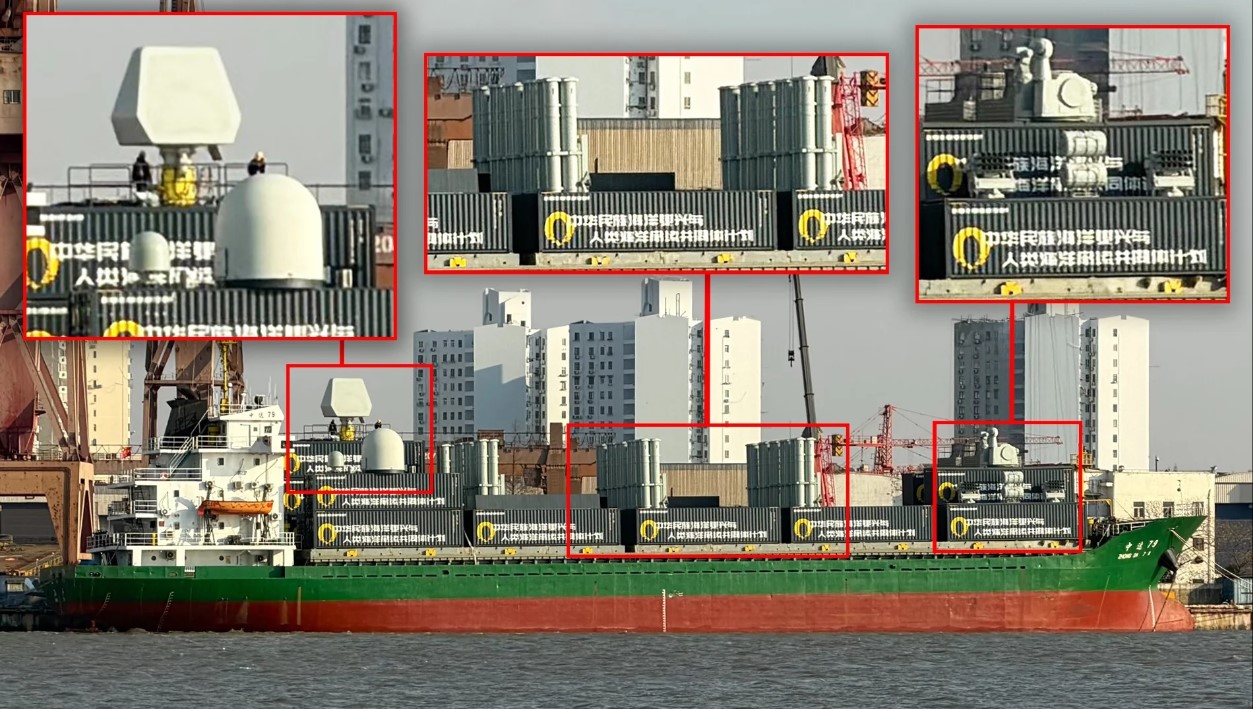
A set of images that surfaced online on December 25, 2025 (Christmas Day) appears to show a Chinese civilian container ship modified into a heavily armed, modular weapons platform—complete with containerized vertical launch system (VLS) cells, a rotating phased-array/AESA radar, a naval CIWS mount, and multiple decoy/rocket launcher arrays. The photos circulated first on Chinese social platforms and were subsequently analyzed by defense-watch outlets that track naval modernization.
Satellite Confirmation Puts the Ship in Shanghai
While the images themselves emerged via social media, analysts say the ship’s existence is not purely speculative. Naval News reported it was able to independently confirm the vessel via satellite imagery, placing it in Shanghai.
What’s Visible on Deck: VLS Cells, Radar, CIWS, Decoys
The ship shown is described as an otherwise standard container carrier whose deck loadout has been altered to support modular combat systems.
In the clearest descriptions published so far, the vessel carries at least 48 containerized VLS cells, arranged as 3 rows of 16, with what appears to be 4 launch cells per container (each row described as 4 containers wide).
Forward, observers identify a Type-1130 30mm CIWS mounted near the bow—an 11-barrel close-in system associated with modern PLA Navy surface combatants—and multiple decoy launchers. Naval News reports at least 3 decoy launchers are visible, and notes the total could be 6 if mirrored mounts exist on the opposite side.
The sensor fit described includes a Type-344 fire-control radar (commonly used to support gun engagements), plus an additional flat-faced array assessed as “likely AESA” that could support air search and/or missile guidance.
A separate analysis published by The War Zone also describes a large rotating phased-array radar mounted forward of the bridge, plus an additional radome-like sensor or communications unit.
48 Cells—or 60? Why Counts Differ
A key dispute is the ship’s apparent missile capacity. Naval News describes at least 48 VLS cells based on what it can confidently count in the available imagery.
The War Zone, analyzing a different view of the deck loadout, assesses the ship may carry 60 containerized VLS cells, describing an arrangement “five wide and three deep,” with four launch tubes per containerized module.
The mismatch likely comes down to image angle, partial deck visibility, and whether some modules were obscured. Until higher-resolution overhead imagery is available (or additional photos emerge), the safest conclusion is that the ship appears configured for dozens of VLS cells, plausibly in the 48–60 range depending on final fit.
What Missiles Could It Fire? Public Sources Can Only Speculate
No official payload has been disclosed. Still, Naval News argues the containerized cells appear consistent with China’s broader naval VLS ecosystem, suggesting potential compatibility with a “standard suite” of Chinese anti-ship and land-attack weapons. It lists possible munitions such as CJ-10 land-attack cruise missiles, YJ-18 anti-ship/land-attack cruise missiles, and even the YJ-21 anti-ship ballistic missile—while stressing that the actual loadout remains unconfirmed.
It also raises the possibility that, if the ship is using a universal VLS architecture (referencing GJB 5860-2006), it might be able to employ long-range surface-to-air missiles such as HHQ-9—but again notes this is not verified from the imagery alone.
Why This Matters: A “Civilian Arsenal Ship” Concept Comes Into Focus
If authentic and operationally integrated, the ship points to a powerful idea: China could potentially convert elements of its vast commercial fleet into rapidly fielded missile magazines, complicating targeting and expanding salvo capacity without building a traditional destroyer-sized combatant for every launcher.
The War Zone frames the images as an explicit signal that China could turn commercial hulls into “shooters,” but also questions how “real” the configuration is—raising the possibility of a proof-of-concept demonstrator or a photo-ready mockup pending full combat-systems integration. It highlights open questions such as what combat management system is onboard, how sensors and weapons are fused, and whether the arrangement is robust enough for sustained operations at sea.
Containerized Missiles Are Spreading Globally
The broader trend is not unique to China. Naval News notes Russia’s long-discussed Club-K concept—containerized cruise missiles—and outlines U.S. experimentation with containerized launchers, including Lockheed’s Mk 70 Mod 1 Payload Delivery System, a containerized launcher that uses strike-length VLS cells and has been tested for firing missiles such as SM-3, SM-6, and Tomahawk depending on configuration.
The Legal and Strategic “Grey Zone”
Weaponizing merchant hulls also creates legal and operational risks. A 2021 paper published through the U.S. Naval War College’s International Law Studies argues that using merchant vessels to conduct offensive belligerent acts would violate international law unless the vessels are formally converted into warships consistent with rules such as the 1907 Hague Convention (VII). The same paper warns that widespread use of converted commercial ships could make it extremely difficult to distinguish converted from non-converted vessels—raising the risk that broader categories of shipping become legitimate targets in wartime.
That concern has already surfaced in other China-related dual-use discussions. An ABC News report citing U.S. intelligence assessments describes China’s growing integration of commercial ferries and dual-use maritime assets into potential contingency planning, and notes the associated risk that such platforms could be treated as military targets during conflict scenarios.
What’s Still Unknown
Despite the striking imagery, the core unanswered questions remain: who operates the ship, whether it is a prototype or an operational capability, what missile types it can actually deploy, and whether its sensors and weapons are tied into a modern combat system or simply installed for demonstration. For now, the most defensible conclusion from public data is narrow but significant: a real container ship has been observed in China with a visible fit consistent with a containerized, modular naval missile platform, featuring dozens of VLS cells and a set of recognizable Chinese naval defensive and sensor systems.
✍️ This article is written by the team of The Defense News.