ISRO Successfully Qualifies Drogue Parachutes for Gaganyaan Crew Module
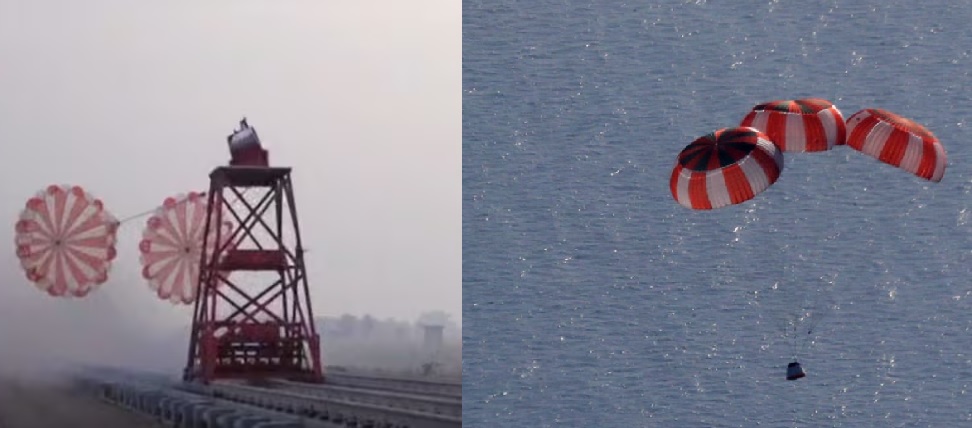
Chandigarh, December 19, 2025: The Indian Space Research Organisation (ISRO) has successfully completed a critical set of qualification tests for the Gaganyaan human spaceflight programme with the validation of the drogue parachute deployment system for the Crew Module. The tests were conducted on December 18 and 19 at the Rocket Track Research Facility (RTRS) of the Terminal Ballistics Research Laboratory (Terminal Ballistics Research Laboratory) in Chandigarh.
The successful trials mark an important milestone in qualifying the parachute-based recovery system, which will play a vital role in ensuring the safe return of Indian astronauts to Earth.
Validation Under Simulated Flight Conditions
According to ISRO, the two-day qualification campaign confirmed the performance, reliability, and structural integrity of the drogue parachutes under a range of simulated flight conditions closely matching actual mission profiles. The drogue parachutes perform a critical function during descent, stabilising the Crew Module and reducing its velocity before the deployment of the main parachutes.
The tests evaluated key parameters such as deployment timing, inflation behaviour, opening shock loads, aerodynamic stability, and suspension line loads. Data gathered through onboard sensors and high-speed imaging systems showed consistent and predictable parachute performance, meeting the stringent human-rating safety requirements defined for the mission.
High-Speed Ground Testing at RTRS Facility
The qualification trials were carried out using the RTRS rocket sled track, a specialised ground-test infrastructure capable of accelerating test vehicles to near-flight velocities. This facility allows engineers to recreate realistic descent dynamics on the ground, enabling precise evaluation of parachute deployment without the complexities of airborne testing.
ISRO officials said the controlled test environment helped validate design models, confirm safety margins, and generate high-quality data essential for crew safety certification.
Major Step Toward Gaganyaan Mission Readiness
The drogue parachute system forms part of a multi-stage parachute recovery architecture developed for the Gaganyaan Crew Module (Gaganyaan). After drogue deployment, pilot parachutes and main parachutes are sequentially released to further decelerate the capsule for a safe splashdown. Each stage incorporates redundancy to ensure reliability under off-nominal conditions.
With the successful completion of the drogue parachute qualification, ISRO will now move toward integrated testing of the full parachute chain, including main parachute qualification trials and combined system demonstrations, which are essential before uncrewed and crewed mission phases.
Strengthening India’s Human Spaceflight Capabilities
The achievement underscores the growing technical maturity of India’s human spaceflight programme and highlights strong collaboration between ISRO and national defence research institutions. Officials described the outcome as a significant boost to confidence as the programme advances toward its long-term objective of independent crewed space missions.
As the Gaganyaan programme progresses, ISRO will continue a rigorous sequence of subsystem validations, integration tests, and mission simulations, ensuring that every element of the flight and recovery system meets the exacting standards required for safe human spaceflight.
✍️ This article is written by the team of The Defense News.