ISRO Successfully Conducts Third and Final ‘Pushpak’ Reusable Launch Vehicle Landing Experiment
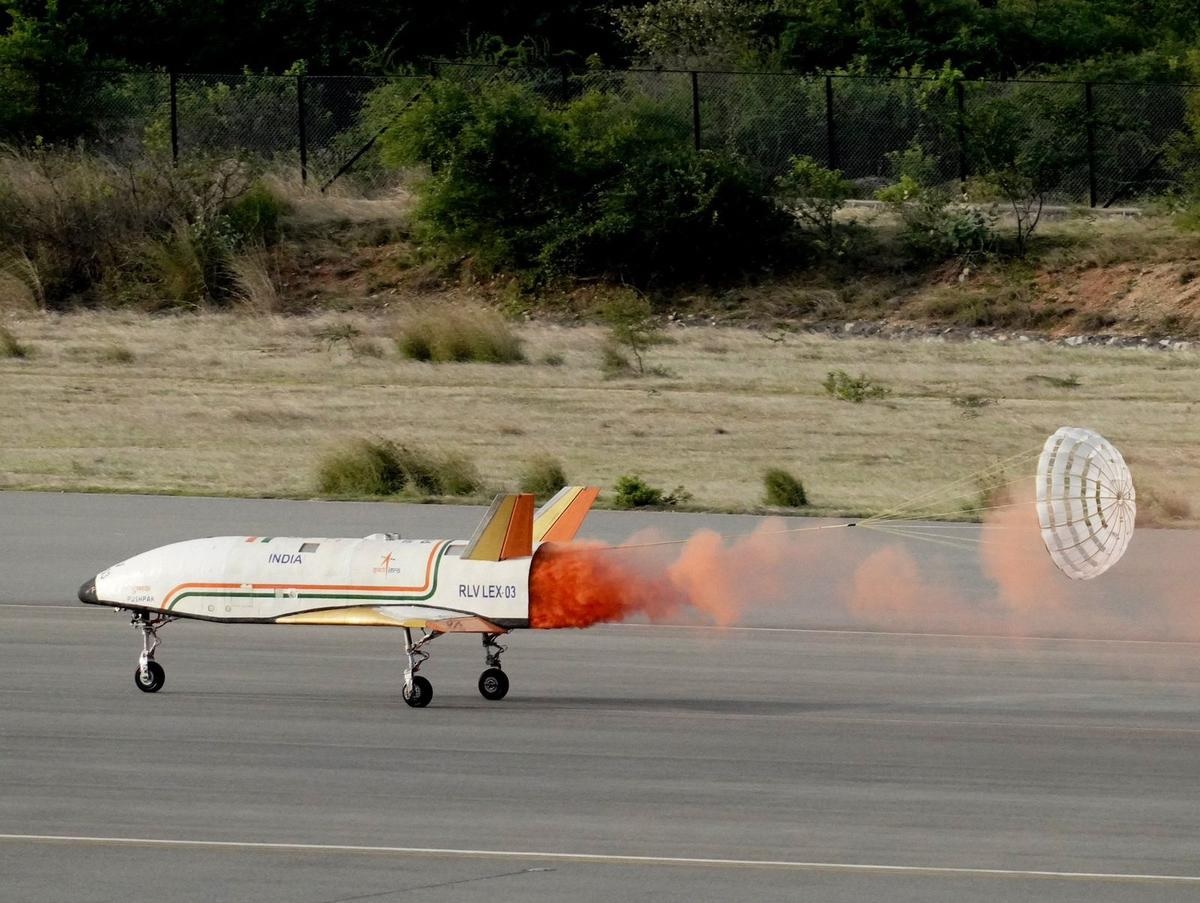
The Indian Space Research Organisation (ISRO) marked a significant milestone today, June 23, by successfully completing the third and final Reusable Launch Vehicle (RLV) Landing Experiment (LEX) at the Aeronautical Test Range (ATR) in Chitradurga, Karnataka. This crucial test, known as LEX-03, was conducted at 7:10 a.m., demonstrating advanced autonomous landing capabilities and reaffirming ISRO's prowess in reusable space technology.
A Series of Successful Tests
Following the successes of the RLV LEX-01 and LEX-02 missions, the LEX-03 mission aimed to further validate the autonomous landing technology under more demanding conditions. The winged vehicle, named Pushpak, was released from an Indian Air Force Chinook Helicopter at an altitude of 4.5 km. The mission showcased ISRO's ability to adapt to challenging release conditions, with a cross range of 500 meters compared to the 150 meters achieved in LEX-02, and more severe wind conditions.
Precision and Autonomy in Action
From a release point 4.5 km away from the runway, Pushpak autonomously performed cross-range correction maneuvers, approached the runway, and executed a precise horizontal landing on the runway centerline. Due to its low lift-to-drag ratio aerodynamic configuration, Pushpak achieved a landing velocity exceeding 320 kmph, surpassing the 260 kmph typical for commercial aircraft and the 280 kmph for typical fighter jets. After touchdown, the vehicle's velocity was reduced to nearly 100 kmph using its brake parachute, and further decelerated to a complete stop using its landing gear brakes. During the ground roll phase, Pushpak utilized its rudder and nose wheel steering system to autonomously maintain a stable and precise trajectory along the runway.
Advanced Technology and Robust Design
The LEX-03 mission not only simulated the approach and landing interface but also the high-speed landing conditions for a vehicle returning from space. This experiment reaffirmed ISRO's expertise in acquiring the critical technologies essential for developing a Reusable Launch Vehicle. The advanced guidance algorithm, which caters to longitudinal and lateral plane error corrections essential for future Orbital Re-entry Missions, was successfully validated during this mission.
ISRO highlighted the robustness of the RLV-LEX system, noting that the LEX-03 mission reused the winged body and flight systems from the LEX-02 mission without any modifications. This demonstrates the robustness of ISRO’s design and capability to reuse flight systems for multiple missions, underscoring the efficiency and reliability of their technology.
Multi-Sensor Fusion and Technological Integration
The RLV-LEX employs a multi-sensor fusion system, incorporating an array of sensors such as the Inertial sensor, Radar altimeter, Flush air data system, Pseudolite system, and NavIC. This integration of advanced sensors ensures precise navigation and control during the autonomous landing process.
Future Prospects
The successful completion of the LEX-03 mission marks a significant step forward in ISRO’s journey towards developing fully operational reusable launch vehicles. The technologies validated and the expertise gained through these experiments lay a strong foundation for future missions, including the ambitious Orbital Re-entry Missions.
With the accomplishment of the third and final Pushpak RLV landing experiment, ISRO continues to demonstrate its commitment to advancing space technology and contributing to the global efforts in space exploration and utilization. The successful execution of this mission is a testament to the dedication and innovation of ISRO’s scientists and engineers, propelling India’s space capabilities to new heights.
✍️ This article is written by the team of The Defense News.