ISRO Conducts Successful Hot Tests of Gaganyaan Propulsion System
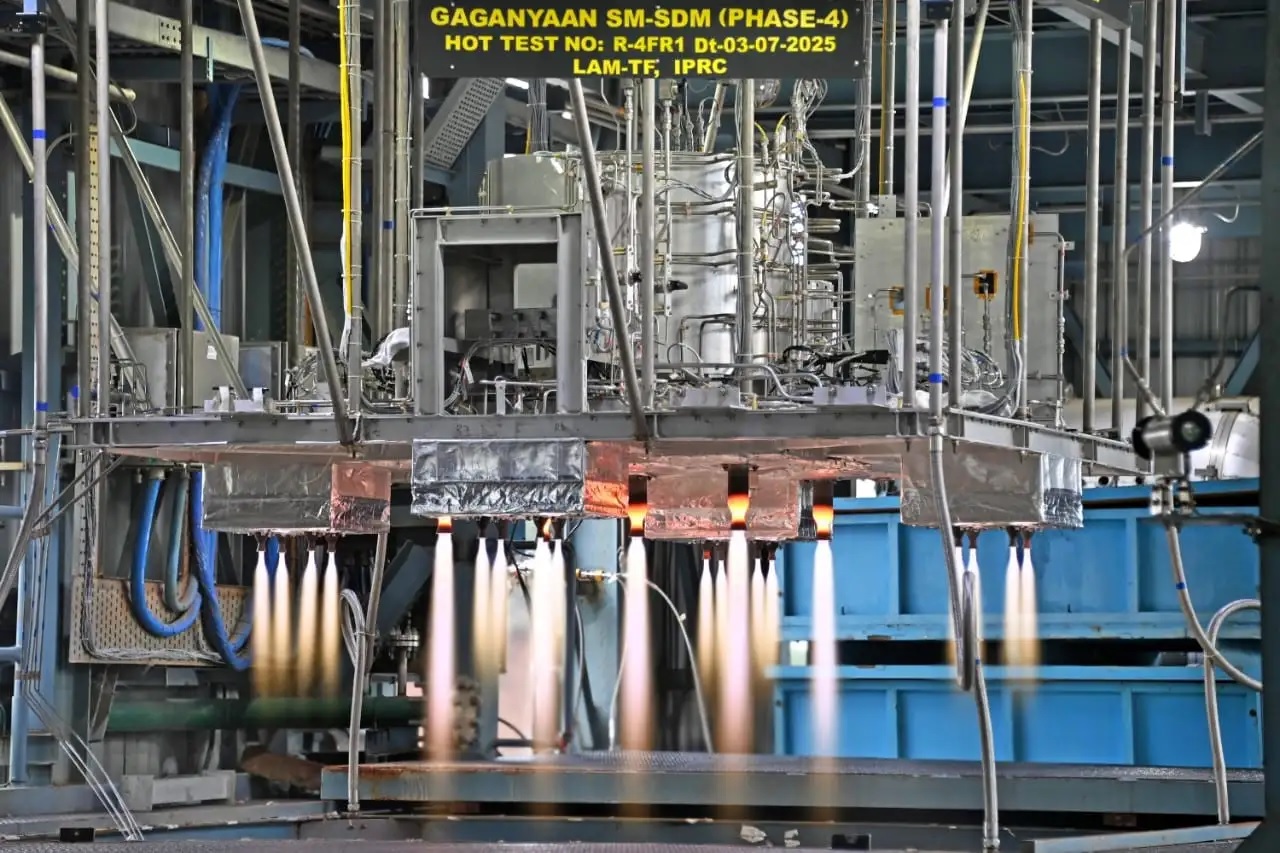
India’s space ambitions soared another step closer to reality as the Indian Space Research Organisation (ISRO) successfully conducted two hot tests of the Gaganyaan Service Module Propulsion System (SMPS) at its Propulsion Complex in Mahendragiri on July 3, 2025. These tests are a key milestone in the Gaganyaan mission, which aims to send Indian astronauts into space aboard an entirely indigenous platform.
The SMPS is one of the most vital parts of the Gaganyaan spacecraft. It is housed in the Service Module, which sits below the crew module and plays a central role in maneuvering the spacecraft once in orbit. It’s responsible for operations such as orbit insertion, fine-tuning orbital paths, re-entry preparations, and even emergency de-orbiting if needed. Simply put, this system must perform flawlessly to ensure the astronauts’ safety throughout the mission.
What the Hot Tests Proved
The two hot tests simulated real operational conditions to validate the propulsion system’s behavior under intense thermal and pressure environments—just like it would experience in space. The objectives of these tests included:
-
System Integrity Checks: To ensure that tanks, engines, piping, and other components could handle high stress without failure.
-
Performance Evaluation: Testing engine thrust, propellant flow rate, and burn duration under realistic conditions.
-
Reliability Assurance: Looking for any potential weak points that might lead to mission risk or system failure.
During the tests, the propulsion system was fired for a planned duration while multiple sensors recorded data on thrust consistency, chamber pressure, temperature variations, and system response to control signals. ISRO confirmed that the results showed stable combustion, reliable engine starts and stops, and no anomalies, pointing to a robust and flight-worthy system.
Technical Breakdown: What is the SMPS?
The Gaganyaan Service Module Propulsion System is based on a bi-propellant design, using MMH (Monomethylhydrazine) as fuel and Mixed Oxides of Nitrogen (MON-3) as oxidizer. It consists of:
-
Five 440N engines for larger orbital maneuvers.
-
Sixteen 100N reaction control thrusters for attitude control.
-
Two propellant tanks and helium pressurization tanks to maintain fuel flow under microgravity.
The system is designed to operate in the vacuum of space and is built with triple redundancy to ensure safety even if a component fails.
Why This Is Critical for Gaganyaan
Gaganyaan is not just another space mission—it’s India’s first crewed human spaceflight program. With lives on board, every component must go through exhaustive testing and validation. The SMPS, being the system responsible for keeping the spacecraft in the correct orbit and guiding it safely back to Earth, holds one of the highest responsibilities in mission safety.
The successful completion of these hot tests marks a green signal to move forward toward final qualification and integration with the rest of the spacecraft. ISRO will now continue with additional tests, simulations, and full system integration activities. These results will also inform adjustments to control software, mission planning, and hardware refinements ahead of both uncrewed and eventually crewed missions.
Before astronauts lift off from Earth, ISRO will conduct more uncrewed tests, including the upcoming Test Vehicle missions (TV-D series), to further validate the Crew Escape System and flight hardware. Meanwhile, the SMPS will go through more system-level tests and be integrated with the complete Service Module and Crew Module structure.
The July 3 achievement is a firm step forward in India’s quest to join the elite league of nations capable of sending humans to space. With every test, ISRO not only inches closer to realizing the Gaganyaan dream but also strengthens India’s standing as a serious player in human spaceflight and deep-space exploration.
✍️ This article is written by the team of The Defense News.