IAF Launches Indigenous Drive to Mask S-400 Batteries From Space-Based Surveillance
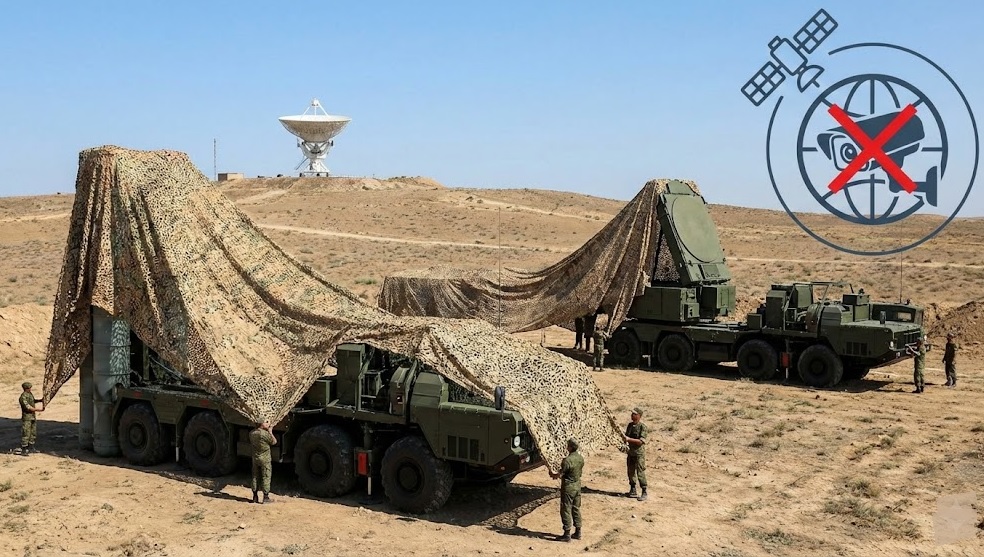
The Indian Air Force has initiated an urgent, indigenous programme to reduce the radar and thermal signatures of its S-400 Triumf long-range air-defence batteries, responding to the growing threat posed by foreign synthetic-aperture-radar (SAR) satellites and multi-sensor space surveillance.
According to defence-industry reporting and officials familiar with the effort, the programme is aimed at making the S-400, one of India’s most strategically valuable air-defence assets, significantly harder to detect, track and classify from orbit. The initiative blends new materials, deployable structures, and revised operational practices, with first induction planned for mid-2027 and a fleet-wide rollout by 2030.
Why Space-Based Radar Has Changed the Equation
Modern SAR satellites can image targets day and night, through cloud cover, and revisit the same locations at short intervals. For ground-based air-defence systems, this persistence allows adversaries to build a high-confidence targeting picture, identifying vehicle layouts, radar masts, power units, and even routine movement patterns.
The challenge is compounded by thermal sensors, which can highlight heat emissions from generators, radar electronics and missile support vehicles. Indian planners assess that in a high-intensity conflict, advanced air-defence systems are likely to be identified first from space, then tracked over time, and finally engaged with long-range precision weapons.
Inside the Indigenous “Stealth Kit”
At the heart of the programme is an indigenous “stealth kit” tailored for ground-based air-defence assets. The package reportedly includes radar-absorbent coatings applied to critical vehicle surfaces and radar structures, alongside deployable metamaterial screens that can be erected around high-value components when a battery is operational.
These metamaterial screens are not designed to render the system invisible, but to distort and weaken radar returns, complicating SAR-based identification and reducing confidence in target classification. In parallel, engineers are working on thermal-signature suppression, using improved heat management, insulation, and masking of prominent heat sources.
Indian defence laboratories and academic institutions have invested in metamaterials and multispectral camouflage research for several years, and officials say the S-400 effort leverages this domestic technology base, reinforcing the push for self-reliance.
Decoys and Rapid Mobility
Technology alone is only one pillar of the effort. The IAF is also refining operational doctrines centred on rapid mobility, frequent relocation, and deception. Decoy launchers, false emitters, and thermal decoys are expected to be deployed alongside real batteries, creating multiple plausible targets for adversary sensors.
By combining reduced signatures, deception, and high mobility, planners aim to disrupt pattern-of-life analysis and compress an adversary’s “find-fix-finish” timeline, increasing the survivability of the S-400 network during the most critical phases of conflict.
Timelines and Broader Context
Sources indicate that the first operational S-400 unit equipped with the full indigenous signature-reduction package is expected by mid-2027, followed by a phased rollout across all regiments by 2030.
The schedule aligns with India’s broader air-defence modernisation roadmap, including the development of indigenous long-range air-defence systems later in the decade. Officials suggest that lessons learned from the S-400 stealth initiative will directly inform the design philosophy and deployment concepts of future Indian systems.
Strategic Significance
India’s S-400 batteries form a critical layer of national air defence, safeguarding key regions and strategic assets. Enhancing their survivability against space-based surveillance marks a shift in thinking—from traditional camouflage to active signature management as a continuous operational requirement.
If implemented as planned, the programme would place India among a small group of countries actively adapting ground-based air-defence systems to an era of persistent satellite observation. For the Indian Air Force, the message is clear: in modern warfare, survivability on the ground increasingly depends on remaining unseen from space.
✍️ This article is written by the team of The Defense News.