IAF Chief Confirm of F-16s, JF-17s, C-130 and More Pakistan Losses During Operation Sindoor
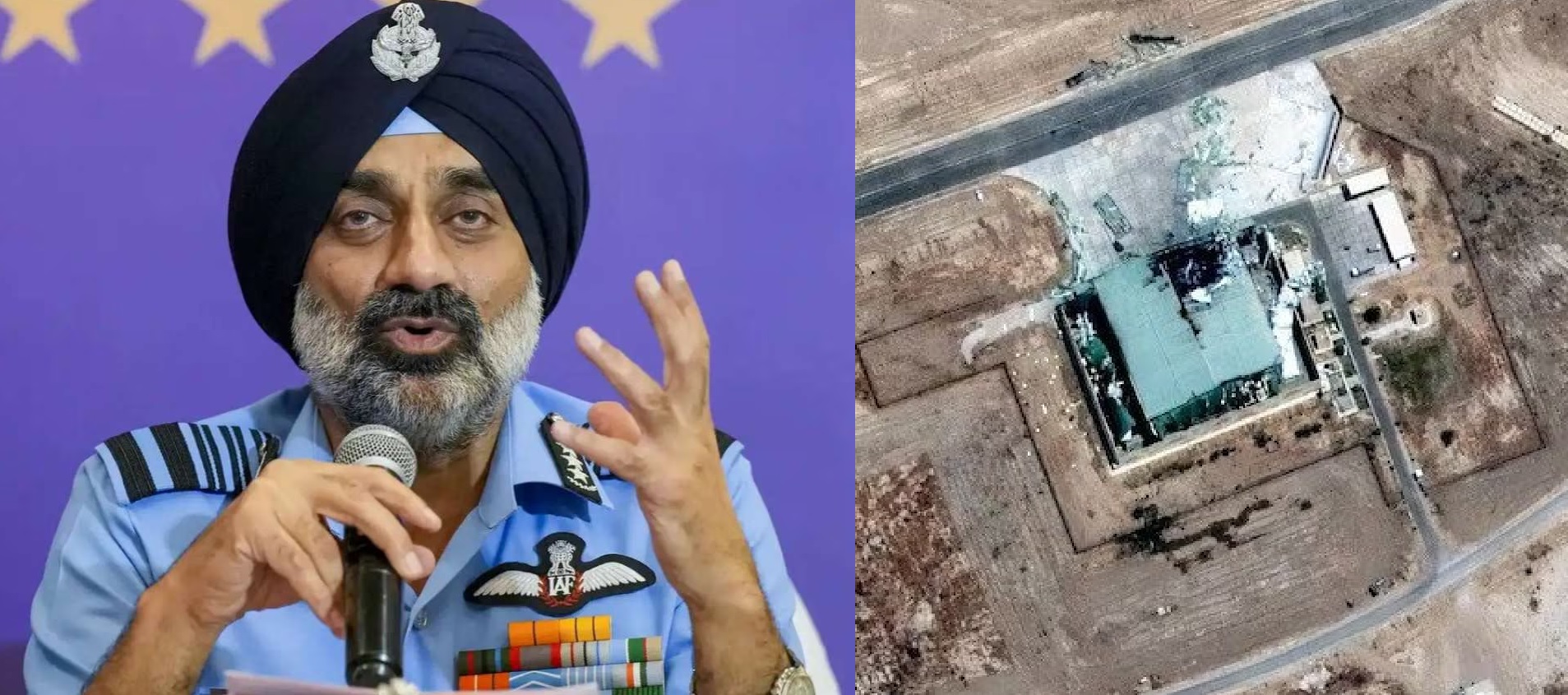
New Delhi, October 3 : The Indian Air Force (IAF) has provided details of Operation Sindoor, which resulted in heavy damage to Pakistan’s air assets and air defence network. Air Chief Marshal Amar Preet Singh, speaking at a press briefing, explained that the operation was carried out with defined objectives and achieved results in a short span of time.
According to the Air Chief, the IAF’s strikes damaged several Pakistani airbases. These included the destruction of radars at at least four places, command and control centres at two places, runways damaged at two airbases, and three hangars in three different stations. Evidence further indicates that at least four to five fighter aircraft, most likely F-16s, were destroyed on the ground. A C-130 transport aircraft was confirmed to be damaged, while another high-value surveillance aircraft, believed to be an airborne early warning and control (AEW&C) platform, and in air combat five F16 or JF17 aircrafts was also struck. In addition, one surface-to-air missile (SAM) system was eliminated during the strikes.
The IAF also revealed that its newly inducted long-range surface-to-air missiles played a critical role in the operation. These systems were able to track and engage targets far inside Pakistani territory. Singh said that the longest successful strike of the campaign extended beyond 300 kilometres, marking a new record for the Indian Air Force. This engagement, which took out either an AEW&C or another significant aircraft, effectively reduced Pakistan’s ability to operate freely even within its own airspace.
The overall strategy of the operation was to deny Pakistan the ability to conduct sustained aerial operations while keeping the conflict limited. By disabling radar coverage, damaging runways, and striking aircraft on the ground, the IAF reduced Pakistan’s combat options and forced them into a defensive posture. Singh emphasised that India entered the conflict with clear political and military instructions, focusing on specific objectives rather than open-ended escalation.
He noted that the campaign was concluded once India’s goals were achieved, and this outcome prompted Pakistan to seek a ceasefire. The Air Chief also observed that this approach stands in contrast to other conflicts around the world that continue without a defined end, pointing out that a war can be resolved quickly when objectives are precise and execution is deliberate.
Military observers believe Operation Sindoor will be studied for the way it combined precise targeting, the use of advanced missile systems, and a short timeline to achieve decisive results. It demonstrated India’s capability to limit an adversary’s air operations without being drawn into a prolonged conflict.
About the Author
Aditya Kumar:
Defense & Geopolitics Analyst
Aditya Kumar tracks military developments in South Asia, specializing in Indian missile technology and naval strategy.