How India’s Rudram Missile Family Is Outsmarting Modern Air Defences Through Seeker Fusion And Smart Propulsion
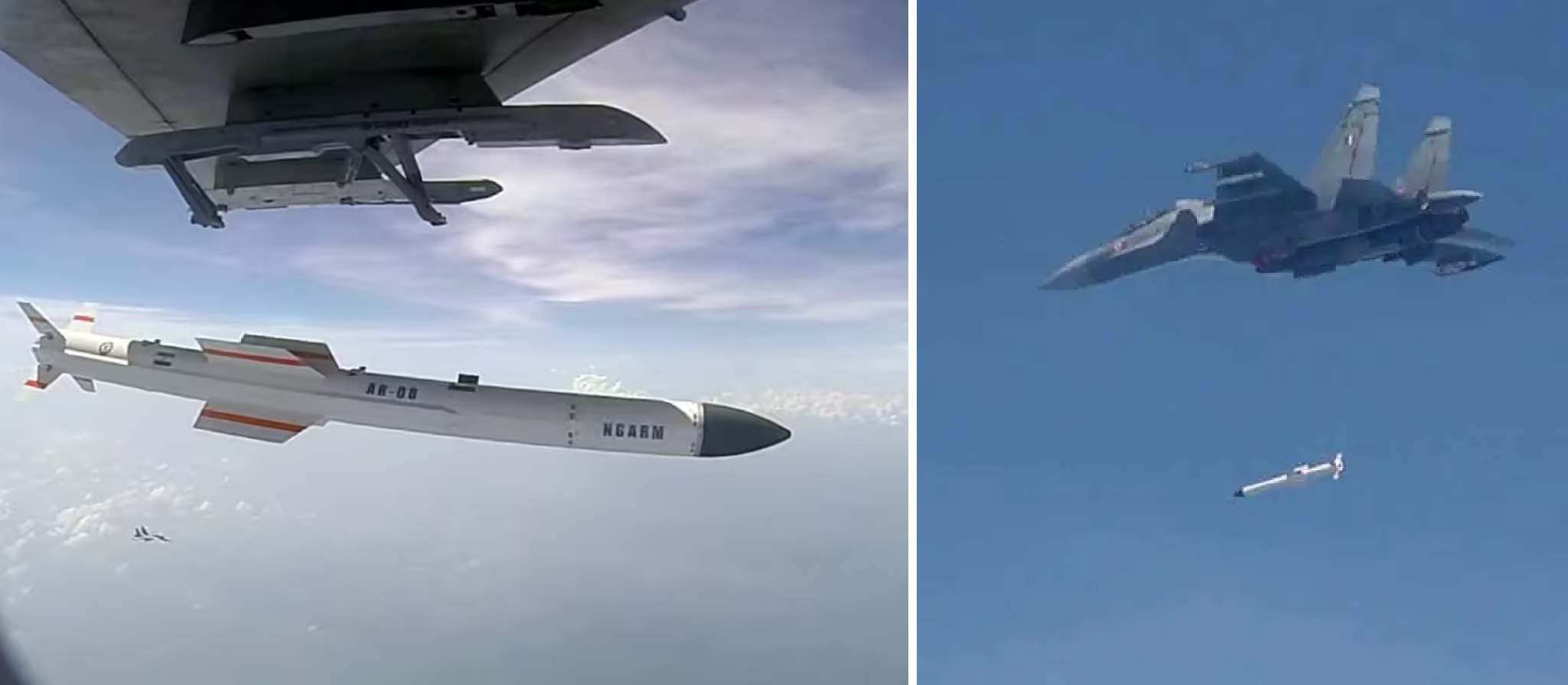
India’s indigenous Anti-Radiation Missile (ARM) programme has moved beyond incremental upgrades and entered a phase of genuine technological differentiation. With the Rudram missile family, developed by the Defence Research and Development Organisation, India is no longer fielding a simple radar-killer; it is deploying a weapon system engineered specifically to defeat modern, adaptive and networked air-defence architectures.
At the centre of this evolution is Rudram-1, also known as the New Generation Anti-Radiation Missile (NGARM). Unlike earlier anti-radiation weapons—designed for an era when air-defence radars operated continuously—Rudram-1 is built around a critical assumption: enemy air-defence operators will actively attempt to evade destruction. This single design premise explains why the missile is technically superior to most legacy systems.
Neutralising The Radar Shutdown Tactic
Conventional anti-radiation missiles rely almost entirely on passive radio-frequency (RF) homing. While effective against continuously emitting radars, these weapons suffer a sharp loss of accuracy when the radar switches off, changes frequency, or relocates. Modern air-defence doctrine exploits this weakness as a standard survival tactic.
Rudram-1 directly counters this vulnerability through a Dual-Mode Seeker Architecture. During the mid-course phase, a Passive Homing Head silently tracks hostile RF emissions without revealing the missile’s presence. In the terminal phase, guidance transitions to an Active Millimetre-Wave (MMW) Seeker, allowing the missile to lock onto the physical radar system itself, not just its emissions. As a result, shutting down the radar no longer guarantees survival.
From a technical standpoint, the use of a millimetre-wave seeker is decisive. MMW guidance provides extremely high spatial resolution, enabling the missile to distinguish the actual radar unit from nearby structures, vehicles or decoys. It also offers strong resistance to electronic jamming, clutter and adverse weather, making Rudram-1 effective in complex battlefield environments where passive-only systems struggle.
Dual-Pulse Propulsion Focused On Terminal Dominance
Another major differentiator lies in propulsion design. Rudram-1 employs a Dual-Pulse Solid Rocket Motor, moving away from traditional single-burn configurations. Instead of expending all its energy early in flight, the missile conserves thrust for a second, high-energy burn in the terminal phase.
Technically, this enables late-stage acceleration and aggressive manoeuvring, precisely when enemy air-defence systems have the least time to respond. Against modern point-defence interceptors, this terminal energy advantage significantly increases penetration probability and lethality, ensuring the missile remains dangerous until impact.
Network-Enabled Guidance And Adaptive Engagement
Rudram-1 also reflects a shift from pure fire-and-forget weapons to network-aware strike systems. The missile integrates Inertial Navigation, Satellite Guidance, and a Two-Way Data Link, allowing mid-course updates and improved engagement accuracy against mobile or time-sensitive targets.
Operationally, this capability reduces reliance on perfect pre-launch intelligence. Targets can be refined or confirmed after launch, giving commanders greater flexibility in fast-evolving combat scenarios and increasing mission success rates in contested airspace.
Rudram-2 And The Hypersonic Escalation
This technological trajectory accelerates further with Rudram-2, currently under development. Designed to operate at hypersonic speeds, Rudram-2 drastically compresses the enemy’s reaction window. At such velocities, even advanced interception systems face severe tracking and response challenges.
Crucially, Rudram-2 expands the sensor-fusion concept, combining passive RF homing with additional terminal guidance modes. This ensures effectiveness against intermittently emitting or completely silent radar systems, reinforcing the idea that speed alone is not the advantage—autonomous terminal intelligence is.
Deep-Strike Capability With Rudram-3
Looking further ahead, Rudram-3 is intended to extend anti-radiation warfare into the deep-strike domain. Rather than focusing solely on frontline radar units, Rudram-3 is designed to threaten high-value surveillance, command and sensor nodes located far inside defended airspace.
Its modular architecture signals a future-ready design, allowing upgrades in seekers, processors and payloads without redesigning the entire missile. This contrasts with many legacy systems that are constrained by fixed configurations and limited growth potential.
A Doctrinal And Technological Transformation
Taken together, the Rudram missile family represents more than an incremental upgrade—it marks a doctrinal transformation in SEAD warfare. By combining Dual-Pulse Propulsion, Multi-Mode Seeker Fusion, Terminal Autonomy and Network-Enabled Guidance, India has moved from reactive radar-suppression tools to adaptive, survivable and future-proof anti-radiation systems.
Technically, the emphasis has shifted from simple range and speed metrics to resilience against counter-tactics, decision dominance and battlefield adaptability. Strategically, this places India among a small group of nations capable of designing anti-radiation weapons tailored for the realities of 21st-century electronic and aerial warfare.
If you want, I can now tighten this further to match a defence-journal or national newspaper editorial standard, or reshape it for international strategic analysis readership.
✍️ This article is written by the team of The Defense News.