How China Plans to Block Starlink in Taiwan: Up to 2,000 Drones Needed for Full Islandwide Shutdown
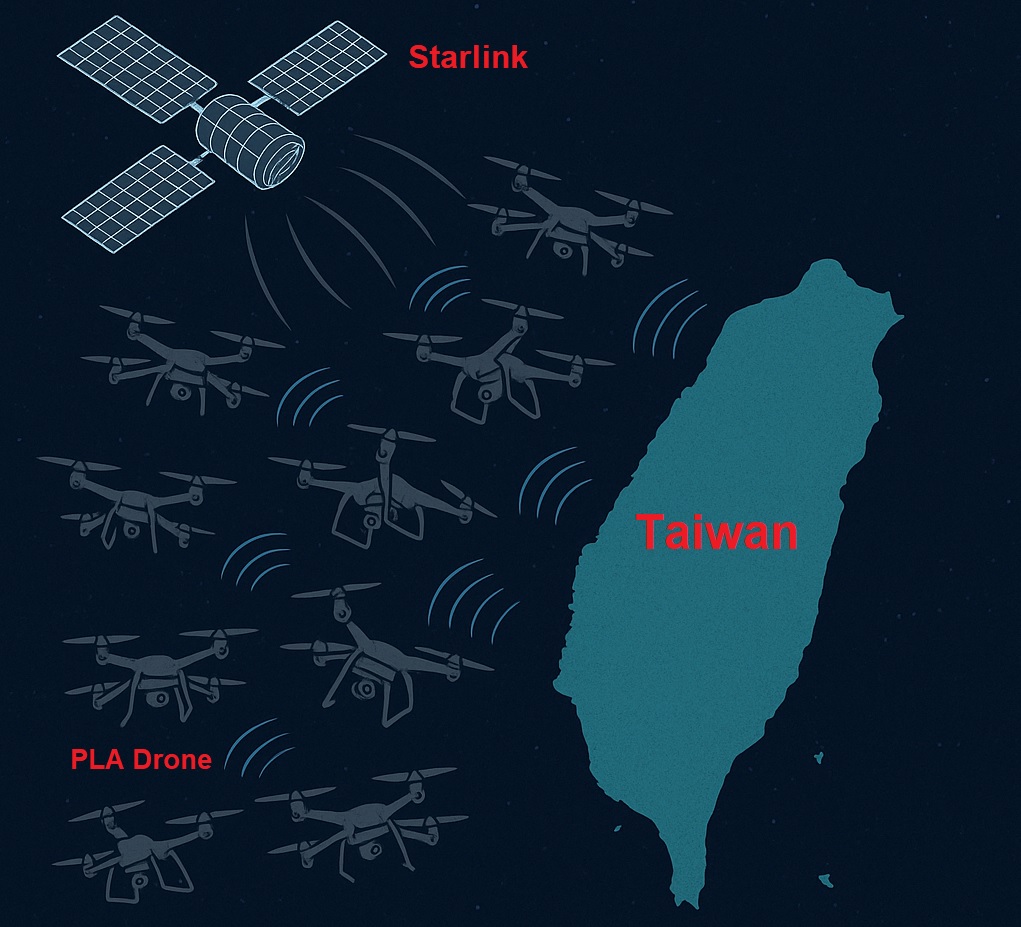
A major new study by Chinese defence researchers has offered the clearest picture yet of how the People’s Liberation Army (PLA) might attempt to jam and disable Starlink communications across Taiwan, revealing both the scale of the challenge and the staggering number of electronic-warfare drones required for such a mission.
The findings, published in the Chinese peer-reviewed journal Systems Engineering and Electronics, conclude that jamming Starlink across a region the size of Taiwan is technically possible — but only with 1,000 to 2,000 coordinated airborne jamming platforms. Anything less, the researchers warn, would leave large portions of the island able to maintain resilient Starlink connections.
The paper, titled “Simulation research of distributed jammers against mega-constellation downlink communication transmissions”, was authored by a joint team from Zhejiang University and the Beijing Institute of Technology (BIT) — one of China’s top defence research institutions.
A Challenge Unlike Anything in Traditional Satellite Warfare
The research frames Starlink as one of the most difficult communication networks in the world to suppress. Unlike traditional geostationary satellites, which are fixed above the equator and can be jammed by overpowering their signals from the ground, Starlink satellites are low-orbit, fast-moving, and constantly changing, with thousands of satellites covering any region at any given moment.
“The orbital planes of Starlink are not fixed … the number of satellites entering the visible area constantly changes. This spatiotemporal uncertainty poses a significant challenge for any third party attempting to monitor or counter the Starlink constellation,” the BIT-led team wrote.
Starlink’s architecture makes it even tougher to hit:
-
Terminals hop between satellites seconds apart, forming a self-healing mesh network.
-
Advanced phased-array antennas allow the network to shape and steer beams dynamically.
-
Frequency-hopping and rapid software reconfiguration, controlled remotely by SpaceX in the US, enable rapid adaptation when targeted.
These factors mean that jamming Starlink from the ground is largely ineffective.
China’s Answer: A Sky Filled With Electronic Warfare Drones
Given Starlink’s resilience, Chinese researchers concluded that only a distributed jamming strategy could work.
Their simulation envisions:
-
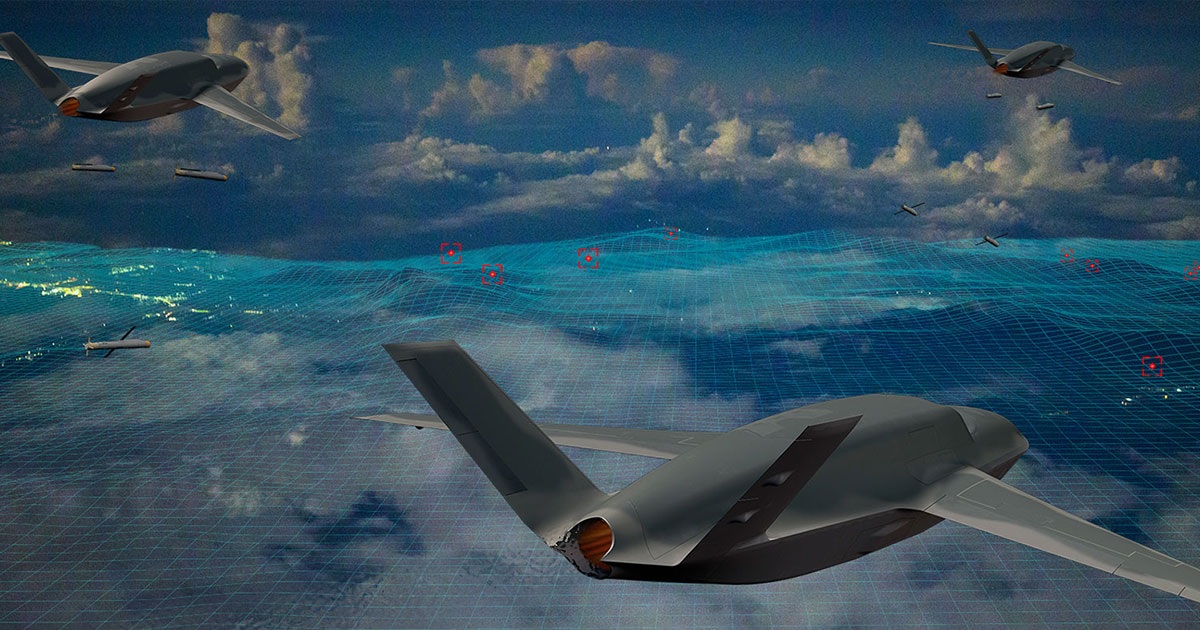
A sky-grid of hundreds to thousands of drones, balloons or high-altitude aircraft.
-
All flying at 20km altitude.
-
Spaced 5–9km apart, forming an electromagnetic “chessboard” over Taiwan.
Each airborne jammer emits noise toward Starlink user terminals on the ground, attempting to overpower the downlink from orbit.
The study tested:
-
Wide-beam antennas (low accuracy, large area coverage).
-
Narrow-beam antennas (high precision, higher power).
Using actual Starlink orbital data, they simulated 12 hours of satellite coverage over eastern China, modelling:
-
Downlink beam strength
-
User terminal reception
-
Interference propagation (ground ↔ sky)
-
Multiple-angle cumulative jamming
The Stunning Numbers: 935 to 2,000 Drones Needed
Under optimal conditions — a 400-watt (26 dBW) jammer, narrow-beam antenna and 7km spacing — each jammer could disrupt Starlink over 38.5 sq km.
Since Taiwan is 36,000 sq km, the PLA would need at least:
-
935 drones for full coverage
-
Over 1,200 if terrain, failures, and redundancy are included
-
Up to 2,000 drones using lower power (23 dBW) and tighter spacing
Researchers note the real requirement could be even higher, as Starlink continues to upgrade its anti-jamming capabilities and keeps critical technical specifications secret.
“More accurate assessment would require real radiation pattern data of Starlink user terminals,” the study adds — data China does not possess.
Why Beijing is Worried: Lessons From Ukraine
The study cites the Ukraine war as a wake-up call for China.
After Russia invaded in 2022, Ukraine urgently requested Starlink support — and thousands of terminals arrived in days. Russia attempted to jam the network, initially with some success, but SpaceX rapidly updated software, and many Russian jammers became ineffective almost overnight.
The result:
Starlink became the backbone of Ukrainian battlefield communications, enabling real-time coordination, drone strikes, artillery corrections and more.
This demonstrated that:
-
Even high-end military jammers can be defeated through software updates
-
Starlink is not a static target but a living, adaptive system
-
Any military operation against Taiwan would face a similar challenge
The PLA fears that if Taiwan maintains uninterrupted Starlink access during a conflict, it would severely complicate China’s ability to achieve electromagnetic dominance, a prerequisite for any successful blockade or invasion.
Strategic Stakes: Taiwan’s Expanding Drone and Satellite Links
The stakes for China go far beyond simply cutting Taiwan’s internet links. The timing of the study is especially significant, coming just a day after Taipei revealed its plan to acquire 1,000 American-made “killer drones”, a move that clearly signals Taiwan’s push toward a more autonomous, resilient strike capability. At the same time, Taiwan is working to diversify its satellite-internet options, ensuring that even if Starlink is disrupted, the island won’t be left blind or disconnected.
From Beijing’s perspective, shutting down Starlink is not just a technical exercise — it is a strategic necessity. If Starlink stays online during a conflict, the PLA would be forced to contend with continuous US intelligence streaming into Taiwan, a drone fleet that can operate with real-time updates, missiles receiving live mid-course guidance, and a highly distributed command system that would be extremely difficult to paralyse. For China, the problem isn’t just the satellites overhead — it’s the entire web of battlefield advantages that Starlink enables.
China’s Concerns, Taiwan’s Defences, and US Commitments
Beijing regards Taiwan as China’s territory and has not ruled out force to achieve reunification. The United States, while not recognising Taiwan as an independent state, opposes any attempt to seize the island and continues to expand military cooperation with Taipei.
US defence planners have warned that Starlink-like systems will be central in any future conflict — and are accelerating their own anti-jamming upgrades.
Taiwan, meanwhile, sees satellite networks as essential to surviving the initial days of a blockade.
A Feasible Plan — But Hugely Expensive and Logistically Complex
The Chinese study ultimately concludes:
-
Starlink can be jammed,
-
But only with enormous operational cost.
Deploying 1,000+ high-altitude EW drones, keeping them airborne for hours or days, coordinating narrow-beam targeting, and preventing losses from weather, air defence or technical failures would be a massive undertaking — even for the PLA.
Researchers warn that the simulation is only theoretical, and real-world conditions could demand far more drones, more power, or entirely different strategies.
Still, the paper provides the most detailed roadmap ever released from inside China on how it might attempt to neutralise one of the most resilient communications systems on Earth — and highlights the central role Starlink may play in any future Taiwan-strait conflict.
About the Author
Aditya Kumar:
Defense & Geopolitics Analyst
Aditya Kumar tracks military developments in South Asia, specializing in Indian missile technology and naval strategy.