Hidden Nuclear Pact: Russia Helps Iran Build Warheads Without a Single Test
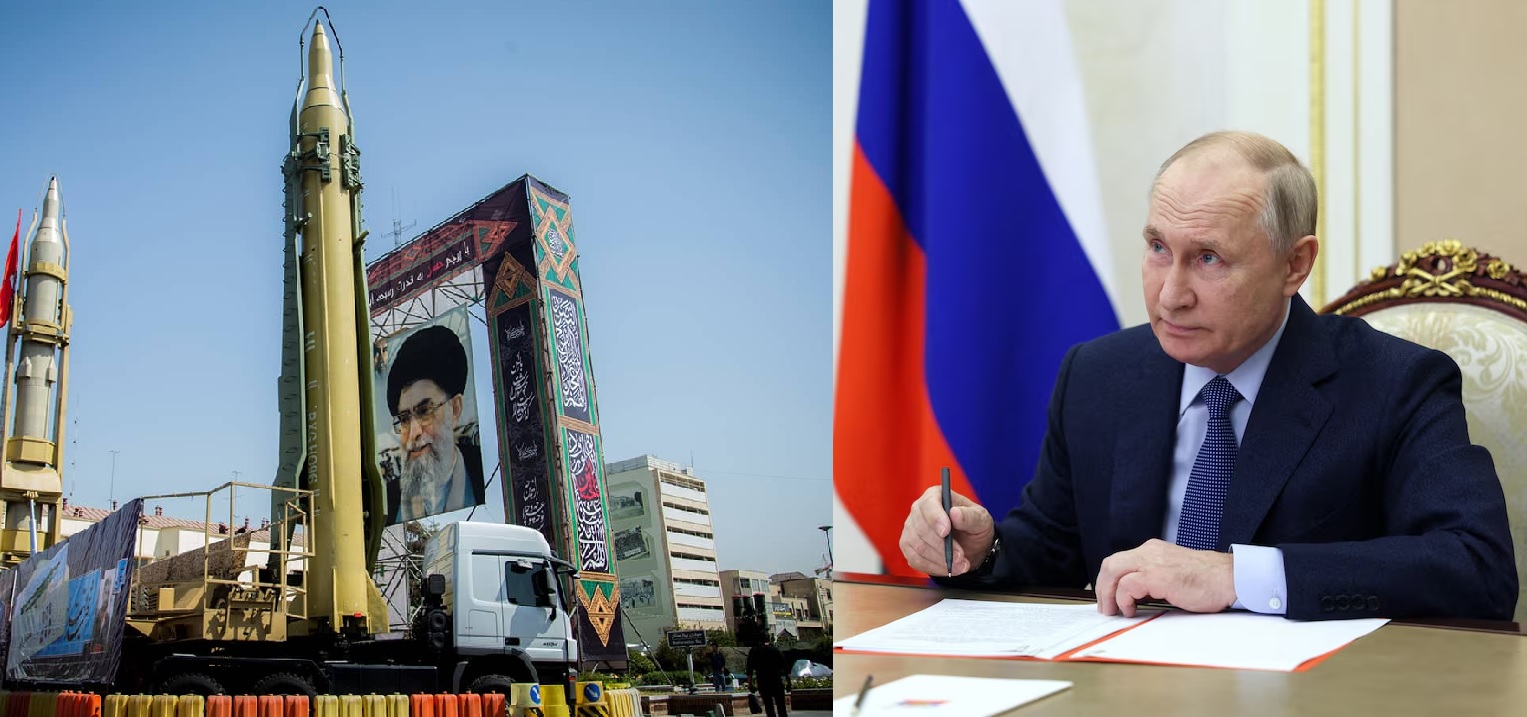
New revelations suggest that Russia is quietly assisting Iran in acquiring technology that could allow Tehran to design nuclear weapons without ever conducting a nuclear test, a method that would enable the Islamic Republic to advance toward nuclear-arms capability while avoiding the most visible red line in the global non-proliferation system.
According to reporting by the Financial Times, a group of Iranian scientists linked to state-run defence institutions travelled to Russia in late 2024 to pursue advanced laser-based diagnostic and simulation technology — tools that experts say can validate nuclear-warhead designs without the need for a live explosive test.
A Secret Visit With Suspicious Goals
The visit took place between 7 and 11 November 2024 and was organised through DamavandTec, a company identified by U.S. intelligence as a front for Iran’s military research network. The delegation reportedly included physicists and engineers from several Iranian universities long tied to the country’s defence ministry, including Malek Ashtar University of Technology, Shahid Beheshti University, and Islamic Azad University of Kashan.
In St. Petersburg, the Iranians met with Laser Systems, a Russian firm under U.S. sanctions for dual-use military laser research. The discussions were followed by a second meeting in February 2025, when Russian specialist Andrey Savin travelled to Tehran for continued technical consultations.
Western officials say the purpose of the meetings goes far beyond civilian research. Analysts interviewed by the Financial Times believe the Iranian delegation was specifically seeking high-precision laser diagnostics and advanced modelling capabilities that could help replicate the effects of a nuclear detonation in laboratory conditions — a vital component of modern warhead development.
How Lasers Replace a Nuclear Test
Traditional nuclear-weapons programmes rely on test explosions to confirm that a warhead’s design, implosion symmetry, and triggering mechanisms will function correctly. But since global treaty pressure has made real nuclear tests politically explosive, countries have been exploring alternative methods for years.
High-energy lasers, supercomputing models, and ultrafast imaging allow scientists to simulate the internal physics of a nuclear core, test key components, and validate miniaturised designs — all without producing a radioactive test blast. The U.S., China, Russia and France use similar technologies to maintain their arsenals under test-ban norms.
If Iran acquires such capability, experts warn that it could finalise a viable nuclear weapon without giving the world the unmistakable warning of a real test. This would dramatically reduce the time needed for Tehran to move from nuclear threshold status to operational nuclear arms.
A Shift in Russia’s Position
Russia has long insisted that it opposes a nuclear-armed Iran. Yet the FT report suggests that the meetings were approved at senior levels in both Moscow and Tehran, reflecting a deeper strategic alignment forged since Russia’s invasion of Ukraine and Iran’s supply of drones to the Russian military.
For the Kremlin, tightening nuclear-related cooperation with Iran serves multiple goals: pressuring Western powers, expanding influence in the Middle East, and cementing a strategic partnership with a key sanctions-resistant ally.
Moscow has not publicly responded to the allegations, while Iran continues to insist that all of its nuclear activity is for peaceful purposes. The documented involvement of sanctioned institutions, however, has raised significant alarm in Western capitals.
Growing Regional and Global Alarm
Intelligence agencies in the United States, Europe, and the Middle East are re-evaluating Iran’s nuclear trajectory in light of these disclosures. With access to advanced Russian technology, Tehran could potentially shorten its “breakout” window — the time required to produce a nuclear weapon — and do so under far less international scrutiny.
Regional powers such as Israel, Saudi Arabia and the United Arab Emirates are expected to intensify security cooperation and pursue additional missile-defence and counter-proliferation measures. Diplomatically, the revelations may also trigger calls for new sanctions on Iranian defence-linked institutions and stricter monitoring from the International Atomic Energy Agency.
The development also places further strain on the already fragile JCPOA framework, which has steadily eroded since the U.S. withdrawal in 2018 and Tehran’s subsequent expansion of uranium enrichment.
A New Phase in Iran’s Nuclear Path
The idea that Iran could approach nuclear-weapons capability without conducting a test represents a profound shift in how analysts assess the risks. For decades, the absence of a nuclear test has been viewed as a final proof that Iran had not crossed the threshold. But the Russian-Iranian cooperation described by the FT reflects a modern proliferation model — one where simulation replaces explosions, and where strategic partnerships can quietly accelerate the world’s most dangerous technologies.
If confirmed, the Russia-Iran laser-technology partnership may mark the most consequential change in Iran’s nuclear capabilities in over a decade, setting the stage for a new and far more unpredictable chapter in Middle Eastern security.
About the Author
Aditya Kumar:
Defense & Geopolitics Analyst
Aditya Kumar tracks military developments in South Asia, specializing in Indian missile technology and naval strategy.