HENSOLDT Boosts TRML-4D Radar Production Rate 30 Units Per Year, Soaring Demand Across Europe

Berlin, August 2025 — German defence electronics group HENSOLDT has announced a major expansion in the production of its TRML-4D air surveillance radar, as European nations step up efforts to bolster air defence capabilities in response to evolving aerial threats. The decision follows strong interest under the European Sky Shield Initiative (ESSI) and heightened demand for modern air defence systems, with HENSOLDT estimating a market potential of nearly €2 billion for the radar sensor.
Expanding Production for a Growing Market
HENSOLDT confirmed that it is ramping up annual production capacity of the TRML-4D to as many as 30 units per year. According to company executives, between 40 and 60 radars would be needed to ensure full coverage of German airspace, although Berlin has not yet formally committed to such a procurement.
If long-term demand continues to grow, the company indicated it could pursue partner-led assembly or joint manufacturing, widening the radar’s production footprint. This move underlines how European defence industries are adapting to the sharp increase in demand for air surveillance and signal intelligence systems following the war in Ukraine and growing missile and drone threats worldwide.
The TRML-4D: A Next-Generation Sensor
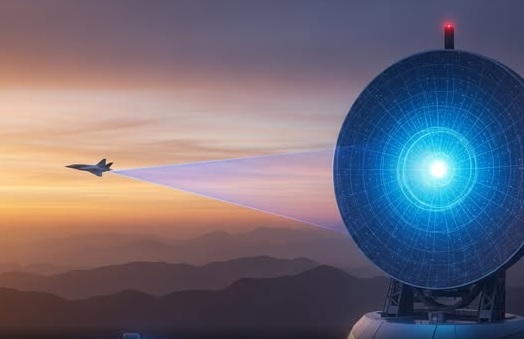
The TRML-4D radar is based on Active Electronically Scanned Array (AESA) technology, allowing it to track up to 1,500 targets simultaneously at ranges of up to 250 kilometres. It is designed to identify and classify a wide spectrum of threats, including cruise missiles, rockets, drones, aircraft, and even stealthier low-RCS targets.
The radar is a key component of Diehl Defence’s IRIS-T SLM air defence system, which has gained global attention after being successfully deployed in Ukraine, where it has helped intercept Russian missiles and drones. Beyond Ukraine, the TRML-4D has also entered service in Egypt, while Germany, Estonia, Latvia, Slovenia, Sweden, and Switzerland have placed procurement orders. Other nations such as Bulgaria, Lithuania, and Austria have expressed interest, highlighting the system’s growing export footprint.
Capability Upgrades: From 3D to 4D Advantage
Unlike traditional 3D radars that measure range, azimuth, and elevation, the 4D radar adds a crucial fourth element: time (speed and trajectory). This enables the TRML-4D to calculate not just where a target is, but where it is heading in real time. This “four-dimensional” capability greatly enhances the accuracy of threat evaluation, target prioritisation, and weapon cueing in complex multi-target environments.
HENSOLDT is also introducing a suite of new upgrades:
-
Counter-RAM capability: Future deliveries will include functions to detect artillery shells and mortar rounds in flight, improving battlefield situational awareness.
-
AI-based target recognition: Announced at the Paris Air Show in June, this upgrade will allow the system to distinguish between different threat types faster and with greater reliability, even in cluttered or contested electromagnetic environments.
These enhancements make the TRML-4D not just an air surveillance radar, but a multi-role sensor capable of defending against both traditional and asymmetric threats.
Strategic Implications
The radar’s rapid production scale-up comes at a critical time when European defence strategies are shifting toward integrated air and missile defence networks. Under the ESSI framework, European nations are pooling resources to plug gaps in aerial coverage and improve resilience against long-range missiles, drones, and hypersonic weapons.
By expanding TRML-4D production, HENSOLDT is positioning itself at the heart of this effort. The system’s proven performance in Ukraine has amplified its credibility, while its technological flexibility allows integration both as part of IRIS-T SLM or as a standalone national air defence radar.
The TRML-4D has emerged as one of Europe’s most sought-after air defence radars, combining cutting-edge AESA technology, 4D tracking capability, and adaptability to evolving threats. HENSOLDT’s decision to increase production underscores both rising demand and the strategic necessity of securing Europe’s skies in an era of heightened geopolitical tensions.
With its expanding deployment across NATO and beyond, the TRML-4D is set to become a cornerstone of next-generation air defence, symbolising how advanced sensors are redefining the speed and precision of modern warfare.
✍️ This article is written by the team of The Defense News.