HAL Signs Major Tech Transfer Deal for OAS and DVE Systems with HENSOLDT at Dubai Airshow
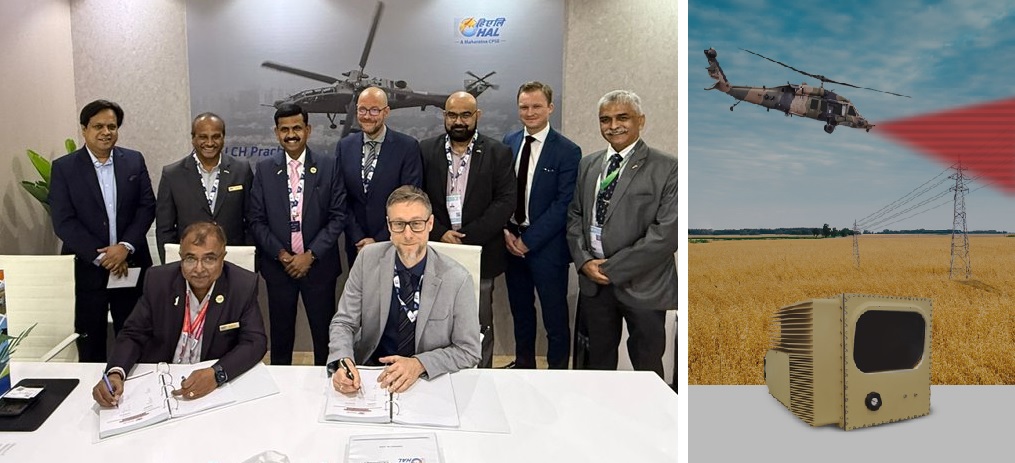
On a bright and bustling afternoon at the Dubai Airshow, where defence giants unveiled their most advanced technologies and global delegations shuffled between pavilions, a quieter but far more strategic moment unfolded. Hindustan Aeronautics Limited (HAL), India’s state-owned aerospace leader, signed a landmark contract with HENSOLDT Sensors GmbH of Germany — a deal that many observers would later call one of the most important achievements for India at this year’s show.
It wasn’t just another partnership. It was a transfer of power — the full Transfer of Design (ToT), Intellectual Property Rights (IPR), and complete manufacturing and repair capability for two critical helicopter technologies: the Obstacle Avoidance System (OAS) and the Degraded Visual Environment (DVE) solution. For HAL, this moment represented a decisive step into a future where India would no longer simply import cutting-edge helicopter avionics, but build, master, and even export them.
A Deal That Shifted the Atmosphere
As officials from both sides shook hands, the significance of the moment rippled through the Indian pavilion. HAL had arrived in Dubai seeking partnerships, but it walked away with something far more powerful — ownership.
The contract gives HAL not just the right to manufacture the systems, but the authority to modify, upgrade, and evolve them. For an Indian defence company, gaining complete IPR from a major European sensor manufacturer is rare, and it signalled a deep level of trust in HAL’s engineering capabilities.
To many experts watching, this wasn’t just a win — it was a statement. HAL was no longer a junior partner in global aerospace discussions. It was now a technology holder.
Why These Technologies Matter So Much
In the world of helicopter operations, seconds save lives, and visibility decides missions. That is where the two technologies from HENSOLDT come in.
The Obstacle Avoidance System is like an extra pair of eyes for a helicopter — spotting power lines, towers, poles, trees, and terrain features long before they become a danger. It is the system that warns before pilots even realize what’s ahead.
The Degraded Visual Environment solution is even more vital. In dust storms, fog, snow, heavy rain, or battlefield smoke — moments where pilots often struggle to see the ground — DVE allows them to “see” using sensors and synthetic vision. For platforms like the LCH Prachand, ALH Dhruv, and high-altitude rescue helicopters, DVE can be the difference between a safe landing and a disaster.
When HAL gains the technology to build and maintain these systems in-house, every Indian helicopter becomes safer, more modern, and more mission-ready.
How HAL Stood Out at Dubai Airshow 2025
The Dubai Airshow is a competitive environment. Companies make noise, display massive aircraft, and sign billion-dollar deals. Yet HAL’s achievement stood out because of its strategic value.
Across the exhibition hall, analysts noted how the Indian company had matured — not with flashy announcements, but with purposeful agreements that expand technological sovereignty.
This contract showed three things clearly:
-
HAL can negotiate for complete ownership, not partial access.
-
India’s aerospace sector is climbing higher into the global value chain.
-
Foreign defence companies see HAL as a capable, long-term partner.
For India, this wasn’t just an international win — it was symbolic of the country’s growing aerospace confidence.
A Boost for Atmanirbhar Bharat
Back home, the deal aligns seamlessly with India’s push for Atmanirbhar Bharat in the defence sector. Full ToT and IPR mean that upgrades no longer require foreign permissions. Repairs can be done within Indian facilities. Custom versions can be developed for specific missions. Future variants can be modified without waiting for foreign approvals.
And perhaps most importantly — HAL now has the authority to export the system.
With many Asian, African, and Middle Eastern nations seeking cost-effective helicopter upgrades, HAL’s new capability positions India as a supplier, not just a buyer.
The Dubai airshow moment was not loud, but it was decisive. As HAL executives walked out of the pavilion with the signed agreement, they carried more than a contract — they carried a transformation.
In the coming years, Indian-made helicopters will fly with advanced German-origin systems built entirely on Indian soil. Pilots landing in dust-filled valleys, rescuing civilians in storms, or flying combat missions at night will rely on technologies that HAL now fully owns.
For HAL, this was more than success at a global event.
It was a turning point — a moment when India’s aerospace sector took a confident stride towards technological independence.
And in the narrative of India’s rising aviation capabilities, the Dubai Airshow 2025 will be remembered as the place where HAL quietly won big.
About the Author
Aditya Kumar:
Defense & Geopolitics Analyst
Aditya Kumar tracks military developments in South Asia, specializing in Indian missile technology and naval strategy.