HAL Planning Flight Trials of Twin-Engine UH-M in 2026, Induction by 2030 to Replace Chetaks
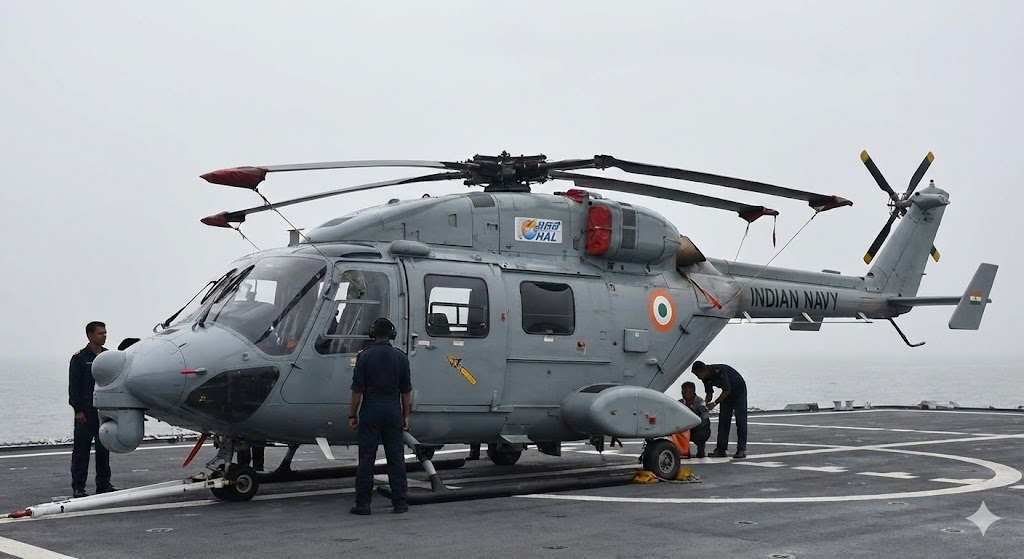
BENGALURU : India’s long-running effort to indigenise its maritime aviation capability has entered a decisive phase, with Hindustan Aeronautics Limited (HAL) preparing to begin flight trials of its indigenous Utility Helicopter-Marine (UH-M), a twin-engine platform designed specifically for ship-borne operations. The Indian Navy is planning to induct the helicopter in significant numbers by the end of the decade, positioning it as the principal replacement for the ageing Chetak fleet, which has remained in service for more than sixty years.
Senior officials familiar with the programme say the UH-M prototype is now mechanically complete, marking the transition from design and ground integration to flight testing. The helicopter is being developed by Hindustan Aeronautics Limited to meet a long-standing naval requirement for a modern, compact, and survivable utility helicopter capable of sustained operations from frontline warships.
Why the Navy Chose UH-M Over LUH
Recent clarifications from Naval Headquarters have removed lingering ambiguity over the Navy’s helicopter roadmap. While the single-engine Light Utility Helicopter (LUH) is being inducted by the Army and the Air Force, the Navy has formally ruled it out for maritime roles, citing the inherent risks of single-engine flight over open seas and during deck operations.
Instead, the Navy has committed to the UH-M, a navalised derivative of the ALH Dhruv. The UH-M retains the core airframe philosophy of the Dhruv but introduces extensive modifications to address corrosion, shipboard handling, safety redundancy, and space constraints on destroyers, frigates, and offshore patrol vessels.
Trials Timeline and Induction Plan
According to officials at HAL’s rotary-wing complex in Bengaluru, the UH-M’s maiden flight is expected within the current financial year, with early 2026 emerging as the most likely window. Following internal test flights, the programme will move into a demanding phase of User Evaluation Trials (UET), conducted jointly with the Indian Navy.
These trials will include repeated deck landings in day and night conditions, compatibility checks with ship hangars, blade and tail-fold evaluations, and endurance testing in high-humidity maritime environments. If the trials proceed on schedule, limited-series production deliveries could begin around 2027, with full operational capability targeted by 2030.
The Ministry of Defence has already issued a Request for Information (RFI) for 76 helicopters, comprising 51 units for the Navy and 25 for the Indian Coast Guard. The programme is estimated to be valued at over ₹5,000 crore, making it one of the most consequential indigenous rotary-wing projects currently underway.
A Helicopter Built for the Sea
Unlike land-based variants of the Dhruv, the UH-M has been engineered from the outset for the harsh realities of maritime operations. The helicopter falls into the ~5.7-ton class and is powered by two Shakti 1H1 turboshaft engines, co-developed with Safran, providing the redundancy essential for naval flying.
Structural changes include extensive use of corrosion-resistant materials, marinised avionics, and reinforced landing gear optimised for deck manoeuvring. The adoption of wheeled landing gear, rather than skids, allows the helicopter to be moved safely within confined decks and hangars of warships. A segmented blade and tail-boom folding mechanism reduces the aircraft’s footprint to approximately 3.5 metres, enabling it to fit aboard vessels originally designed around much smaller helicopters.
The UH-M is also equipped with a full glass cockpit, naval weather radar, deck-approach aids, and emergency flotation gear to enhance survivability in the event of a forced sea landing.
Roles Across the Maritime Spectrum
Operationally, the UH-M is intended to be a true multirole platform. Its primary missions will include Search and Rescue (SAR), Casualty Evacuation (CASEVAC), ship-to-ship logistics, and surveillance in low-intensity maritime operations. The helicopter will also be capable of underslung load carriage, supporting replenishment tasks and humanitarian assistance during disaster-relief operations along India’s vast coastline and island territories.
Naval planners view the UH-M as a critical enabler for distributed maritime operations, allowing smaller surface combatants to project reach beyond the horizon without relying on imported platforms.
Strategic Impact and the End of Imports
The progress of the UH-M programme signals a broader strategic shift. For years, the Navy evaluated foreign utility helicopters, including European and American designs, to fill the gap left by the ageing Chetak fleet. However, policy emphasis on self-reliance under the “Make in India” framework has reshaped procurement priorities.
If the UH-M meets performance and reliability benchmarks during trials, it is expected to close the door on large-scale imports in this category. By 2030, naval planners anticipate the helicopter will form the backbone of India’s ship-borne utility aviation, operating routinely from frontline warships and contributing to maritime security across the Indian Ocean Region.
As flight trials approach, the UH-M now stands as one of the most closely watched defence aviation programmes in the country, carrying both operational importance for the Navy and symbolic weight for India’s ambition to build complex military platforms at home.
About the Author
Aditya Kumar:
Defense & Geopolitics Analyst
Aditya Kumar tracks military developments in South Asia, specializing in Indian missile technology and naval strategy.