Gwadar and Karachi Under Watch: Satellite Imagery Reveals Pakistan Navy’s Retreat During Operation Sindoor
The May 2025 Indo-Pak conflict, codenamed Operation Sindoor, marked a turning point in South Asian naval strategy. Following India’s precision strikes on nine terror-linked locations across Pakistan and PoJK on the night of May 6–7, New Delhi declared its mission complete. Yet, while Islamabad vowed retaliation, the reality captured in satellite imagery of Karachi and Gwadar ports told a different story—one of strategic retreat and defensive repositioning.
Karachi: Commercial Terminals Turned into Naval Refuge
Satellite pictures dated May 8, 2025, revealed a striking shift in Pakistan Navy (PN) operations. Instead of projecting power seaward, several frontline warships were docked at Karachi’s commercial container terminals—a move that senior naval experts interpreted as an attempt to shield assets under civilian cover.
-
Ships Identified at Karachi:
-
PNS Alamgir (Oliver Hazard Perry-class frigate)
-
A Babur-class corvette
-
A Damen Offshore Patrol Vessel (OPV)
-
At least one additional frigate at the container terminal
-
These vessels were berthed just meters away from cargo ships and containers, blending with civilian maritime activity. Retired Vice Admiral S.C. Suresh Bangara, a veteran of the 1971 Karachi harbour attack, described this as a “clear sign of low operational readiness.” He added, “Berthing them in the commercial port area is a sign of hoping to evade missile attacks, even at the cost of civilian risk.”
Gwadar: From CPEC Jewel to Naval Fallback
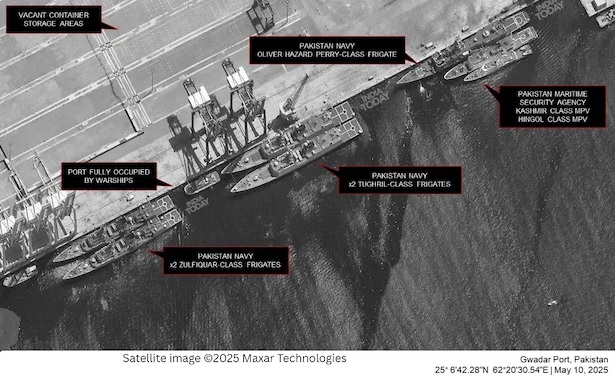
The Gwadar port, touted as the crown jewel of the China–Pakistan Economic Corridor (CPEC), played an unexpectedly military role during the conflict. By May 10, high-resolution imagery from Maxar Technologies showed Gwadar’s 600-meter berth packed with warships, while its commercial container storage areas lay empty.
-
Ships Identified at Gwadar:
-
Two Tughril-class (Type 054A/P) frigates
-
Two Zulfiquar-class (F-22P) frigates
-
One Oliver Hazard Perry-class frigate (PNS Alamgir)
-
Two Maritime Security Agency patrol vessels (Kashmir-class and Hingol-class)
-
Instead of hosting container trade, Gwadar became a temporary naval refuge, barely 100 km from Iran. Vice Admiral Bangara observed, “Gwadar, bereft of commercial activity, was the wrong choice to berth front-line ships. They stuck out prominently. It would appear that the only force at sea were their submarines.”
The INS Vikrant Factor
At the heart of Operation Sindoor was INS Vikrant, India’s first indigenous aircraft carrier, which undertook its maiden combat deployment. Backed by a Carrier Battle Group (CBG) of destroyers, frigates, submarines, and BrahMos-equipped platforms, Vikrant’s presence in the Arabian Sea exerted immense psychological and strategic pressure.
Geo-intelligence researcher Damien Symon noted that Pakistan Navy’s decision to disperse and hide its fleet mirrored the deterrent effect of Vikrant. He explained, “India postured toward potential military objectives in Karachi, forcing Pakistan to scatter its fleet between civilian berths and Gwadar.”
Operational Weaknesses in Pakistan Navy
Despite showcasing its new P282 ship-launched ballistic missile in late 2024, the Pakistan Navy struggled to demonstrate credible deterrence. Many of its submarines were sidelined for refits and maintenance, significantly diluting its undersea strength at a critical juncture.
Moreover, Pakistan’s Army-dominated joint command limited the Navy’s operational autonomy. This asymmetry allowed India to conduct coordinated joint operations, achieving objectives swiftly while conserving ordnance. As Vice Admiral Bangara summarized:
“India’s clear articulation of punitive retaliation saw the end of a swift operation without firing a single missile from the sea. Remember, Operation Sindoor has only been paused.”
Strategic Takeaways
-
Pakistan’s Defensive Posture – Instead of confronting the Indian Navy, PN warships sheltered in commercial and fallback ports.
-
Gwadar’s Shift in Role – Marketed as a commercial hub, it turned into a naval hideout, exposing CPEC’s dual-use vulnerabilities.
-
INS Vikrant’s Debut – Proved decisive in establishing India’s maritime dominance.
-
Civilian Cover Risks – Pakistan’s use of commercial berths and proximity to civilian ships mirrored its earlier practice of shadowing military aircraft with commercial flights.
The satellite imagery of May 2025 underscores a critical reality: while Pakistan threatened retaliation, its naval fleet sought shelter rather than sea control. Karachi’s commercial terminals and Gwadar’s underutilized berths became makeshift sanctuaries, highlighting both India’s maritime ascendancy and Pakistan’s defensive frailties.
Operation Sindoor was not just about airstrikes—it was a demonstration of deterrence from the sea, with INS Vikrant at its core. The images captured from space reveal a navy forced into hiding, symbolizing the widening gap in naval readiness between India and Pakistan.
✍️ This article is written by the team of The Defense News.