Greenland Rejects U.S. Ownership Talk, Reaffirms Loyalty to Denmark, NATO and Europe
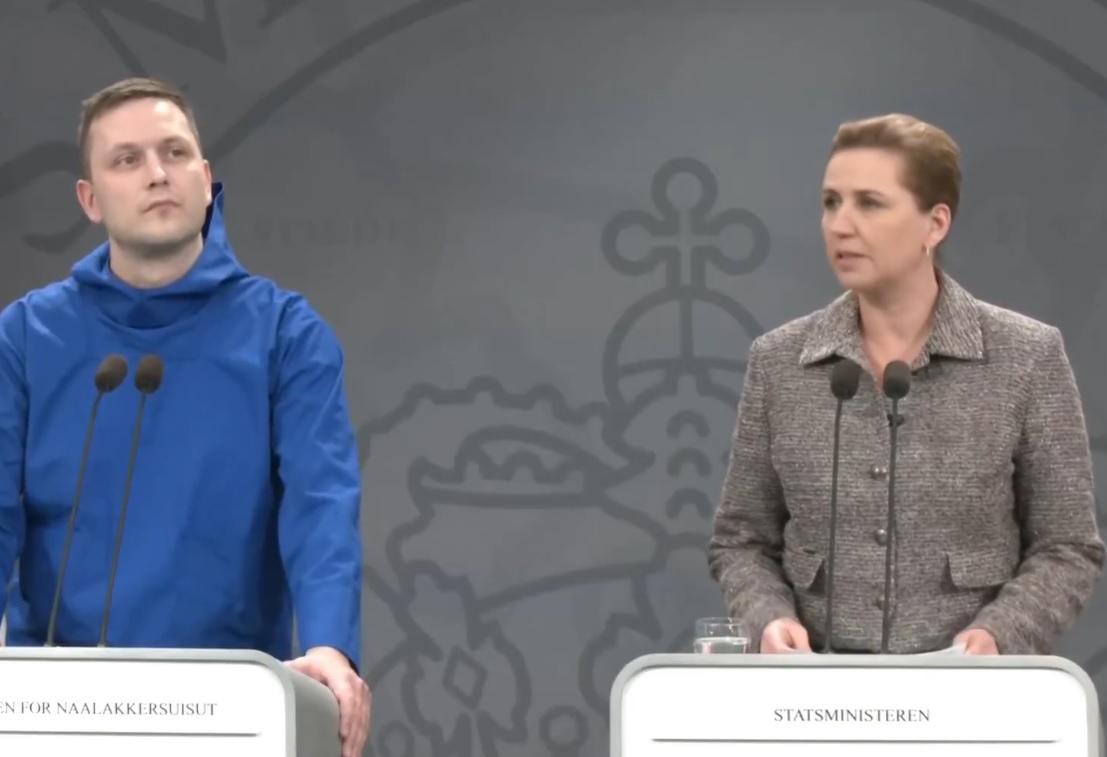
Nuuk / Copenhagen : Greenland’s political leadership has delivered its clearest and most forceful rejection yet of any suggestion that the vast Arctic island could fall under American control, declaring unequivocally that Greenland’s future lies with Denmark, NATO, and Europe, not the United States.
Speaking amid renewed international attention on the Arctic’s strategic value, Greenland’s Prime Minister Jens-Frederik Nielsen said that if Greenland were compelled to make a choice between Washington and Copenhagen, the decision would be unambiguous.
“If we have to choose between the United States and Denmark here and now, we choose Denmark. We choose NATO. We choose the Kingdom of Denmark. We choose the EU,” Nielsen said, underscoring Greenland’s political alignment and security priorities.
He went further, directly addressing long-running speculation in U.S. political circles about Greenland’s status. “Greenland will not be owned by the United States. Greenland will not be governed by the United States. Greenland will not be part of the United States,” the prime minister stated, framing the issue as one of sovereignty and self-determination rather than diplomacy alone.
A Firm Line on Sovereignty
Greenland, an autonomous territory within the Kingdom of Denmark, controls its domestic affairs while Copenhagen retains responsibility for defense and foreign policy. Although sparsely populated, the island occupies a pivotal position between North America and Europe and is increasingly central to global security calculations as melting Arctic ice opens new shipping routes and access to natural resources.
Past remarks by U.S. leaders about acquiring Greenland — once dismissed as rhetorical or symbolic — have left a lasting imprint on political discourse in Nuuk and Copenhagen. Greenlandic leaders have consistently stressed that any discussion about their future must begin with respect for the will of the Greenlandic people.
Nielsen’s comments reflect growing confidence within Greenland’s political class, which has sought to balance aspirations for greater autonomy with the realities of security dependence in a more contested Arctic environment.
Denmark: Arctic Security Is a Collective Responsibility
Backing Greenland’s stance, Danish Prime Minister Mette Frederiksen framed the issue within a broader defense of international norms and NATO solidarity.
“We want to strengthen security cooperation in the Arctic — with the United States, NATO, Europe, and our Arctic NATO allies,” Frederiksen said, emphasizing that Denmark does not seek confrontation but deeper cooperation within existing alliances.
Drawing parallels with Eastern Europe, she argued that Arctic security cannot be shouldered by one country alone. “Just as the Baltic states do not defend NATO’s eastern flank alone, security in the Arctic is a shared responsibility,” she said.
Frederiksen stressed that NATO must treat Greenland as it would any other part of allied territory. “NATO must protect Greenland as it does every part of its territory, and that collective guarantee is the strongest defense against Russian or Chinese threats in the Arctic,” she said, pointing to rising geopolitical competition in the High North.
A Warning Against Power Politics
Beyond immediate security concerns, the Danish prime minister cast the debate as a test of the post–World War II international order.
“This is not just about Greenland or the Kingdom,” Frederiksen said. “It is about the principle that borders cannot be changed by force, that a people cannot be bought, and that small countries should not have to fear larger ones.”
Her remarks echoed long-standing European anxieties about great-power coercion, particularly as tensions with Russia persist and China expands its economic and scientific footprint in the Arctic.
Frederiksen said Denmark and its partners would continue to speak out “together with allies in the North, in Europe, and around the world” to defend the democratic world order built over generations.
‘Greenland Is Not for Sale’
Copenhagen’s message to Washington, Frederiksen insisted, has been consistent. “Greenland is not for sale,” she said, adding that Denmark has told the United States from the outset that if concerns are truly about security, there is ample scope for cooperation within NATO and existing defense frameworks.
She indicated that Denmark remains open to expanding joint military activities, surveillance, and infrastructure investments in the Arctic — but only on the basis of partnership, not ownership.
Strategic Arctic, Shared Future
As climate change accelerates transformations in the Arctic, Greenland’s importance is set to grow further, intensifying interest from major powers. For Nuuk and Copenhagen, the challenge lies in navigating that attention without compromising sovereignty or stability.
The latest statements from Greenlandic and Danish leaders leave little room for ambiguity. Greenland’s future, they insist, will be decided by Greenlanders themselves, anchored within the Kingdom of Denmark, protected by NATO, and aligned with Europe — not bought, transferred, or imposed from abroad.
About the Author
Aditya Kumar:
Defense & Geopolitics Analyst
Aditya Kumar tracks military developments in South Asia, specializing in Indian missile technology and naval strategy.