Greece Seeks U.S. Approval for AIM-120D Missiles to Arm F-35s Amid Türkiye’s Meteor Deal
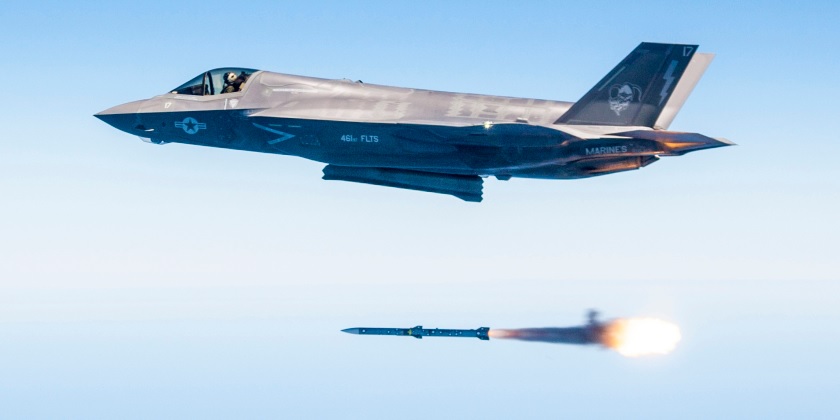
Greece has formally renewed its request for U.S. approval to purchase AIM-120D Advanced Medium-Range Air-to-Air Missiles (AMRAAMs) for its incoming fleet of F-35A Lightning II fighters, in a move aimed at preserving the delicate balance of airpower in the Aegean Sea as Türkiye prepares to field the Meteor missile on its Eurofighter Typhoon aircraft.
The request, reported by Kathimerini, was resubmitted to Washington by Greece’s Ministry of National Defense, underscoring the country’s determination to equip its fifth-generation fighters with the latest long-range missile technology. The proposal is currently under review by the U.S. State Department and Department of Defense, as part of a broader regional arms transfer assessment.
Greek defense officials have emphasized that without access to the AIM-120D, the Hellenic Air Force (HAF) may consider purchasing the European MBDA Meteor missile instead — a potential shift that would mark a deeper realignment toward European defense suppliers.
Preserving Air Superiority in the Aegean
For Athens, arming its F-35As with AIM-120D AMRAAMs is not just a matter of modernization, but a critical requirement for deterrence and strategic balance. Türkiye’s move to integrate the Meteor missile — with its formidable range exceeding 200 km and active ramjet propulsion — has raised alarm in Greek defense circles.
Greece sees the AIM-120D, developed by Raytheon, as the only viable counterbalance. The missile offers an effective engagement range of up to 180 kilometers, advanced two-way datalink communication, and GPS-aided inertial navigation for mid-course guidance. Designed to operate in high electronic-warfare environments, it enables pilots to “fire-and-forget” while maintaining target updates in flight.
Defense analysts in Athens warn that if Türkiye’s Meteor-equipped Typhoons enter service before Greece’s F-35s are fully armed, it could temporarily tilt the airpower equation in Ankara’s favor — particularly across disputed airspaces of the Aegean and Eastern Mediterranean.
A senior Greek air force source told Army Recognition,
“Without AIM-120Ds, our fifth-generation aircraft lose part of their strategic edge. We need a long-range engagement capability that ensures our pilots can strike first, and survive.”
Washington’s Cautious Approach
While the U.S. has approved the sale of twenty F-35A fighters to Greece under a €3.47 billion contract, Washington has so far taken a cautious approach to the export of the AIM-120D, which remains one of America’s most closely controlled air-to-air weapons.
U.S. defense officials are reportedly weighing regional stability and export precedents before granting approval. Similar hesitations were observed during past transfers to Japan, South Korea, and Taiwan, all of which required lengthy security assurances.
If denied, Greek officials have indicated that the Meteor missile — already in service with the country’s Dassault Rafale F3R fighters — could be procured for the F-35A, following a new integration agreement with MBDA. Such a step would not only maintain combat parity with Türkiye but also strengthen Athens’ alignment with European defense industries, reducing reliance on U.S. suppliers.
The Missiles at the Core of the Rivalry
AIM-120D AMRAAM (Raytheon, USA)
-
Range: 160–180 km (depending on altitude and flight profile)
-
Speed: Close to Mach 4
-
Features: Two-way datalink, GPS-aided inertial navigation, improved ECCM (Electronic Counter-Countermeasures)
-
Launch weight: ~160 kg
-
Length: 3.66 m
-
Compatibility: F-15, F-16, F/A-18, F-22, and F-35
Meteor (MBDA, Europe)
-
Range: 200+ km
-
Speed: Mach 4+, powered by an active ramjet motor maintaining thrust throughout flight
-
Guidance: Active radar seeker with data-link update
-
Features: Large “no-escape zone,” optimized for highly maneuverable targets
While the Meteor offers slightly longer range and sustained propulsion, the AIM-120D provides tighter integration with U.S. avionics and is fully certified for the F-35’s internal weapons bay, an important factor for maintaining the aircraft’s stealth profile.
Greece’s Expanding Airpower Strategy
The Hellenic Air Force’s modernization plan has accelerated since 2020, aiming to build a three-tiered fighter structure composed of F-35As, F-16V Vipers, and Rafale F3Rs.
-
F-35A Lightning II: 20 aircraft on order, with deliveries starting in 2028. The first jets will remain in the U.S. for pilot training before joining the 117th Fighter Wing at Andravida Air Base by the early 2030s.
-
Rafale F3R: 24 aircraft delivered between 2022 and early 2025, equipped with Meteor, MICA, SCALP, and AM39 Exocet missiles.
-
F-16V Viper Fleet: 83 upgraded aircraft forming the operational backbone of the Air Force, supplemented by a planned modernization of 38 F-16 Block 50s valued at nearly €900 million.
Athens has ruled out purchasing more Rafales for now, emphasizing that its combined fighter fleet provides a credible deterrent and ensures interoperability with NATO allies.
Future Weapons and Next-Generation Systems
Looking ahead, Greece is also expressing interest in the AIM-260 Joint Advanced Tactical Missile (JATM) — the successor to the AMRAAM being developed by Lockheed Martin. The AIM-260 is expected to offer a range exceeding 200 km, a top speed near Mach 5, and enhanced resistance to electronic warfare.
The U.S. military has allocated $687 million for JATM development and procurement in FY2026, but the system is not yet export-ready. Greece’s early interest signals its desire to remain aligned with next-generation NATO capabilities once the missile becomes available for foreign sale.
Additionally, Athens is exploring participation in Collaborative Combat Aircraft (CCA) programs — pairing manned fighters with autonomous drones for reconnaissance and strike missions. Discussions with the U.S. Air Force could see Greece join early development or testing phases.
The HAF is also evaluating the APKWS II laser-guided rocket as a low-cost anti-drone solution, capable of converting existing 70mm Hydra rockets into guided munitions with a range of 5–8 km.
Strategic Significance
For Greece, securing AIM-120D approval would reaffirm its strategic partnership with the United States, solidify its position as the southern anchor of NATO’s airpower, and ensure technological parity with Türkiye.
However, if Washington hesitates, Greece’s pivot toward European missile systems could reshape defense procurement dynamics across Southern Europe — deepening industrial ties with France and MBDA, while signaling a new era of strategic autonomy within NATO’s southern flank.
Either way, Athens appears determined to ensure that when its F-35A Lightning II jets take to the skies in 2028, they will do so fully armed and ready to secure the Aegean — whether with Raytheon’s AIM-120D or MBDA’s Meteor.
About the Author
Aditya Kumar:
Defense & Geopolitics Analyst
Aditya Kumar tracks military developments in South Asia, specializing in Indian missile technology and naval strategy.