Germany and Netherlands Sign €4.5 Billion Deal for 222 New SCHAKAL Infantry Fighting Vehicles
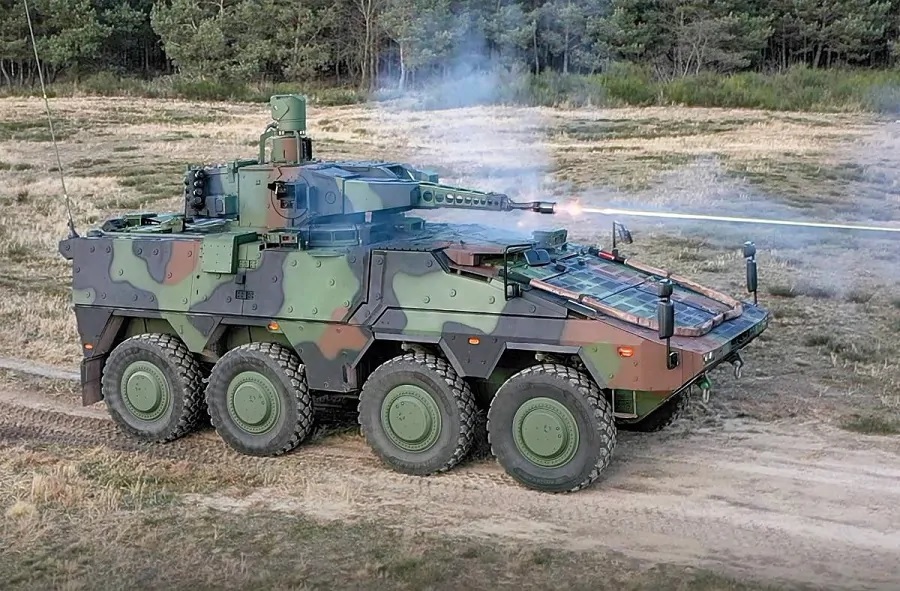
On 17 October 2025, Germany and the Netherlands officially signed a landmark €4.5 billion contract through the Organisation for Joint Armament Cooperation (OCCAR) to jointly procure 222 new SCHAKAL Infantry Fighting Vehicles (IFVs) — a cutting-edge variant of the proven Boxer modular armored vehicle family. The agreement marks one of the most significant European land systems investments in recent years and reinforces both nations’ commitment to deepening defense industrial cooperation and enhancing NATO’s protected mobility.
A Milestone for European Defense Cooperation
The contract, signed in Bonn, represents the latest phase in the evolving Boxer program, already in service with several NATO members including Germany, the Netherlands, the UK, and Lithuania. Managed by ARTEC GmbH, a joint venture between Krauss-Maffei Wegmann (KMW) and Rheinmetall Landsysteme, the Boxer family has become a cornerstone of Europe’s next-generation armored mobility.
The new SCHAKAL variant, jointly developed by German and Dutch industries, will expand both nations’ Boxer fleets and provide a dedicated infantry fighting vehicle (IFV) configuration designed to deliver superior firepower, troop protection, and digital integration for high-intensity warfare. This expansion brings the total OCCAR-managed Boxer program value to over €10 billion, cementing it as one of Europe’s largest cooperative defense projects.
SCHAKAL: The Next-Generation Infantry Fighting Vehicle
The Boxer SCHAKAL (Schwerer Kampf- und Aufklärungswagen Leicht) is conceived as a highly modular, multi-role platform capable of adapting to diverse operational needs — from frontline combat to reconnaissance and medical evacuation.
Key Specifications and Features:
-
Combat Weight: Approximately 45 tonnes (depending on configuration)
-
Crew: 3 (commander, gunner, driver) + up to 8 infantry troops
-
Main Armament:
-
Lance 2.0 Remote-Controlled Turret
-
30mm MK30-2/ABM automatic cannon with programmable airburst munitions
-
Coaxial 7.62mm machine gun
-
Optional Spike-LR2 or MELLS anti-tank guided missile launchers
-
-
Armor Protection: STANAG 4569 Level 4+ ballistic and mine protection, with modular add-on armor kits
-
Engine: MTU 8V199 TE21 diesel engine producing 720 hp, providing a top speed of 100 km/h
-
Range: Over 700 kilometers on-road
-
Digital Systems: Integrated battle management system, situational awareness sensors, and next-gen communication suite compatible with NATO networks
The SCHAKAL variant emphasizes survivability, mobility, and firepower, giving German and Dutch mechanized infantry units the ability to fight alongside Leopard 2 main battle tanks and other modern assets. It also incorporates enhanced mine and IED protection, improved crew ergonomics, and greater autonomy-ready architecture to accommodate future unmanned systems integration.
Industrial and Strategic Impact
This new phase of the Boxer program significantly strengthens German-Dutch industrial cooperation, as both nations will share production, logistics, and system integration responsibilities. Rheinmetall, KMW, and Dutch industry partners such as Dutch Defence Vehicle Systems (DDVS) will collaborate closely, ensuring long-term sustainment and upgrade pathways.
The contract also signals Europe’s intent to consolidate its defense supply chains amid global instability and rising demand for armored vehicles. The SCHAKAL’s modular nature allows it to evolve with emerging technologies, ensuring decades of service relevance.
Enhancing NATO’s Battlefield Mobility
For NATO, the SCHAKAL procurement represents a tangible step toward greater operational resilience and interoperability. The new IFVs will enhance the alliance’s protected mobility in Eastern Europe, support rapid deployment forces, and strengthen deterrence against evolving threats — particularly in hybrid and high-intensity combat environments.
The inclusion of medical evacuation and command post variants in future orders will also improve battlefield sustainability, ensuring that the Boxer fleet forms a complete, networked family of vehicles for combat, logistics, and recovery missions.
With deliveries expected to begin in the late 2020s, the SCHAKAL program will define the next decade of European armored warfare. Its combination of modular design, powerful weapon systems, and digital integration makes it a central pillar of the European Defence Industrial Strategy.
In an era where mobility, protection, and interoperability define modern battlefields, the Germany–Netherlands SCHAKAL initiative stands as a model of effective multinational defense collaboration — one that both strengthens NATO’s frontlines and signals Europe’s growing determination to take collective responsibility for its security.
About the Author
Aditya Kumar:
Defense & Geopolitics Analyst
Aditya Kumar tracks military developments in South Asia, specializing in Indian missile technology and naval strategy.