Germany Orders 84 RCH 155 Boxer Howitzers in €1.2 Billion Push to Reinforce Artillery Capabilities
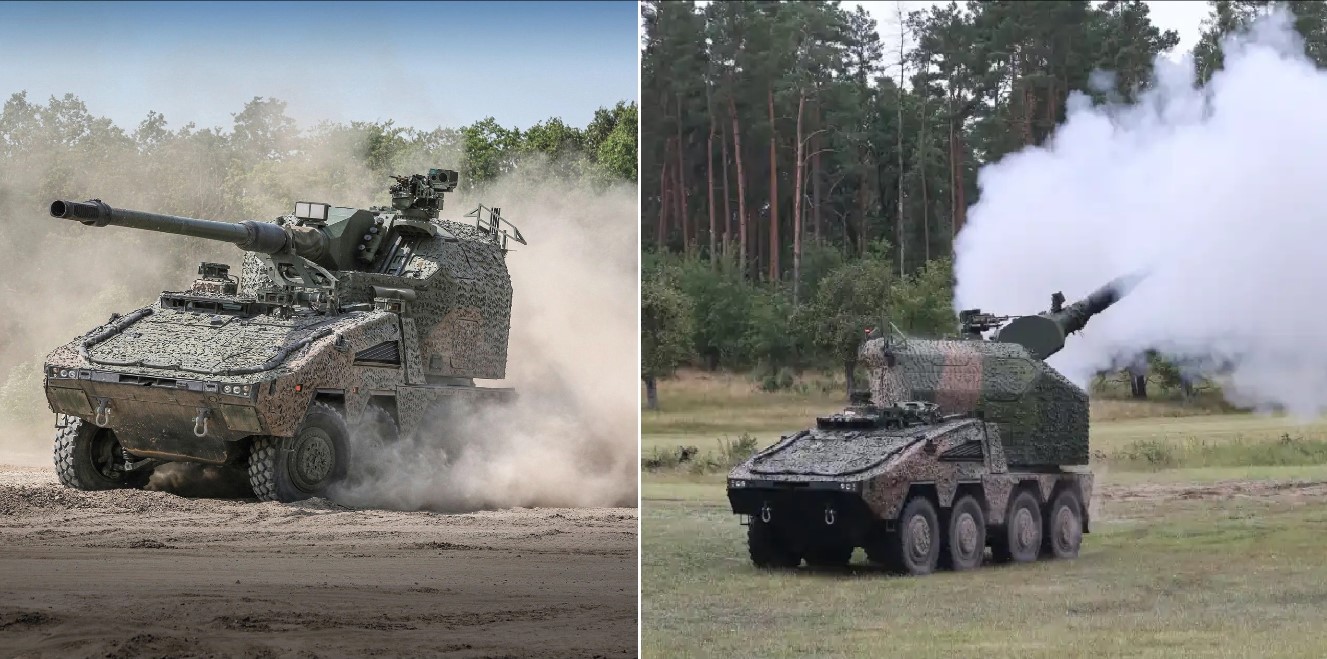
Germany’s Bundeswehr is taking a decisive step to modernize its artillery forces with a major procurement of RCH 155 wheeled self-propelled howitzers, part of a broader effort to rebuild and expand long-range fires capability after years of operational strain and equipment transfers abroad. The announcement from defence industry group KNDS on 19 December 2025 confirms a €1.2 billion contract with ARTEC — the joint venture of KNDS Deutschland and Rheinmetall Landsysteme — covering 84 RCH 155 systems, associated training equipment, logistical support and in-service sustainment, positioning Berlin to field an immediately deployable artillery capability rather than a limited fleet.
The RCH 155 represents a new generation of artillery for the Bundeswehr, integrating a 155 mm L52 automated gun module on a Boxer 8×8 protected wheeled chassis. The system is designed to execute rapid “shoot-and-scoot” operations, including firing on the move and delivering long-range precision fires beyond 50 km with advanced ammunition types, all operated by a reduced two-soldier crew inside armour protection suited to a battlefield dominated by drones and counter-battery threats.
At the technical level, the RCH 155’s automation is a significant advance: navigation and fire control, gun laying, and ammunition handling, including inductive fuze programming, are fully automated. Standard ammunition capacity includes roughly 30 fused rounds and 144 modular charges, with a rate of fire of up to 9 rounds per minute. Effective range spans up to about 40 km with base bleed projectiles, 54 km with V-LAP, and as far as 70 km with extended-range VULCANO-type munitions in optimal conditions.
The Bundeswehr’s investment in the RCH 155 comes amid a broader political push to strengthen Germany’s military. In December 2025 lawmakers approved more than €50 billion in defence contracts to accelerate procurement across land, air and space domains, reflecting Berlin’s commitment to meeting NATO readiness targets and to rebuilding high-intensity warfighting capabilities following Russia’s full-scale invasion of Ukraine.
Current Artillery Strength and Challenges
For years, Germany’s tube artillery backbone has been the Panzerhaubitze 2000 (PzH 2000) — a tracked 155 mm self-propelled howitzer renowned for its high rate of fire, digital fire control and robust protection. Originally fielded from 1998, the PzH 2000 has been central to Bundeswehr fires but its numbers in German service have diminished through transfers to Ukraine and other commitments, with reports indicating that stockpiles and operational readiness have been strained.
Data from mid-2025 suggest that Bundeswehr artillery holdings included approximately 121 PzH 2000 howitzers and 36 MARS II rocket artillery systems, with plans to increase tube artillery systems significantly by 2035 as part of restructuring efforts; older towed systems have largely been phased out.
However, heavy commitments abroad and limited domestic inventories have left capability gaps: industry analysis has highlighted that only a fraction of existing self-propelled howitzers may be operationally available at any time due to maintenance and sustainment backlogs. This shortfall has intensified calls within defence circles for a rapid recapitalisation of indirect fire assets.
Strategic Rationale and Future Outlook
The procurement of the RCH 155 is not merely an equipment upgrade; it reflects a shift in German artillery doctrine toward highly mobile, networked, long-range systems that can survive under persistent surveillance and counter-battery fire. The wheeled Boxer-based platform offers strategic mobility — enabling rapid redeployment by road across Germany and allied territory — and commonality with other Boxer variants, simplifying training, logistics and maintenance.
Compared with legacy vehicles, the RCH 155 bridges doctrine and technology: it sits between lighter expeditionary howitzers like France’s CAESAR and highly automated competitors like Sweden’s Archer, but its protected chassis and two-soldier crew suite it to anticipated European battlefield demands.
Germany’s artillery modernization is expected to grow beyond the initial 84 units. Separate reports indicate plans for additional RCH 155 purchases potentially totaling over 200 systems in the coming years under a multi-billion-euro program, with deliveries slated through the late 2020s and into the early 2030s as part of the Bundeswehr’s broader arsenal resurgence.
Taken together with ammunition industrial scale-ups — a priority after Ukraine exposed how swiftly stocks can be depleted in high-intensity combat — Germany’s actions mark a significant shift from post-Cold War force reductions toward a robust, sustainable artillery force designed for peer-level deterrence and alliance interoperability.
✍️ This article is written by the team of The Defense News.