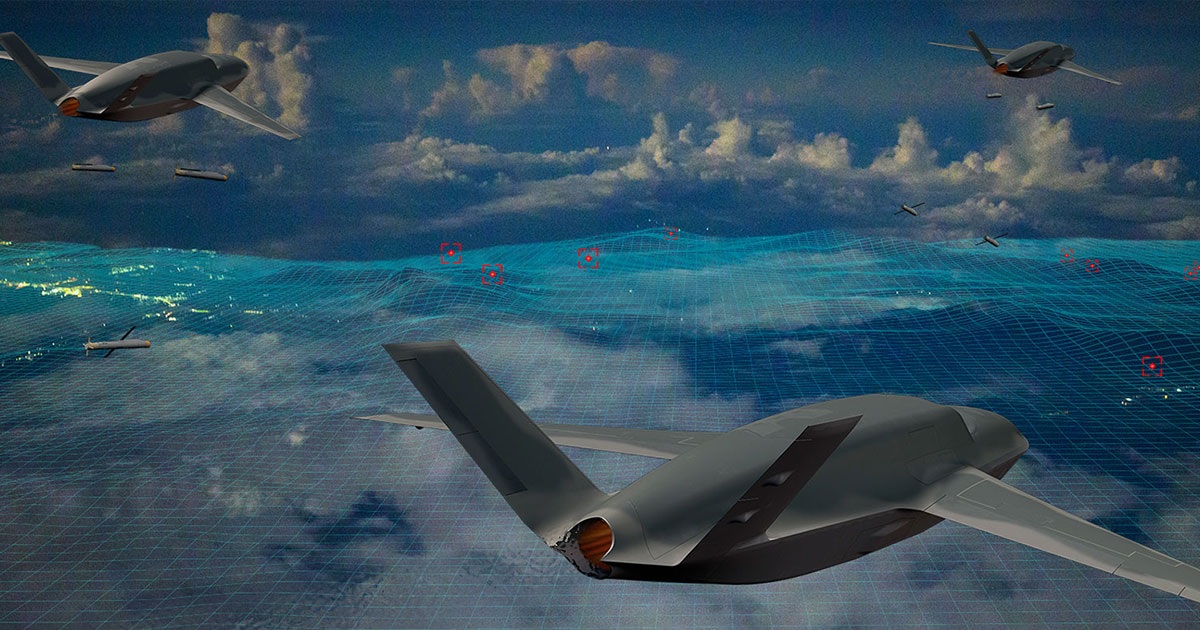
WASHINGTON : General Atomics Aeronautical Systems Inc. has unveiled Gambit 6, the latest and most combat-oriented variant in its rapidly evolving Gambit Series of modular uncrewed aircraft, marking a significant step in the global race to deploy autonomous combat airpower at scale.
Developed by General Atomics Aeronautical Systems (GA-ASI), Gambit 6 is designed specifically for air-to-ground combat operations under the emerging Collaborative Combat Aircraft (CCA) concept. The platform blends high-end autonomy, artificial intelligence–driven mission systems, and a mature weapons-integration architecture to deliver what the company describes as “affordable mass” for future high-intensity conflicts.
A New Role in the Gambit Family
Gambit 6 represents a clear shift toward strike-focused missions within the broader Gambit ecosystem. While earlier Gambit variants emphasized multi-mission adaptability, Gambit 6 is optimized from the outset for precision attack, suppression of enemy air defenses (SEAD), and battlefield strike support.
The aircraft is designed to operate seamlessly alongside both crewed fighter jets and other uncrewed platforms, functioning as a loyal wingman, forward strike asset, or independent attack system depending on mission requirements. GA-ASI officials say the modular design allows the aircraft to be rapidly reconfigured for different payloads, sensors, and weapons without major structural changes.
Advanced Autonomy and AI at the Core
At the heart of Gambit 6 is a next-generation autonomy stack that enables the aircraft to plan routes, avoid threats, coordinate with other aircraft, and adapt to changing battlefield conditions with minimal human input. Artificial intelligence (AI) is used not only for navigation and formation flying, but also for sensor fusion, target recognition, and mission execution.
Despite its advanced autonomy, Gambit 6 is designed to remain under human command authority, with operators able to supervise multiple aircraft simultaneously, approve weapons release, and retask missions in real time.
Proven Weapons Integration
One of the distinguishing features of Gambit 6 is its reliance on GA-ASI’s proven experience integrating complex weapon systems across multiple uncrewed aircraft platforms. The aircraft is expected to support a wide range of air-to-ground munitions, including precision-guided bombs, stand-off weapons, and modular mission payloads tailored to specific operational needs.
This approach significantly reduces development risk and shortens the timeline from concept to operational deployment, a key priority for air forces seeking rapid capability expansion.
Built for Affordable Mass
Gambit 6 is explicitly designed to be cost-effective when compared with traditional crewed combat aircraft. By emphasizing modularity, digital engineering, and scalable production, GA-ASI aims to enable air forces to field larger numbers of combat-capable aircraft without the financial and logistical burden associated with fifth-generation fighters.
Defense analysts note that this philosophy aligns closely with evolving U.S. and allied airpower strategies, which increasingly prioritize survivability through numbers, force dispersion, and man–machine teaming, rather than reliance on a small fleet of highly exquisite platforms.
Global Market and Strategic Implications
Although closely aligned with U.S. Air Force CCA concepts, Gambit 6 is being positioned for the global defense market. GA-ASI has indicated that the platform can be adapted to meet export requirements and integrated into a wide range of command-and-control architectures used by allied and partner nations.
The introduction of Gambit 6 comes amid intensifying international competition in autonomous combat aviation, as major powers invest heavily in uncrewed strike systems capable of operating in highly contested airspace.
A Glimpse of Future Airpower
With Gambit 6, GA-ASI is signaling that autonomous combat aircraft are moving beyond experimental concepts into mission-specific, production-ready platforms. If adopted at scale, systems like Gambit 6 could fundamentally reshape air-to-ground combat operations, combining human decision-making with AI-enabled speed, endurance, and battlefield adaptability to help secure the skies of future conflicts.