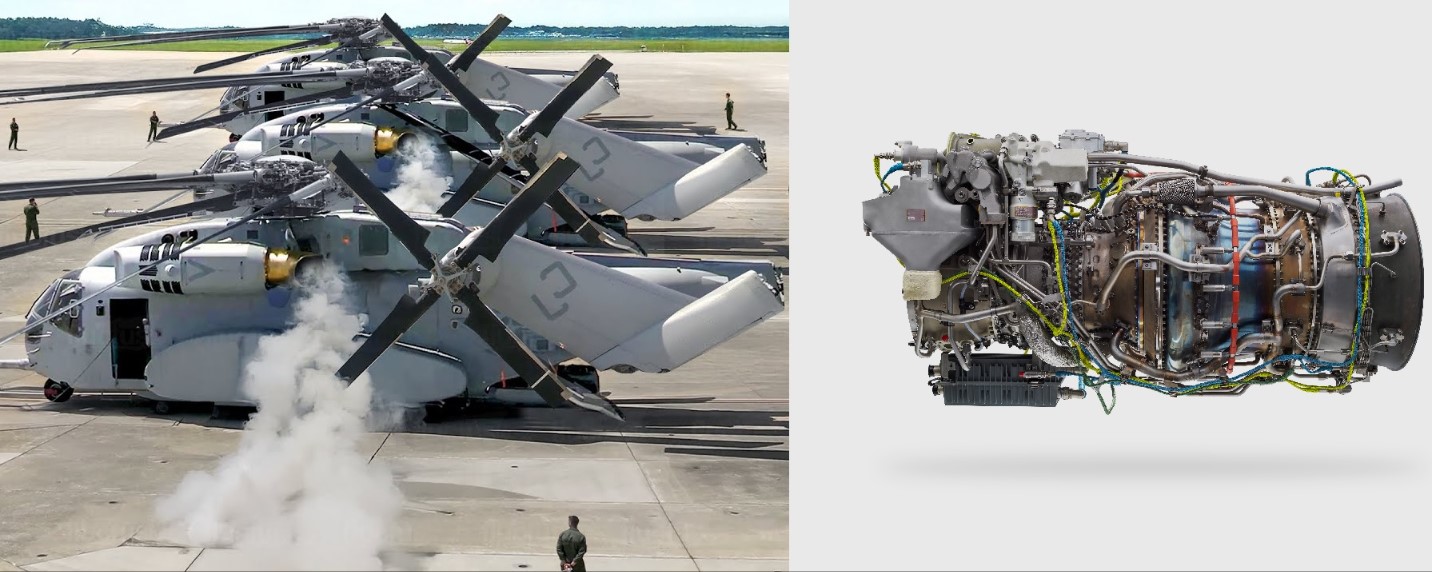
Washington / Lynn, Massachusetts : GE Aerospace has been awarded a $1.4 billion multi-year contract by the Naval Air Systems Command to supply Lots 9–13 of its T408 turboshaft engines, strengthening long-term propulsion support for the U.S. Marine Corps’ most advanced heavy-lift helicopter, the Sikorsky CH-53K King Stallion.
The award continues a series of production and sustainment agreements for the programme, building on six previous contracts and following the $684 million Lot 6–8 block-buy announced in April 2023. Under the new deal, GE Aerospace will deliver new-production engines, spare engines, and a comprehensive package of sustainment services, with final assembly conducted at the company’s historic Lynn, Massachusetts facility.
The contract underlines the U.S. Navy’s and Marine Corps’ commitment to accelerating fleet fielding and readiness of the CH-53K, which is designed to operate from austere forward bases and ship decks while supporting expeditionary and distributed maritime operations.
Powering the Marine Corps’ Heavy-Lift Backbone
The CH-53K King Stallion is the Marine Corps’ next-generation heavy-lift platform, engineered to replace the legacy CH-53E. Capable of lifting 36,000 pounds, conducting aerial refuelling, and executing a broad spectrum of assault support missions, the aircraft is central to moving heavy equipment, vehicles, and supplies in contested environments. The helicopter achieved Initial Operating Capability (IOC) in April 2022, marking a key milestone in Marine Corps aviation modernisation.
Each CH-53K is powered by three T408 engines, collectively delivering unprecedented lift and endurance. Each T408 produces 7,500 shaft horsepower, representing a 57 per cent increase in power over its predecessor, the GE Aerospace T64, while simultaneously improving efficiency and durability. This leap in performance enables the CH-53K to provide three times the range and payload capacity of the CH-53E Super Stallion, significantly expanding operational reach.
Efficiency, Durability and Life-Cycle Savings
Beyond raw power, the T408 was designed with life-cycle affordability and maintainability as core objectives. Compared with the T64, the engine achieves 18 per cent better specific fuel consumption, translating into substantial fuel and sustainment cost savings across decades of service.
The design also incorporates 63 per cent fewer parts, reducing maintenance complexity and downtime. Advanced engineering features include a ruggedised compressor with erosion-resistant coating and a split-case architecture, improving inspection access, repairability, and overall aircraft availability—critical metrics for expeditionary forces operating far from established logistics hubs.
Industrial Footprint and International Partnership
While final assembly takes place in Lynn, the T408 programme supports a broad U.S. industrial base. Key GE Aerospace manufacturing and supply sites involved include Hooksett, New Hampshire; Rutland, Vermont; Madisonville, Kentucky; Dayton, Ohio; and Jacksonville, Florida, underscoring the programme’s nationwide economic footprint.
The engine is also supported by an international partnership. Germany-based MTU Aero Engines manufactures the power turbine, reinforcing transatlantic defence-industrial cooperation in support of NATO and allied forces operating the CH-53K.
Industry and Programme Significance
Commenting on the award, Scott Snyder, Heavy Lift Engines Program Director at GE Aerospace, said the contract reflects sustained confidence in the T408’s performance. “This latest contract is a testament to the T408’s ability to deliver the power, durability and efficiency the Marine Corps depends on,” he said, adding that GE Aerospace is “honoured to support the CH-53K and the critical mission it performs for Marines, joint forces and allies around the globe.”
As CH-53K production ramps up and additional squadrons transition to the new platform, the Lot 9–13 contract ensures continuity in engine supply and long-term sustainment. For GE Aerospace, the deal reinforces its position as a cornerstone supplier to U.S. military aviation, while for the Marine Corps, it secures the propulsion backbone of a helicopter fleet designed to meet the demands of high-end conflict and global crisis response well into the coming decades.