First Saudi Multi-Mission Surface Combatant Enters the Water After Years of Delay
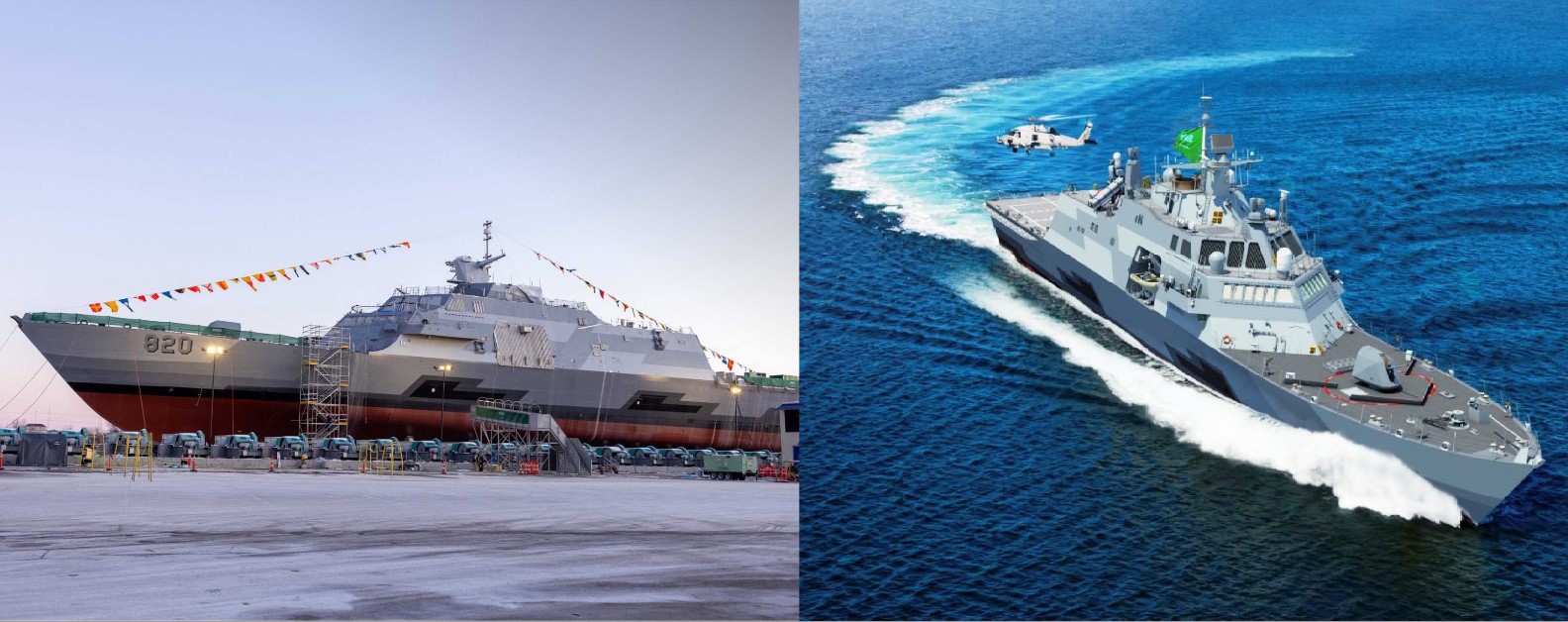
The first of four Multi-Mission Surface Combatant (MMSC) warships being built for the Royal Saudi Naval Forces (RSNF) under Project Tuwaiq has formally entered the water, marking a long-awaited milestone in one of Saudi Arabia’s most ambitious naval modernisation programmes.
The first-of-class vessel, HMS Saud (820), was launched at the Fincantieri Marinette Marine shipyard in Wisconsin following a blessing ceremony held on 13 December 2025. Although the ship was rolled out from its construction shed to the waterfront on 27 October 2025, ship-spotter imagery confirms that HMS Saud actually floated for the first time on 20 December 2025, using the yard’s newly installed syncrolift system.
Naval sources indicate this is the first vessel ever launched using the new syncrolift, a major infrastructure investment originally intended to support the now-cancelled Constellation-class frigate programme of the US Navy.
Project Tuwaiq and Saudi Naval Modernisation
Speaking at the ceremony, RSNF Chief of Naval Staff Lieutenant General Mohammed Al-Ghuraibi described Project Tuwaiq as a strategic cornerstone in Saudi Arabia’s drive to build a modern, professional, and technologically advanced naval force. He emphasised that the programme integrates advanced combat systems, alongside training and qualification initiatives, to ensure the RSNF can safeguard Saudi Arabia’s strategic interests and vital maritime routes.
According to the RSNF, the new combatants will significantly enhance the Kingdom’s ability to conduct multi-domain naval warfare, enabling effective engagement against aerial, surface, and subsurface threats across the Red Sea and Arabian Gulf.
The four-ship MMSC programme is being procured by the Kingdom of Saudi Arabia through a Foreign Military Sales (FMS) agreement signed in May 2017. The vessels are intended to form the backbone of the recapitalised RSNF Eastern Fleet, part of the broader Saudi Naval Expansion Program II.
Under the programme structure, Lockheed Martin serves as prime contractor, while Gibbs & Cox is responsible for the functional ship design. Fincantieri Marinette Marine is tasked with ship construction, integration, and launch activities. The FMS case also includes RSNF crew training, as well as shore-based support, training systems, and combat-system integration.
Design Origins and Combat Capability
The MMSC design is derived from the US Navy’s Freedom-variant Littoral Combat Ship (LCS), retaining the same 118-metre hull and combined diesel and gas (CODAG) propulsion system. However, unlike the US Navy’s modular LCS concept, the Saudi variant adopts a fully integrated, permanent multi-mission combat system.
At the heart of the ship’s air-defence capability is MBDA’s Sea Ceptor system, employing Common Anti-air Modular Missile (CAMM) interceptors. These are quad-packed into an eight-cell Mk 41 Vertical Launch System, providing 32 ready-to-fire missiles for local and area air defence. Surface-strike capability is delivered by two quad launchers for Boeing Harpoon anti-ship missiles, while close-range protection includes two Nexter Narwhal 20 mm remote weapon stations.
Additional enhancements over the baseline LCS include the integration of Saab’s Ceros 200 fire-control radar and Indra’s Rigel electronic support measures (ESM) system, significantly improving target tracking, electronic warfare awareness, and engagement precision.
Equipment shared with the late-build Freedom-variant LCS includes the Lockheed Martin COMBATSS-21 combat management system, derived from the Aegis Common Source Library, and the Hensoldt TRS-4D multimode surveillance radar. The ship is also armed with BAE Systems’ Mk 110 57 mm medium-calibre naval gun, the Raytheon Mk 15 Mod 31 SeaRAM for inner-layer missile defence, and Lockheed Martin’s ALEX 130 mm decoy launching system for soft-kill protection.
The MMSC features a full-capability flight deck and hangar, designed to operate one MH-60R Seahawk helicopter, alongside support for unmanned aerial vehicles (UAVs). Saudi Arabia has separately acquired 10 MH-60R helicopters through another FMS case, providing the RSNF with advanced anti-submarine warfare (ASW), anti-surface warfare (ASuW), and maritime surveillance capabilities.
Years of Delay and Revised Timelines
Despite the successful launch of HMS Saud, the MMSC programme remains several years behind its original schedule. Initial plans called for all four ships to be delivered to the US Navy’s NAVSEA International Small Combatants programme office (PMS 525) by the end of 2025.
However, deliveries slipped due to a combination of Covid-19-related shipyard disruptions, workforce shortages, the extended time required to finalise the MMSC design, and customer-driven design changes requested by Saudi Arabia. Industry sources now expect a phased delivery schedule extending beyond 2026, as outfitting, combat-system integration, and trials continue.
Strategic Significance
The entry of HMS Saud (820) into the water represents more than a shipyard milestone. It signals tangible progress in a programme critical to Saudi Arabia’s maritime security posture, particularly as regional naval competition intensifies. Once fully operational, the four MMSC warships are expected to provide the RSNF with a modern, networked, and heavily armed surface combatant force, capable of sustained operations across contested sea lanes.
As harbour trials and systems integration move forward in 2026, attention will now shift to how quickly Project Tuwaiq can transition from delayed construction to operational deployment, reshaping the future balance of naval power in the region.
✍️ This article is written by the team of The Defense News.