Finland Successfully Transmits Electricity Through Air Using Sound and Laser Beams
HELSINKI : In a breakthrough that redefines how electricity can be delivered, scientists in Finland have successfully transmitted electric power through open air without using physical wires, demonstrating a new generation of contactless energy technologies based on sound, light and radio waves.
Researchers from University of Helsinki and University of Oulu revealed that controlled electric transmission is possible by shaping the air itself, rather than relying on traditional copper cables. The findings, disclosed in January 2026 through university research briefings, position Finland at the forefront of experimental wireless energy systems.
Sound Waves That Act Like Invisible Wires
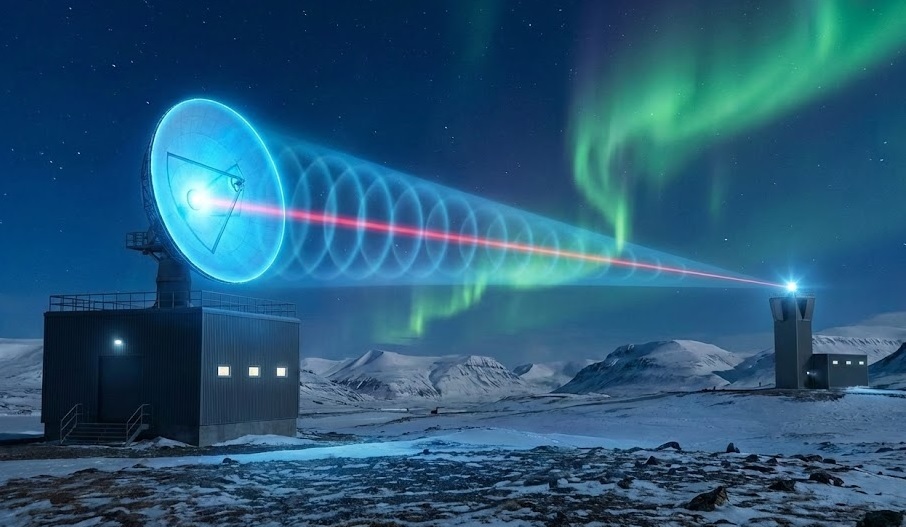
At the heart of the research is a concept scientists describe as an “acoustic wire.” Using high-intensity ultrasonic sound waves, researchers were able to manipulate air density in precise patterns, creating invisible channels through which electrical sparks could travel in a controlled manner.
Unlike conventional wireless charging, which relies on short-range electromagnetic fields, the acoustic method actively guides electricity along a defined path. The ultrasonic beams compress and rarefy the air, forming a temporary conduit that directs tiny electrical discharges safely through open space.
Scientists emphasized that the electricity is not freely floating or uncontrolled. Instead, it follows a sound-defined route, behaving much like a wire that exists only for a fraction of a second. While the energy levels remain modest, the experiment demonstrates unprecedented control over electrical movement without physical contact.
Laser Power and “Electricity by Light”
Parallel to the acoustic work, Finnish researchers and private-sector partners are advancing “power-by-light” systems that use lasers to deliver electricity to remote receivers. In these setups, high-powered laser beams transmit energy across distance, where specialized photovoltaic cells convert the light back into electrical current.
This method offers a critical advantage: complete galvanic isolation. Because there is no physical electrical connection, laser-based power delivery can be used safely in high-risk environments, including nuclear facilities, high-voltage substations and hazardous industrial zones.
Although efficiency is currently lower than wired systems, researchers say the technology is already viable for niche applications requiring extreme safety and reliability.
Harvesting Power From the Air Itself
The third pillar of Finland’s research focuses on radio-frequency energy harvesting. Instead of transmitting new power, these systems collect microwatts of energy already present in the environment from radio, cellular and Wi-Fi signals.
By combining ultra-efficient antennas and advanced power-management circuits, researchers have shown that ambient radio waves can power low-energy devices such as environmental sensors, industrial monitors and smart infrastructure components. The approach could significantly reduce dependence on disposable batteries, particularly across large Internet-of-Things networks.
Scientists describe the concept as “Wi-Fi for power,” where electricity is gathered continuously rather than delivered in bursts.
Not Science Fiction, but Precision Physics
Researchers are careful to clarify that the experiments do not violate the laws of physics. The systems do not provide unlimited electricity at any distance, nor do they replace the power grid. Instead, the breakthrough lies in precision control.
Ultrasonic waves guide electric fields, lasers convert light into usable current, and radio systems recycle existing energy. Together, they demonstrate that electricity can be shaped, directed and delivered through air in ways previously considered impractical outside the laboratory.
A Step Toward Cable-Free Infrastructure
While still experimental, the implications are far-reaching. Future applications could include plug-free electronics, self-powered industrial sensors, contactless connectors in robotics, and safer power delivery in extreme environments.
By combining sound, light and radio technologies into a single research framework, Finland has emerged as one of the first countries to demonstrate multiple working methods of air-based electricity transmission at once.
Scientists involved in the project say the work does not signal the end of wires, but it does mark the beginning of a more flexible, cable-free layer of electrical infrastructure — one where power moves safely through air, guided by physics rather than copper.
About the Author
Aditya Kumar:
Defense & Geopolitics Analyst
Aditya Kumar tracks military developments in South Asia, specializing in Indian missile technology and naval strategy.