Estonia acquire South Korea’s K239 Chunmoo to Complement HIMARS
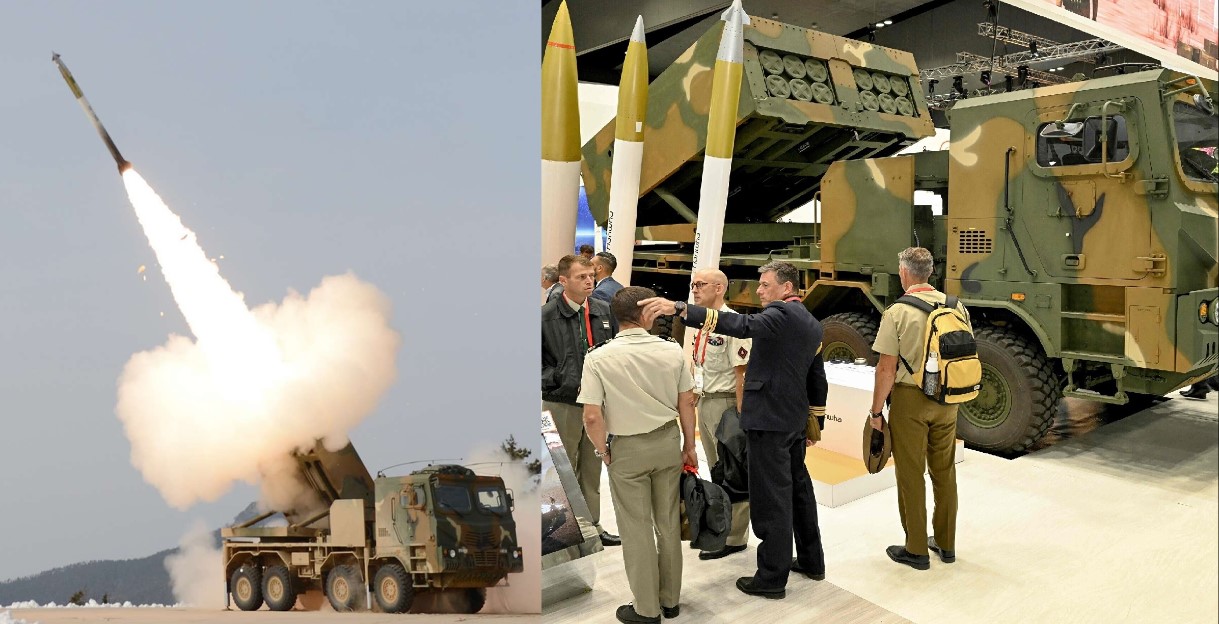
Estonia has signed a defense cooperation agreement in Seoul to acquire South Korea’s K239 Chunmoo multiple rocket launchers, signaling a significant expansion of its long-range fires capabilities. This move complements the U.S.-made HIMARS already in service, enhancing Estonia’s deterrence posture on NATO’s eastern flank while deepening defense-industrial ties across Europe and Asia.
The agreement, confirmed by Estonia’s Ministry of Defense, follows the spring 2025 delivery of six HIMARS vehicles and ongoing discussions to expand that fleet. Tallinn emphasizes that Chunmoo will not replace HIMARS but will operate alongside it, providing commanders with flexible options for both high-volume and precision fires.
Chunmoo: Flexibility and Firepower
The K239 Chunmoo system is prized for its mechanical simplicity and payload flexibility. Mounted on an 8×8 wheeled chassis, each launcher carries two sealed pods, which can be configured according to mission requirements.
In a high-volume fires role, a Chunmoo vehicle can fire up to 40 × 131 mm rockets for area suppression, reaching targets approximately 36 kilometers away. For precision strikes, it can deploy 12 × 239 mm GPS/INS-guided rockets with ranges around 80 kilometers, available with unitary or submunition warheads.
The launcher architecture is also compatible with the CTM-290, a 600 mm-class tactical missile derived from South Korea’s KTSSM family, offering a potential strike range of 290 kilometers. This enables a single launcher to switch from battalion-support fires to deep interdiction if export approvals, integration, and stockpiles align.
Chunmoo’s versatility makes it attractive for smaller militaries like Estonia’s, which benefit from a system that can deliver both massed salvos and precise strikes without fielding multiple specialized launchers.
HIMARS vs. Chunmoo: Two Rhythms of Fire
Estonia’s HIMARS fleet operates on a different principle. The 6×6 truck carries a single pod capable of six GMLRS rockets or one ATACMS missile, with extended-range GMLRS reaching 150 kilometers and ATACMS up to 300 kilometers. HIMARS is tightly integrated into NATO’s digital fires networks, offering precision and proven sustainment pathways.
By combining HIMARS and Chunmoo, Estonia gains two complementary rhythms of fire: HIMARS for precise, networked strikes interoperable with allied forces, and Chunmoo for larger salvoes and potentially national deep-strike options. This mix enhances operational flexibility and hedges against supply-chain or munitions constraints.
Industrial and Strategic Implications
The Seoul agreement also emphasizes localization and industrial cooperation, injecting tens of millions of euros into Estonia’s defense industry. This mirrors Poland’s “dual-track” model of mixing American and Korean launchers while nurturing local production capabilities, ensuring both operational autonomy and economic benefit.
Strategically, Chunmoo strengthens Estonia’s deterrence posture on NATO’s frontline, providing both massed fires and precision options. The potential integration of CTM-290 tactical missiles further expands the country’s reach, though these options remain contingent on regulatory approval and integration work.
Observers will watch closely how Estonia balances its HIMARS and Chunmoo fleets, particularly in training, fire-control integration, and industrial development. The eventual choice to deploy deeper-strike missiles like the CTM-290 could reshape Estonia’s role in NATO’s long-range fires strategy, offering a rare combination of flexibility, interoperability, and national autonomy in a compact, capable package.
By adding Chunmoo to its arsenal, Estonia signals a clear intent: to bolster NATO’s eastern flank with adaptable, potent, and industry-linked firepower, ensuring that both deterrence and operational effectiveness are strengthened for years to come.
About the Author
Aditya Kumar:
Defense & Geopolitics Analyst
Aditya Kumar tracks military developments in South Asia, specializing in Indian missile technology and naval strategy.