Egyptian Navy Renews In-Service Support Deal With Naval Group, Deepening Long-Term Partnership
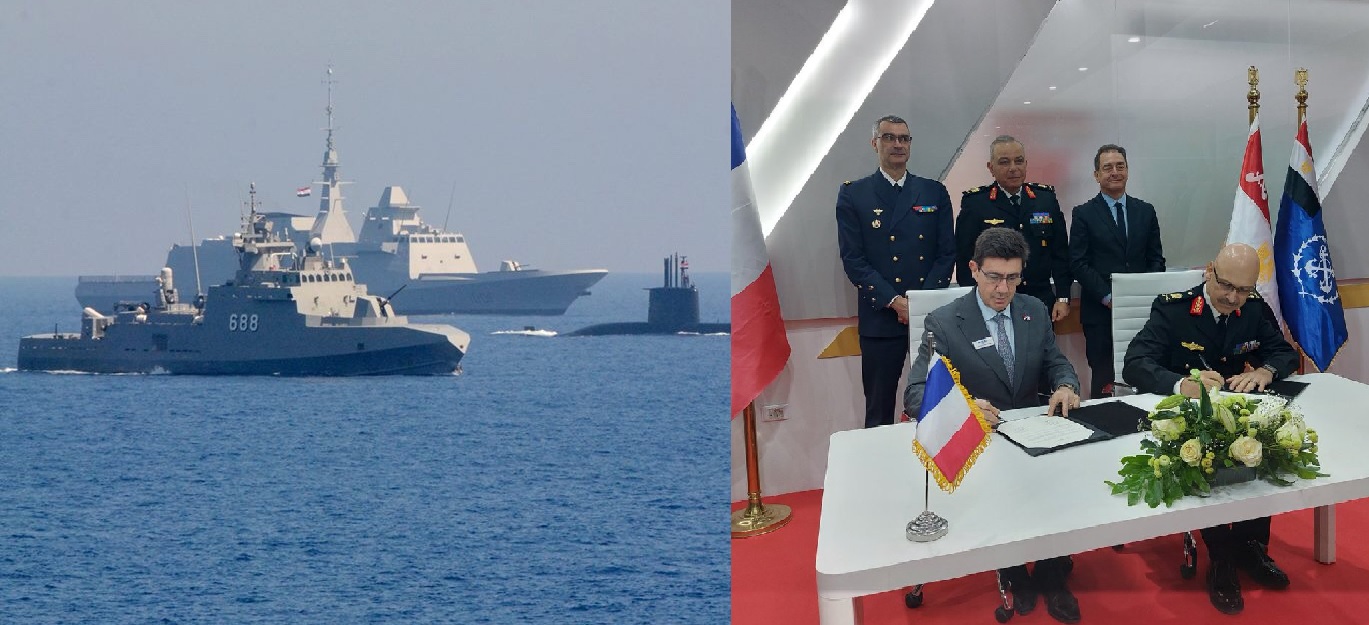
The Egyptian Navy has renewed its contract with French shipbuilder Naval Group for the in-service support (ISS) of the major surface combatants the company has supplied to Egypt, in a move aimed at keeping the fleet at high readiness and extending the two sides’ industrial partnership.
According to Naval Group, the new agreement is an extension of the ISS contract that has been in force since 2019 and will run for another five years. Over this period, mixed teams of engineers and technicians will provide maintenance and support for seven key vessels in Egyptian service: the FREMM multi-mission frigate Tahya Misr, the two Mistral-class Egyptian Landing Helicopter Docks (E-LHDs) Gamal Abdel Nasser and Anwar El Sadat, and the four Gowind 2500 corvettes El Fateh, Port Said, El Moez and Al Ismailia.
Naval Group said the renewal “strengthens their collaboration focused on fleet availability” – meaning the core objective is to keep these high-value ships at sea as much as possible, fully mission-capable and ready for deployment.
What The In-Service Support Deal Actually Covers
In-service support goes far beyond simple repairs. Under the renewed contract, Naval Group will be responsible for a wide spectrum of activities connected to keeping the ships at a high operational standard, including:
-
Planned preventive maintenance on critical systems such as propulsion, combat management, sensors, weapons and mission systems.
-
Corrective maintenance and repairs when faults occur, often with OEM (original equipment manufacturer) expertise that local yards alone may not provide.
-
Provision of spare parts and logistics support, ensuring parts pipelines and inventories are aligned with actual usage and deployment patterns.
-
Upgrades and modernisation packages over the life of the vessels, integrating new sensors, weapons, electronic warfare and communication suites as technologies evolve.
-
Technical assistance and training for Egyptian Navy personnel and local industry, so more tasks can gradually be performed in-country.
For Egypt, this type of long-term ISS framework is designed to avoid the “boom-and-bust” cycle of buying advanced ships and then struggling to maintain them. Instead, it locks in predictable support for complex platforms such as the FREMM frigate, which combines advanced radar, anti-submarine warfare (ASW) sonars and long-range surface-to-air and anti-ship missiles, and the Gowind 2500 corvettes, tailored for multi-mission roles in the Mediterranean and Red Sea.
A Decade-Long Collaboration Now Anchored in Egypt
The renewed ISS contract is the latest step in a partnership that has been developing for roughly a decade. Egypt first turned to Naval Group (then DCNS) in 2014 with a contract for four Gowind 2500 corvettes. The first-of-class, El Fateh, was built in Lorient, France, and delivered in 2017, while subsequent ships were built under a technology transfer agreement at Alexandria Shipyard.
In parallel, Cairo acquired:
-
One FREMM multi-mission frigate, Tahya Misr, delivered in 2015.
-
Two Mistral-class landing helicopter docks, Gamal Abdel Nasser and Anwar El Sadat, delivered in 2016.
To support these ships over their service life, Naval Group and the Egyptian Navy signed a first five-year ISS agreement around the time of EDEX 2018, Egypt’s defence exhibition. The French company then created a dedicated subsidiary in Alexandria – Alexandria Naval for Maintenance and Industry (ANMI) – tasked with local support for the FREMM, the two LHDs and the Gowind corvettes, and with carrying out future upgrades.
The new five-year extension essentially keeps that arrangement in place and expands it. Naval Group says it will grow its Egyptian workforce, creating more local jobs in engineering, maintenance and logistics, and is in talks to bring in additional Egyptian suppliers to participate in ship support work.
Focus on Fleet Availability And Future Upgrades
By renewing the ISS contract, both sides are signalling that fleet availability – how often the ships are actually ready to deploy – is as important as the initial acquisition. The vessels covered by the deal form a large share of the Egyptian Navy’s modern surface fleet, used for:
-
Securing sea lines of communication through the Suez Canal and Eastern Mediterranean.
-
Power projection and amphibious operations via the Mistral-class LHDs.
-
Maritime security, anti-submarine warfare and air defence in regional waters via the FREMM and Gowind classes.
Recent reporting also indicates that Egypt and Naval Group have been exploring capability upgrades, particularly enhanced ASW systems for the Gowind corvettes – an area where an active ISS framework makes it easier to integrate new sensors and weapons during scheduled maintenance periods rather than as one-off projects.
Naval Group’s CEO Pierre Eric Pommellet described the extension as a continuation of a “long-lasting partnership” with Egypt, under which the company not only supports the fleet but also develops Egyptian industrial and human capital in naval engineering.
Strategic Signal in the Mediterranean
Beyond the technical and industrial aspects, the renewed ISS contract carries a clear strategic message. For France, it confirms Naval Group’s role as a key naval partner in the Eastern Mediterranean and Red Sea, backing a regional navy that has rapidly modernised over the past decade. For Egypt, it ensures that some of its most modern ships remain combat-ready, with factory-level support and access to upgrades over the medium term rather than being left to age without proper backing.
In practical terms, the deal means that for at least the next five years, the FREMM Tahya Misr, the two Mistral-class LHDs and the four Gowind corvettes will be supported under a common framework linking Egyptian crews, Alexandria Shipyard, Naval Group’s local subsidiary and the company’s engineering base in France – with the shared goal of keeping the Egyptian Navy’s flagship assets ready for operations at short notice.
About the Author
Aditya Kumar:
Defense & Geopolitics Analyst
Aditya Kumar tracks military developments in South Asia, specializing in Indian missile technology and naval strategy.