Diehl Defence and Lockheed Martin Sign MoU to Integrate IRIS-T Missiles Into Aegis and MK41 Systems
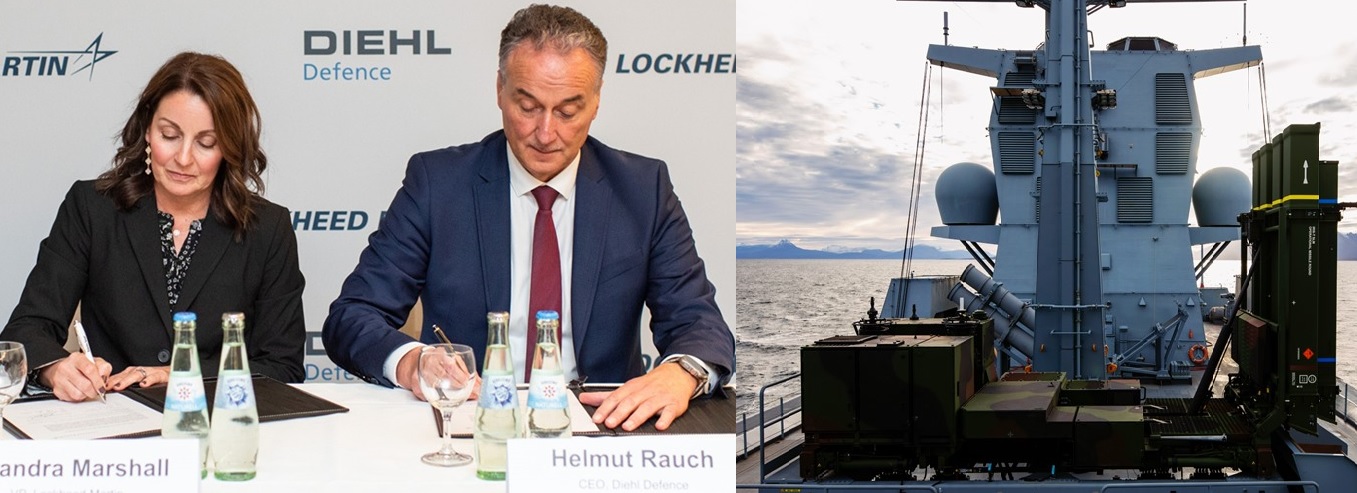
At the 2025 Berlin Security Conference, a major step toward expanding Europe’s air-defence capabilities was announced as Diehl Defence CEO Helmut Rauch and Lockheed Martin Vice President Chandra Marshall signed a Memorandum of Understanding (MoU). The agreement, unveiled at the conference venue, sets the stage for a detailed feasibility study on integrating the IRIS-T family of guided missiles into the Aegis Weapon System and the widely used MK41 vertical launch system (VLS).
The MoU follows a Letter of Intent (LoI) signed the previous day, signaling growing transatlantic cooperation on integrated air and missile defence (IAMD) technologies.
A New Phase of Missile Integration
According to both companies, the first stage of the cooperation will focus on integrating the IRIS-T SLM, the medium-range variant already in service with several European forces. Looking ahead, the partners intend to explore integration of HYDEF, a next-generation hypersonic interceptor under development with support from the European Defence Fund (EDF).
Rauch told journalists after the signing that integration of the IRIS-T SLM into Aegis and MK41 could be achieved within ten months, drawing from experience already gained during trials of IRIS-T SLM on Germany’s Type 125 frigates. He confirmed Diehl is prepared to proceed immediately once a customer places an order.
Other missile variants — including the IRIS-T SLS (short-range) and the future IRIS-T SLX (extended-range) — may also be evaluated if navies express interest.
F127 Frigates Seen as Key Candidate
One platform expected to benefit from the integration is the German Navy’s future F127 air-defense frigate, which will become Germany’s first warship equipped with the Aegis Combat System. The F127 will feature the MK41 VLS and Raytheon’s SPY-6 radar, forming part of a U.S. Navy Program of Record.
Rauch downplayed concerns about compatibility, stating that both IRIS-T SLM and the developing HYDEF interceptor should integrate smoothly, requiring little more than software adjustments. The missile’s IR seeker, he noted, requires no redesign.
He also confirmed that several other European navies have shown interest in adopting IRIS-T SLM for their surface fleets, though he stopped short of naming specific countries.
No Technical Obstacles Expected
Both Diehl and Lockheed Martin stressed that no significant technical barriers are expected in integrating IRIS-T into Aegis. Initial computer-based integration simulations have already been conducted, with positive results. Their decades of cooperation — especially in missile systems such as Patriot and earlier IRIS-T programs — provide a strong industrial foundation.
Chandra Marshall underscored that Aegis’ open-architecture design enables it to interface with both U.S. and non-U.S. effectors and sensors. She noted that the integration process would likely rely on Lockheed Martin’s SPY-7 radar and existing infrastructure, with a smaller, containerized Aegis test system shipped to Germany for live integration and validation. The outcomes would then be applied to larger Aegis installations worldwide.
Integration Into the MK70 Launcher Also Planned
In addition to naval MK41 integration, the MoU also includes exploratory work on fitting IRIS-T missiles to the MK70 launcher, a containerized version of the MK41 for land-based or shipboard use.
The MK70 is designed to fire not only air-defence missiles but also larger munitions such as the surface-launched Tomahawk. This opens the possibility for smaller ships — including corvettes and offshore patrol vessels without built-in VLS — to deploy modern air-defence missiles like the IRIS-T SLM.
Advancing Europe’s Air-Defence Architecture
The agreement aligns with Europe’s broader push to modernize air and missile defence in response to evolving threats such as drones, loitering munitions, ballistic missiles, and hypersonic systems. Integration with Aegis — widely deployed by the U.S., Japan, South Korea, Spain, Norway, and soon Germany — could significantly expand the export potential of the IRIS-T SLM across NATO fleets.
The IRIS-T SLM has already proven itself in combat, particularly in Ukraine, where it has been credited with high success rates against cruise missiles and UAVs.
Statements From Both Companies
Rauch highlighted the strategic importance of the collaboration, saying:
“By combining their expertise and capabilities, Diehl Defence and Lockheed Martin can enable navies worldwide to benefit from the best possible air-defense systems for their surface combat ships.”
Marshall echoed this view, describing the MoU as part of a broader shift toward scalable, next-generation IAMD capabilities:
“This collaboration is further proof of the scalability and increased capacity of our programs, bringing 21st-century security to the world.”
The MoU also comes shortly after both companies signed an agreement to strengthen cooperation on the global supply chain for Patriot missile components — another signal of deepening partnership in high-end defence systems.
The Diehl–Lockheed Martin MoU marks a significant step forward in transatlantic defence integration. If fully implemented, the project could place the IRIS-T missile family alongside major U.S. and allied naval combat systems, giving European fleets more flexible and modern air-defence options.
With the F127 frigates as a likely launch point — and several European navies watching closely — the integration effort could shape the future of NATO maritime air defence for years to come.
About the Author
Aditya Kumar:
Defense & Geopolitics Analyst
Aditya Kumar tracks military developments in South Asia, specializing in Indian missile technology and naval strategy.