DRDO’s Successful 800 km/h Rocket-Sled Test for Fighter Ejection-System Technology, Become World’s 5th Nation
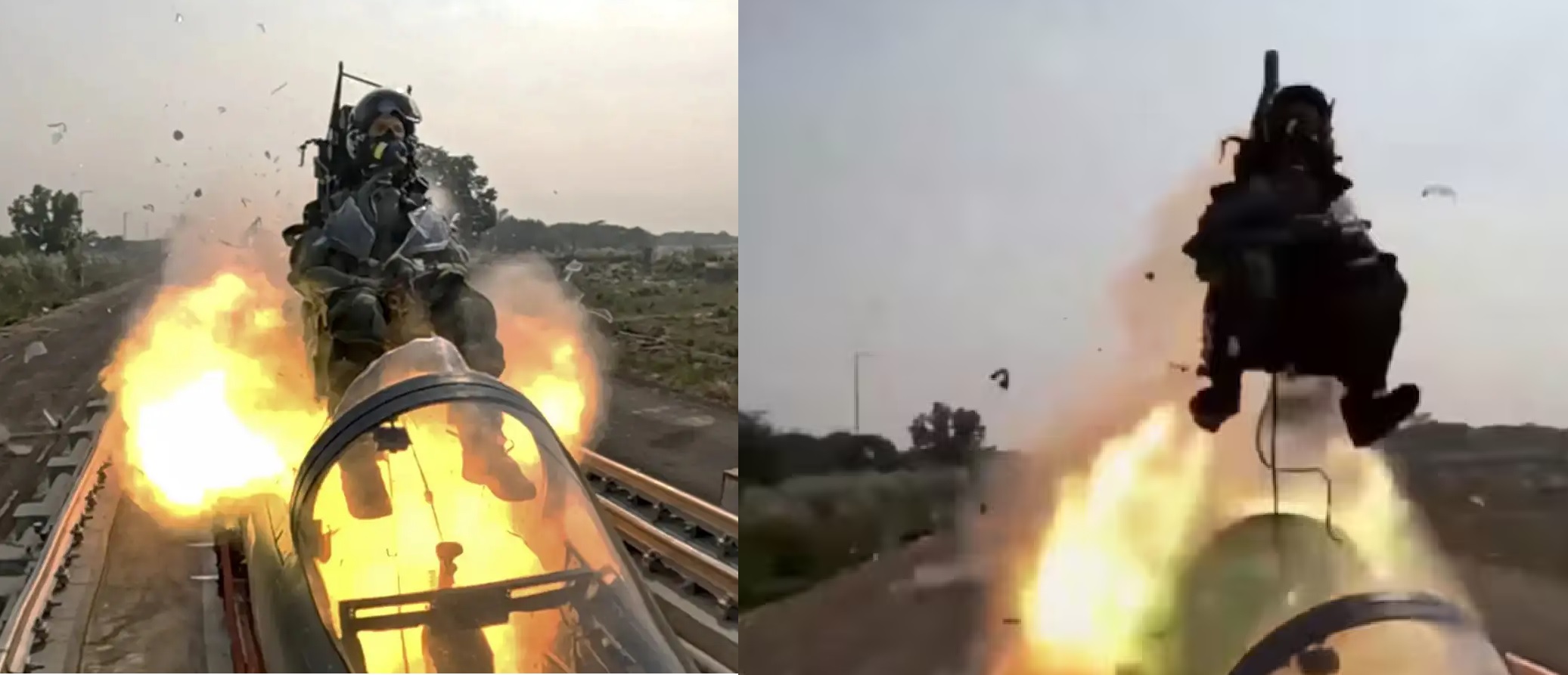
In a landmark achievement for India’s defence-engineering ambitions, the DRDO has successfully carried out a high-speed rocket-sled trial of a fighter-aircraft escape system at 800 km/h. The test was conducted at the Rail Track Rocket Sled (RTRS) facility of the Terminal Ballistics Research Laboratory (TBRL) in Chandigarh.
The success signals a major step toward reducing India’s dependence on foreign ejection-seat systems — most notably built by legacy players such as Martin-Baker — and bolsters India’s credentials in indigenous safety-system development for future combat aircraft.
What happened in the test and why it matters
During the trial, engineers used a rocket-propelled sled to accelerate a test rig to a precisely controlled speed of 800 km/h. The test validated three critical elements of a modern fighter-jet escape system: canopy severance, correct ejection sequencing, and full aircrew recovery via parachute descent, as simulated by an instrumented anthropomorphic test dummy.
Ground- and sled-based instrumentation recorded the loads, accelerations, and mechanical stresses that a real pilot would endure — data that will feed into final qualification, safety certification, and refinement of the system for real-world deployment.
According to the defence ministry, the success of this trial puts India in an “elite club of nations” that possess advanced, in-house capability to test and validate fighter-jet escape systems under high-speed conditions.
Why this is special for India
The achievement holds importance on multiple fronts. First, it marks a concrete stride toward self-reliance in a critical — and life-saving — technology area. Historically, many of India’s combat aircraft have relied on foreign vendors for ejection seats and escape systems — notably the British company Martin-Baker.
Second, by mastering this technology indigenously, India gains the freedom to develop customized escape systems tailored to its own future combat-jet designs, improving strategic autonomy and reducing long-term costs. This also enhances export potential for Indian-built fighter aircraft.
Third, this milestone reinforces the broader push under indigenous defence-manufacturing frameworks to reduce dependence on foreign suppliers across weapons, avionics, and safety systems.
Where India stands on the global map of escape-system capability
Globally, only a handful of nations possess the capability to design, manufacture, and fully test advanced ejection seats and fighter escape systems. For decades, Martin-Baker of the United Kingdom has been the dominant leader in this field, alongside major developers such as Collins Aerospace in the United States, NPP Zvezda in Russia, and specialized aerospace groups in China.
In reality, only five countries have developed complete, indigenous ejection-seat systems: the United Kingdom, the United States, Russia, China, and now India, which enters this elite group with its successful high-speed rocket-sled trials and expanding domestic capability.
With the latest test validating critical escape-system functions, India effectively joins this exclusive global cohort, proving that it now possesses the engineering depth, advanced testing infrastructure, and technological maturity required to stand alongside the world’s established leaders.
What’s Next
While the 800 km/h rocket-sled success is a major milestone, experts caution it is only one step before the system can be certified for operational use. Data collected on canopy break patterns, ejection timing, g-forces, and parachute deployment will guide upcoming refinements.
Further trials — including zero-zero ejections, high-altitude simulations, and potentially full-scale live ejections — will be conducted before integration into real aircraft.
Nevertheless, the road has begun. Officials from the Ministry of Defence, IAF, ADA, and HAL have welcomed the test as a “significant milestone” for India’s indigenous aerospace development.
What this could mean for future Indian jets — and exports
For upcoming indigenous combat aircraft, having an in-house escape system reduces reliance on foreign vendors and sidesteps export restrictions. It also allows customization for Indian pilots and mission requirements.
As India seeks to export aircraft to friendly nations, offering a domestically developed ejection system could become a major selling point, strengthening India’s defence-export profile.
A leap toward self-reliance in pilot safety
The DRDO’s successful rocket-sled test at 800 km/h marks a turning point for India. By mastering critical escape-system technologies — canopy separation, ejection sequencing, and aircrew recovery — India moves closer to reducing dependence on foreign suppliers like Martin-Baker.
This achievement proves India can design and validate complex aerospace safety systems to global standards. As more tests follow, the path toward self-reliance and aerospace export capability grows stronger.
About the Author
Aditya Kumar:
Defense & Geopolitics Analyst
Aditya Kumar tracks military developments in South Asia, specializing in Indian missile technology and naval strategy.