DRDO Transfers Seven Home-Grown Technologies to Indian Armed Forces Under TDF Scheme
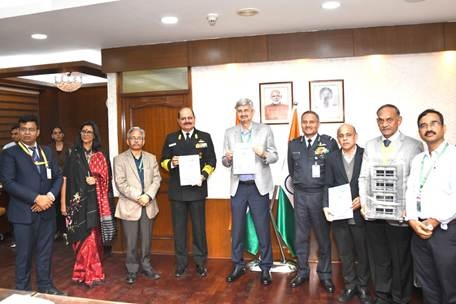
In a major boost to India’s defence self-reliance drive, the Defence Research and Development Organisation (DRDO) has formally handed over seven indigenously developed technologies to the Indian Armed Forces and domestic industry partners under the Defence Ministry’s Technology Development Fund (TDF) scheme. The move strengthens critical capabilities across the Army, Navy, Air Force and tri-service technical programs, while opening doors for large-scale production by Indian companies.
The TDF scheme—managed by DRDO’s Defence Innovation Organisation (DIO)—is designed to support MSMEs, startups and academia in developing cutting-edge systems for the armed forces. Over the past few years, the scheme has accelerated indigenous defence innovation, particularly in niche and high-technology segments traditionally dominated by foreign suppliers.
Strengthening Electronic Warfare, Naval Systems & Energy Technologies
Among the major systems transferred, the Indigenous High-Voltage Power Supply for Airborne Self-Protection Jammers marks a significant leap in India’s electronic warfare capability. Built to support jammer pods on fighter aircraft, the system provides stable high-voltage output under extreme flight conditions. The capability is essential for modern combat aircraft operating in dense radar and missile environments.
For the Indian Navy, two critical technologies were handed over: the Tide-Efficient Gangway for Naval Jetties, designed to improve the stability and safety of personnel movement during varying sea levels; and a fully Indigenous Waterjet Propulsion System for Fast Interceptor Craft, which replaces costly imported propulsion units. Waterjet systems are vital for high-speed coastal security, interception missions, and patrol operations.
Subsurface surveillance systems also received a boost with the delivery of VLF–HF Advanced Switching Matrix Systems and VLF Loop Aerials for underwater platforms. These technologies improve secure long-range communication with submarines and underwater assets—an operational area where India has been rapidly enhancing capacity.
Breakthroughs in Energy & Recycling Technologies
Two of the newly transferred technologies highlight DRDO’s push toward sustainable and long-endurance energy systems. The Long-Life Seawater Battery System, designed for underwater sensors and surveillance nodes, enables persistent, low-maintenance maritime monitoring—critical for anti-submarine warfare and coastal security grids.
Equally notable is a Novel Process for Recovery of Lithium Precursors from Used Li-ion Batteries, developed to strengthen India’s lithium recycling ecosystem. With the global scramble for lithium intensifying, this process enables domestic recovery of essential materials used in missiles, drones, communication equipment, vehicles, and space systems. The innovation aligns with India’s strategic goal of reducing dependency on imported rare materials.
Strong Industry Partnerships Under TDF
DRDO officials emphasized that the technologies were not merely laboratory prototypes but fully developed, evaluated, and transferred to production partners. Under the TDF model, private companies—especially MSMEs—will now scale these systems for operational deployment.
Senior officials noted that these technologies address some of the most pressing requirements of the armed forces, ranging from electronic warfare and coastal defence to underwater communications, propulsion systems, and energy security.
A Step Forward for Atmanirbhar Bharat in Defence
The handover underscores the rapid growth of India’s indigenous defence ecosystem and the government’s push toward Atmanirbhar Bharat. With defence procurement policies increasingly prioritizing Indian content, such technologies will significantly reduce reliance on foreign suppliers and enhance strategic autonomy.
As DRDO continues to develop advanced systems under TDF—spanning robotics, space, materials science, AI, propulsion, and maritime systems—the collaboration between innovators, industry partners, and the armed forces is expected to deliver more indigenous breakthroughs in the coming years.
India’s defence establishment sees the latest technology transfer as a decisive step toward building a self-sustaining, high-technology defence industrial base, supporting both national security and long-term strategic goals.
About the Author
Aditya Kumar:
Defense & Geopolitics Analyst
Aditya Kumar tracks military developments in South Asia, specializing in Indian missile technology and naval strategy.