DRDO Successfully Completes Akash-NG User Evaluation Trials, Missile Meets All PSQR Requirements
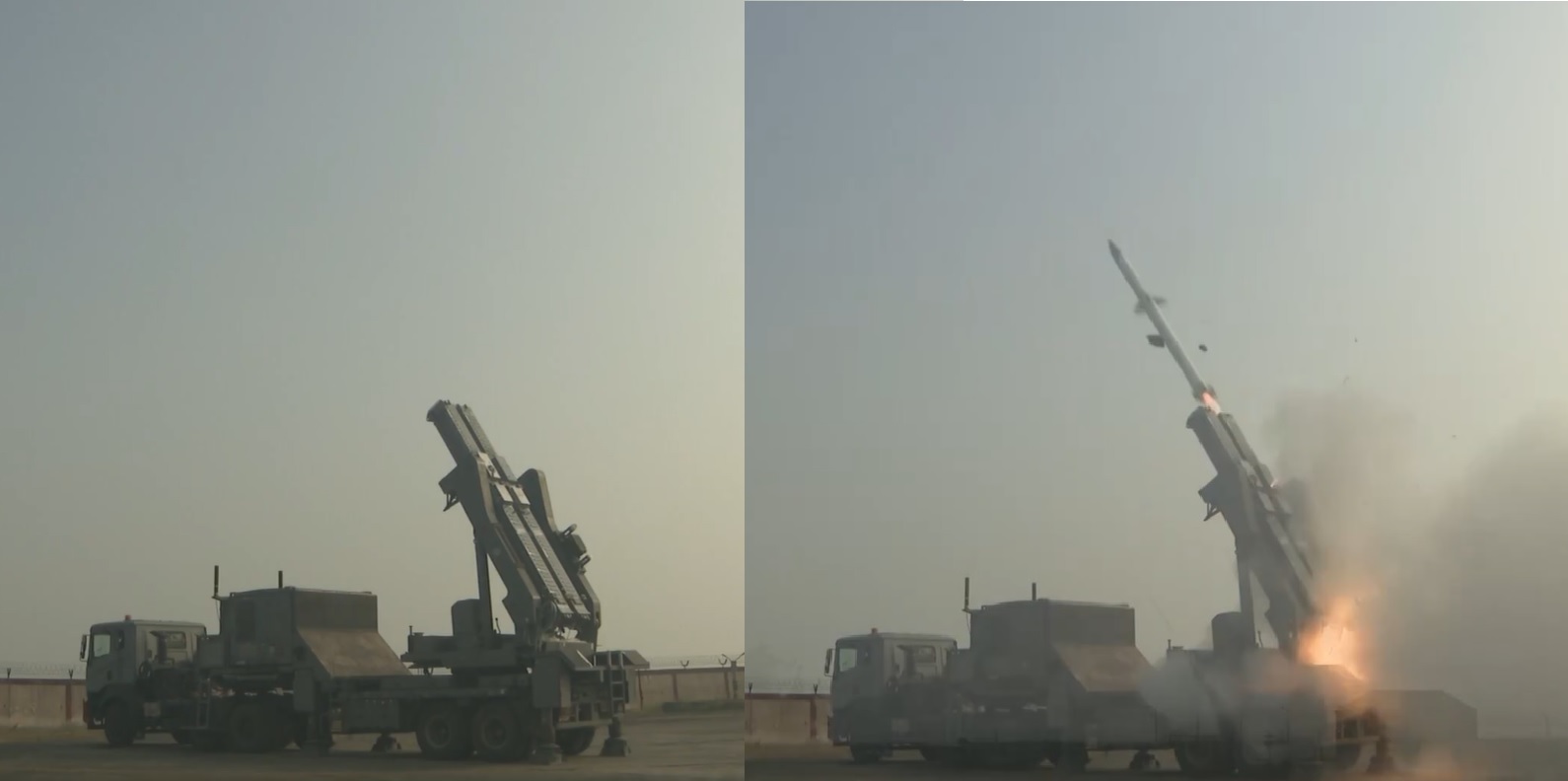
On 23 December 2025, India’s Next-Generation Akash Air-Defence Missile System (Akash-NG) has successfully completed User Evaluation Trials (UET), with the Defence Research and Development Organisation (DRDO) confirming that the system met All Preliminary Staff Qualitative Requirements (PSQR). According to the Ministry of Defence, the missile demonstrated successful interceptions across demanding operational profiles, including Near-Boundary, Low-Altitude engagements and Long-Range, High-Altitude scenarios—conditions designed to replicate real-world threat environments faced by India’s air defenders.
Trials Validate Full Weapon System Under Service Conditions
Officials said the User Evaluation Trials validated the Integrated Performance of all critical system elements, including the Missile Rounds, Multi-Function Radar (MFR), Command-And-Control Unit, and the Mobile Launcher System. The trials were conducted under Service-Representative Conditions, with senior Indian Air Force (IAF) personnel and DRDO Scientists present, signalling that the system has moved beyond developmental testing into an Operational Readiness Phase.
The Defence Minister congratulated DRDO, the IAF and industry partners, stating that the State-Of-The-Art Akash-NG System will significantly enhance India’s Air Defence Capability. DRDO leadership described the successful completion of UET as a Major Milestone that clears the path for Induction Into Service.
What Akash-NG Is Designed To Do
Akash-NG (New Generation) is designed as the successor to the existing Akash Missile Defence System, addressing evolving aerial threats such as Fighter Aircraft, Cruise Missiles, Unmanned Aerial Vehicles (UAVs) and Stand-Off Weapons. The system is equipped with an Indigenous Active Radio-Frequency (RF) Seeker and is propelled by a Solid Rocket Motor, enabling it to engage targets with greater precision, speed and autonomy.
A key technological shift is the move away from the older Ramjet-Based Propulsion of the legacy Akash missile to a Dual-Pulse Solid Rocket Motor, resulting in a Lighter Missile, faster reaction time and improved Operational Mobility.
Akash-NG Missile And System Specifications
Based on officially released information and open-source programme details, Akash-NG incorporates several next-generation features:
The missile uses an Active RF Seeker for terminal guidance, enabling Fire-And-Forget-Like Capability in the end game. It is powered by a Dual-Pulse Solid Rocket Motor, optimised for long-range engagements. The system is supported by a modern AESA-Based Multi-Function Radar, integrated with an Electro-Optical Tracking System (EOTS) for passive detection and tracking.
In terms of performance, Akash-NG is widely reported to have an Intercept Range Of Approximately 70–80 Kilometres, a substantial increase over the 25–30 Kilometre Range of the original Akash system. Radar coverage extends up to 120 Kilometres, with Fire Control Range Of Around 80 Kilometres and the ability to Simultaneously Engage Multiple Targets. The EOTS provides an additional tracking capability up to 45 Kilometres, enhancing survivability in electronic warfare environments.
Why Akash-NG Is Better Than The Akash Missile Defence System
The improvement offered by Akash-NG lies in a comprehensive upgrade across range, guidance, mobility and survivability.
The most visible enhancement is Extended Engagement Range, which nearly triples the defended airspace compared to the legacy Akash system. This allows air-defence commanders more Reaction Time and greater Battlespace Depth.
Another major leap is Terminal Guidance Autonomy. While the older Akash relies heavily on Command Guidance, Akash-NG’s Active RF Seeker enables independent target acquisition in the final phase, improving performance against Manoeuvring Targets, Low-RCS Threats, and Saturation Attacks.
Operationally, Akash-NG features a Reduced Ground Footprint, improved Mobility, and Canisterised Launch Configuration, making it faster to deploy and harder to detect or neutralise. The upgraded Sensor Fusion Architecture, combining radar and electro-optical inputs, significantly enhances effectiveness in High-Threat And Electronic Warfare Conditions.
Akash-NG Programme Timeline: From Approval To User Trials
The Akash-NG Programme has progressed steadily over nearly a decade.
The project received formal approval in September 2016, marking the beginning of development for a lighter, longer-range successor to the original Akash missile. Initial design and subsystem development continued through the late 2010s.
Flight testing began in earnest from 2021, with multiple developmental and integrated trials validating propulsion, guidance and system-level performance. A major milestone was achieved on January 12, 2024, when DRDO successfully conducted a Full Weapon System Flight Test against a High-Speed Unmanned Target At Very Low Altitude, validating the Indigenous RF Seeker, Launcher, Radar, and Command-And-Control Network.
Further testing in 2025 included trials using the Electro-Optical Tracking System, demonstrating multi-sensor engagement capability. The programme culminated on December 23, 2025, with the successful completion of User Evaluation Trials, confirming compliance with All PSQR Parameters across diverse engagement scenarios.
What Comes Next
With User Evaluation Trials Successfully Completed, Akash-NG is now positioned for Operational Induction into the Indian Air Force. The system is expected to become a key component of India’s Layered Air Defence Architecture, complementing existing Akash variants and other air-defence assets.
The successful trials mark a significant step in India’s push for Indigenous Defence Capability, reinforcing DRDO’s role in delivering advanced, mission-ready systems for the armed forces.
✍️ This article is written by the team of The Defense News.