DRDO Issues EoI For Indigenous 6-Ton HALE ISTAR-Strike UAV
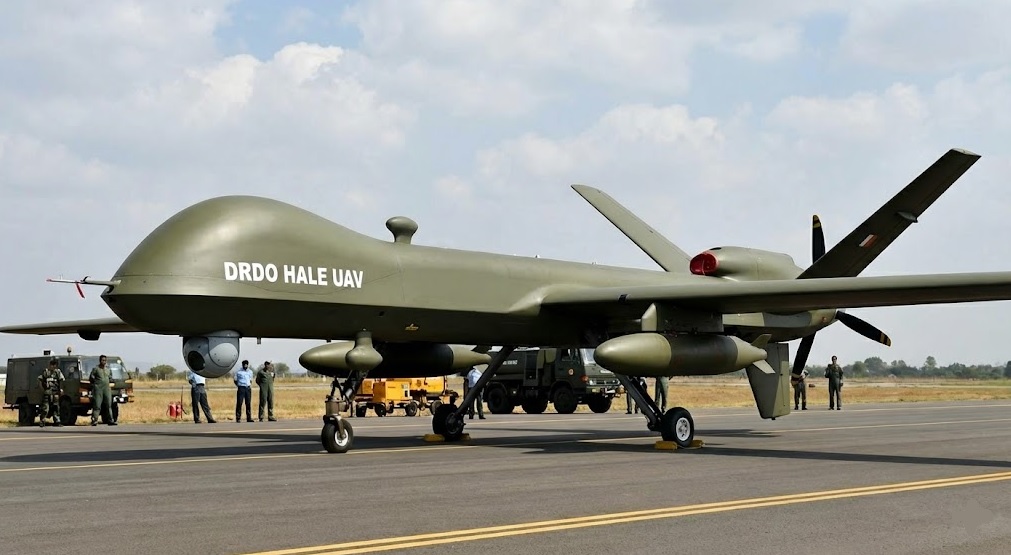
New Delhi: India has taken a significant step towards building a sovereign, high-end unmanned aerial capability with the Aeronautical Development Establishment (ADE) under the Defence Research and Development Organisation (DRDO) issuing an Expression of Interest (EoI) to identify an Indian Development-cum-Production Partner (DcPP) for its High Altitude Long Endurance – Remotely Piloted Aircraft System (HALE-RPAS) programme.
The EoI formally invites Indian vendors and consortia to participate in the development and subsequent production of what is envisaged as a 6-ton class unmanned aerial vehicle, marking one of the most ambitious indigenous UAV programmes ever undertaken by India.
The tender, identified as ADE/MMD/EOI-03/HALE-RPAS/25-26, was issued on December 24, 2025, with a bid submission deadline of January 28, 2026. A pre-bid meeting is scheduled for January 9, 2026, and the opening of bids is planned for January 29, 2026, at ADE, New Thippasandra Post, Bengaluru – 560075.
The HALE-RPAS is designed as a long-endurance ISTAR platform—Intelligence, Surveillance, Target Acquisition and Reconnaissance—with an integrated strike capability, enabling both persistent monitoring and precision engagement roles. The programme specifies a maximum all-up weight of approximately 6 tonnes, placing the aircraft in the strategic HALE category.
According to the technical outline released with the EoI, the UAV will feature a single turboprop engine mounted in a pusher configuration, a layout chosen to maximise aerodynamic efficiency, reduce sensor interference, and enhance endurance. The aircraft will have an approximate wingspan of 25 metres, optimised for high-aspect-ratio lift required for extended high-altitude operations.
The airframe is planned to be predominantly composite, enabling reduced structural weight, improved fatigue life, and enhanced mission adaptability. The platform will incorporate advanced avionics, autonomous flight management systems, secure line-of-sight and beyond-line-of-sight data links, and full integration with a modern ground control system designed for sustained, multi-mission operations.
Operationally, the HALE-RPAS is being designed for missions at around 40,000 feet altitude, enabling wide-area surveillance, persistent target tracking, and improved survivability. The payload architecture is expected to support electro-optical and infrared sensors, synthetic aperture radar, maritime surveillance radar, electronic intelligence suites, and air-to-ground precision weapons, giving the platform a true multi-role ISTAR-plus-strike capability.
The programme roadmap clearly defines the Design and Development (D&D) phase, under which five flying aircraft and two complete ground systems will be developed. This phase will include ground testing, flight trials, sensor and weapon integration, and mission system validation.
Airworthiness and quality assurance will be conducted under the oversight of Centre for Military Airworthiness and Certification (CEMILAC) and Directorate General of Aeronautical Quality Assurance (DGAQA), ensuring the HALE-RPAS meets Indian military aviation standards across structure, propulsion, avionics, and weapon systems.
Upon successful completion of development, testing, and certification, the programme explicitly envisages procurement through the Development-cum-Production Partner (DcPP) route, allowing the selected Indian industry partner to transition the platform into series production, lifecycle support, and future upgrades.
The issuance of the EoI comes at a time when India is simultaneously inducting imported HALE systems for immediate operational needs, while pushing indigenous development to ensure long-term strategic autonomy. In this context, the ADE-led HALE-RPAS programme is intended to establish domestic capability in large UAV design, high-altitude aerodynamics, turboprop propulsion integration, autonomous mission systems, and certification of complex unmanned aircraft.
For Indian industry, the project represents a once-in-a-generation opportunity to participate in the complete lifecycle of a strategic-class unmanned aircraft, from development and flight testing to production and sustainment. For the armed forces, the HALE-RPAS promises a persistent, high-altitude surveillance and strike platform capable of operating across land and maritime domains, significantly strengthening India’s situational awareness and deterrence posture.
With the EoI now issued and timelines clearly defined, the HALE-RPAS programme has moved from concept into a structured industrial phase, setting the foundation for India’s first indigenous 6-ton, 40,000-ft-class HALE unmanned combat-capable aerial system.
About the Author
Aditya Kumar:
Defense & Geopolitics Analyst
Aditya Kumar tracks military developments in South Asia, specializing in Indian missile technology and naval strategy.