DRDO Developing Rudram-4 A2G Missile Range 1500 Km
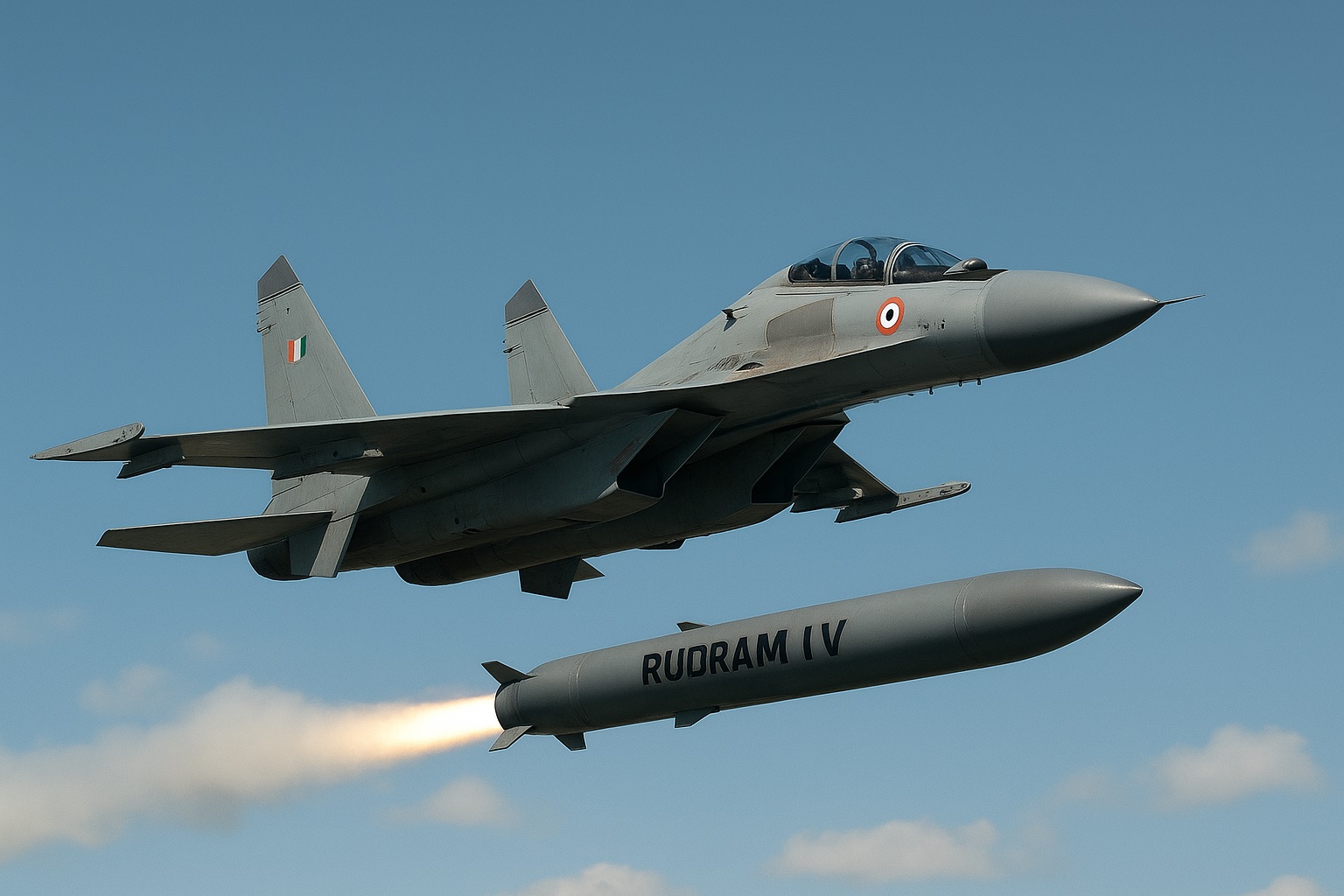
India’s next-generation missile, Rudram-4, is not just another variant of the Pralay missile—it’s a distinct, advanced addition to the Rudram series, offering unmatched reach, speed, and precision.
What We Know: Rudram vs. Pralay
-
Pralay is a surface-to-surface tactical ballistic missile developed by DRDO. It is roughly 5 tonnes in weight, two-staged, travels at about Mach 6.1, and is launched from ground-based transporter erector launchers. Its role is strategic ground strike, not aerial launch.
-
Rudram-4, by contrast, belongs to a family of air-launched, air-to-surface missiles designed to neutralize enemy ground-based defenses like radar, command centers, and bunkers. It’s hypersonic and optimized for operations launched from fighter aircraft.
Rudram-4: Speed, Range, and Tactical Edge
Below is a snapshot of how the Rudram series has evolved:
| Variant | Range | Speed | Notable Features |
|---|---|---|---|
| Rudram-1 | ~200 km | ~Mach 2 | Anti-radiation, supersonic, integrated |
| Rudram-2 | ~300 km | ~Mach 5.5 | Dual-role: ground attack & ARM, hypersonic |
| Rudram-3 | ~550 km | Hypersonic | Two-stage, highly maneuverable |
| Rudram-4 (est.) | ~1,000–1,500 km | >Mach 5 (hypersonic) | Long-range, lightweight LRSOW variant |
-
Rudram-4 is being developed as a Long-Range Stand-Off Weapon (LRSOW) with a projected range between 1,000 and 1,500 km.
-
It’s designed for hypersonic speeds (faster than Mach 5), making interception extremely challenging.
-
The missile will likely use a quasi-ballistic trajectory with low-altitude maneuvers, ideal for evading advanced air-defenses.
-
Equipped with INS-GPS/ENG guidance and possibly Imaging Infrared (IIR) or passive homing heads, Rudram-4 aims for pinpoint accuracy against hardened or radar-equipped targets.
-
It’s designed to integrate with multiple fighter platforms such as Su-30MKI, Mirage 2000, and Rafale, enhancing deployment flexibility.
-
Development got a boost in 2023 when the Defence Acquisition Council approved its Acceptance of Necessity (AoN), signaling path to operational deployment within 3–4 years.
Strategic Implications
-
Rudram-4 is a game-changer in India’s SEAD/DEAD (Suppression/Destruction of Enemy Air Defenses) capabilities. Its combination of range and speed could neutralize threats deep inside adversary territory while keeping Indian aircraft at safe stand-off zones.
-
Designed especially to counter threats from China and Pakistan, it addresses sophisticated air defense systems like the HQ-9 and S-400.
-
The development of Rudram-4 represents India’s growing competence in hypersonic missile technology, alongside global powers like Russia, China, and the US.
-
It underscores India’s commitment to indigenous, network-centric defense capabilities and enhances deterrent credibility.
Rudram-4 stands as a distinct and significant leap beyond the Pralay missile—offering hypersonic speed, extended reach (1,000–1,500 km), low-altitude maneuverability, and multi-platform aerial launch capability. Rather than being an A2G version of Pralay, it represents a strategic and technological evolution in air-to-ground strike capacity.
✍️ This article is written by the team of The Defense News.