DRDO Developing New Agni Variant with Bunker Buster Warhead for Targets 100m Below Ground
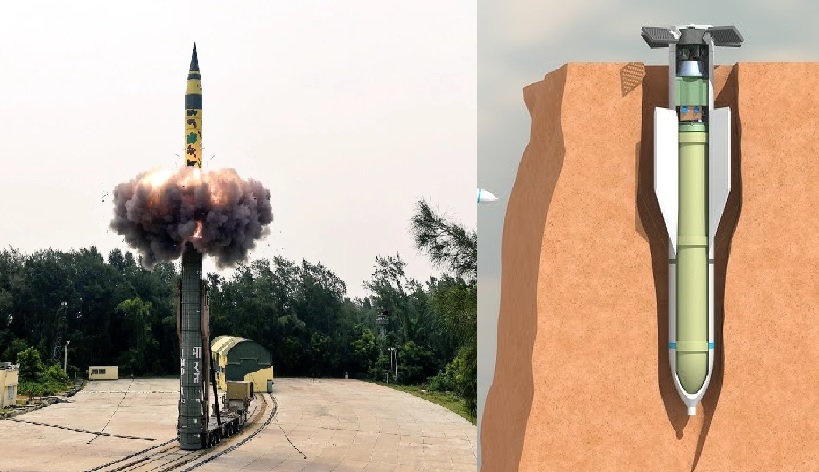
In a significant development aimed at enhancing India’s long-range conventional strike capabilities, reports circulating on social media platforms—particularly X (formerly Twitter)—suggest that the Defence Research and Development Organisation (DRDO) is working on a new variant of the Agni-V ballistic missile. Unlike the nuclear-capable original version with an intercontinental range, this upcoming iteration is said to be conventionally armed and optimized for tactical missions, carrying a massive 7.5-tonne warhead.
While no official confirmation has come from the Ministry of Defence or DRDO, these reports point to a deliberate shift in India's missile doctrine—moving from deterrence by nuclear capability to active, precision-based conventional deep-strike options. The new version is believed to have a reduced range of 2,000 to 2,500 km to accommodate the increased payload, trading distance for destructive power.
Two Conventional Warhead Variants Under Development?
Sources on social media suggest that two types of warheads are under consideration:
-
Airburst Warhead: Designed to detonate mid-air, this version can spread high-velocity fragments over a wide area, ideal for targeting troop concentrations, fuel depots, airfields, and command posts.
-
Bunker Buster Warhead: Intended to strike underground hardened facilities, this variant reportedly aims to penetrate depths of 80–100 meters, theoretically enabling India to target enemy leadership bunkers, WMD storage sites, or buried infrastructure.
If accurate, this move could position India alongside military powers like the U.S., China, and Russia, which are all investing heavily in high-precision, long-range conventional weapons that can serve strategic goals without nuclear escalation.
Strategic and Operational Advantages
This new Agni-V variant would offer India a critical intermediate capability—stronger than an airstrike or cruise missile but falling short of nuclear use. It could enable swift, punitive strikes on high-value targets deep inside hostile territory while remaining within the bounds of India’s ‘No First Use’ nuclear policy. The missile’s speed and payload capacity could make it a valuable tool for decapitation strikes or battlefield-shaping operations in a two-front war scenario.
Moreover, conventional warheads are cheaper and politically less sensitive than nuclear ones, offering repeat usability during sustained conflicts.
But There's a Major Technical Hurdle: Accuracy
While the idea of a conventional Agni-V variant with bunker-busting capability is tactically appealing, it raises serious technical questions—foremost among them: accuracy.
Ballistic missiles, including the original Agni-V, typically have a Circular Error Probable (CEP) of around 30–50 meters under ideal conditions. However, bunker busters need precision within 3–5 meters to ensure penetration into hardened underground facilities. A deviation of even 10 meters could cause the warhead to explode harmlessly on the surface, failing to neutralize the target.
To overcome this, the missile would require advanced terminal guidance technologies—such as:
-
Manoeuvrable Re-entry Vehicles (MaRVs) with onboard sensors and GPS-aided Inertial Navigation Systems,
-
Possibly Radar/Optical Scene Matching in the terminal phase,
-
Or even loitering second-stage systems that can course-correct mid-flight.
Yet, these technologies come with their own challenges—especially when applied to a heavy, fast-moving ballistic platform. Precision at such scales is still largely the domain of cruise missiles and air-delivered munitions, not ICBMs.
Unverified Reports and Global Context
It is important to note that all this information has so far emerged only from social media, primarily through posts and threads on X, without any official backing. The timing of this viral speculation coincides with the recent use of American GBU-57 Massive Ordnance Penetrators (MOPs)—also known as bunker busters—allegedly against underground targets in Iran.
This has led to growing discussions in Indian defense circles about the need for similar capabilities, and the possibility that India is either responding to these global trends or simply exploring the concept on paper.
For now, these remain unverified claims. Until DRDO or the Indian government issues formal details, the Agni-V conventional variant with a 7.5-tonne warhead remains an intriguing but speculative development, with major technical hurdles—particularly pinpoint accuracy for bunker busting—still to be solved if it is to become a battlefield reality.
✍️ This article is written by the team of The Defense News.