DRDO Conducts Successful Pralay Dual-Missile Salvo Test During User Evaluation Trials
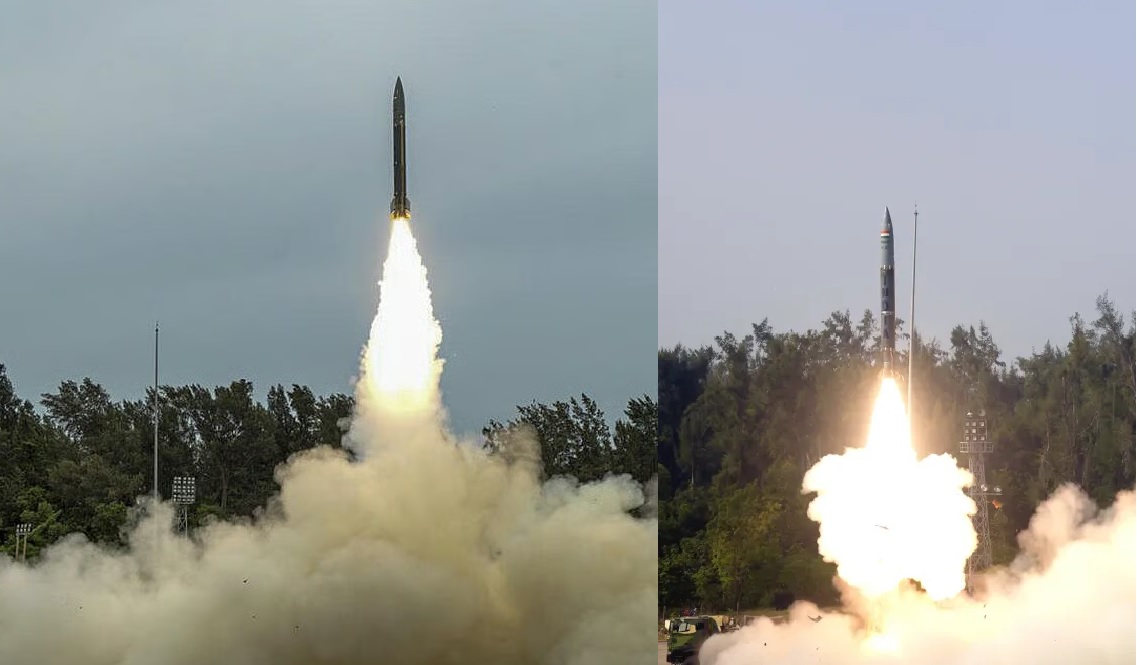
Chandipur (Odisha): India on Tuesday successfully carried out a salvo launch of two Pralay surface-to-surface missiles in quick succession from the same launcher at the Integrated Test Range (ITR), Chandipur, underscoring the growing maturity of the country’s conventional strike missile capabilities. The test was conducted by the Defence Research and Development Organisation (DRDO) as part of User Evaluation Trials, a critical phase preceding operational induction.
According to officials, both missiles were launched in rapid sequence from a road-mobile, canisterised launcher and precisely followed their intended trajectories, successfully meeting all mission objectives. The salvo firing validated not only the missile’s performance but also the reliability of the launcher, command systems and launch crew procedures under realistic operational conditions.
Designed for Rapid Conventional Strike
The Pralay missile is an indigenously developed, solid-propellant, quasi-ballistic missile with a range between 150 km and 500 km. It has been specifically designed for rapid conventional deep-strike missions, enabling Indian forces to neutralise critical enemy assets without crossing the nuclear threshold.
Pralay’s quasi-ballistic trajectory and high manoeuvrability make it difficult to intercept, while its circular error probable (CEP) of less than 10 metres places it among the most accurate missiles in its class. The system is capable of engaging time-sensitive and high-value targets, including enemy air bases, command and control centres, logistics hubs and missile infrastructure, particularly across India’s northern and western fronts.
Advanced Guidance and Flexible Warhead Options
The missile employs state-of-the-art guidance and navigation systems, combining inertial navigation with advanced correction mechanisms to maintain precision throughout its flight. Designed with operational flexibility in mind, Pralay can carry multiple types of conventional warheads, allowing it to be tailored for different target sets such as hardened structures, area targets or infrastructure nodes.
Its road-mobile and canisterised configuration significantly enhances survivability, enabling quick deployment, shoot-and-scoot operations and ease of transportation across varied terrain.
A Truly Indigenous Programme
The Pralay missile has been developed by Research Centre Imarat (RCI), Hyderabad, in collaboration with several DRDO laboratories, including the Defence Research and Development Laboratory, Advanced Systems Laboratory, Armament Research and Development Establishment, High Energy Materials Research Laboratory, Defence Metallurgical Research Laboratory, Terminal Ballistics Research Laboratory, Research & Development Establishment (Engineers), and the Integrated Test Range.
The missile’s development-cum-production partners, Bharat Dynamics Limited (BDL) and Bharat Electronics Limited (BEL), integrated the weapon system for the present trials. Representatives from the Indian Army and the Indian Air Force, along with senior DRDO scientists and industry partners, witnessed the tests.
Leadership Reactions and Induction Outlook
Rajnath Singh, Raksha Mantri, congratulated DRDO, the Indian Army, the Indian Air Force, defence public sector undertakings and industry partners on the successful launches, stating that the salvo firing in quick succession establishes the reliability and operational readiness of the Pralay missile system.
Secretary, Department of Defence R&D and Chairman DRDO, Samir V Kamat, described the achievement as a clear indicator of imminent induction, noting that the successful user evaluation trials demonstrate the system’s readiness for deployment with the armed forces.
The 2025 User Trials Track
Pralay’s user evaluation campaign has included two consecutive flight-tests earlier in July 2025 from Dr APJ Abdul Kalam Island, aimed at validating minimum and maximum range performance, with the Ministry stating the missiles achieved “pin-point accuracy” and all subsystems performed as expected. The December 31, 2025 event builds on that track by demonstrating rapid-fire operational handling from a single launcher—an important step for field deployment concepts.
Strategic Significance
With the successful salvo launch from a single launcher, Pralay strengthens India’s conventional deterrence posture, filling a critical capability gap between long-range artillery and strategic missile systems. As induction draws closer, the missile is expected to become a key pillar of India’s precision strike arsenal, providing commanders with a fast, accurate and survivable option for battlefield and theatre-level operations.
✍️ This article is written by the team of The Defense News.