DRDO Astra Mk-3 ‘Gandiva’ Missile Gears Up for Trials with GaN-Based AESA Seeker
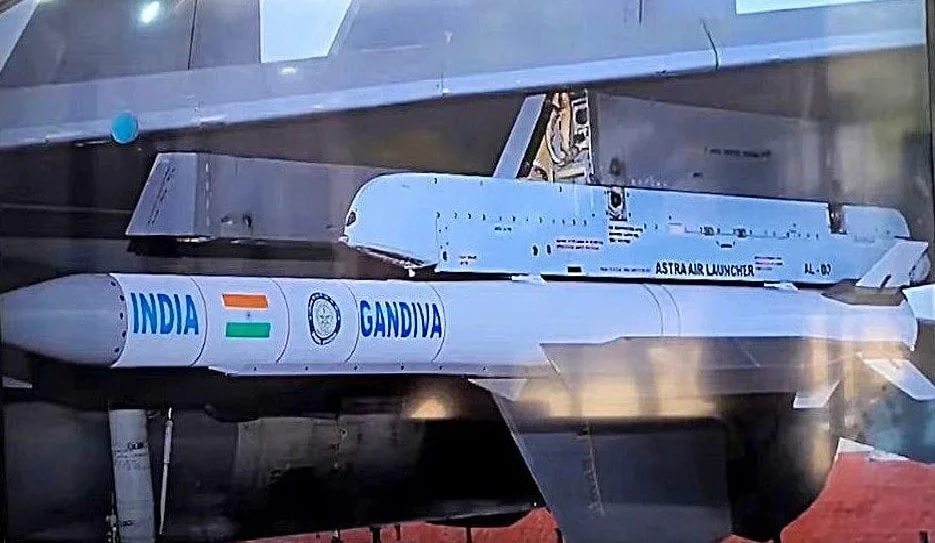
India is steadily moving closer to fielding one of its most advanced air-to-air weapons yet—the Astra Mk-3 missile, officially named ‘Gandiva’, after the legendary bow wielded by Arjuna in the Mahabharata. Developed by the Defence Research and Development Organisation (DRDO), Gandiva is designed to be a next-generation Beyond Visual Range Air-to-Air Missile (BVRAAM) that could transform the Indian Air Force’s ability to strike distant and stealthy aerial threats.
What makes Gandiva so advanced is its Solid Fuel Ducted Ramjet (SFDR) engine, a cutting-edge propulsion system that offers greater speed, range, and fuel efficiency compared to traditional rocket-powered missiles. Instead of carrying both fuel and oxidizer like a rocket, the SFDR system uses atmospheric air for combustion, making the missile lighter and faster. This allows Gandiva to reach speeds of up to Mach 4.5 (more than four times the speed of sound) and achieve a strike range of over 300 kilometers.
This long range makes it one of the most powerful air-to-air missiles in the world, capable of hitting targets far beyond visual distance. Importantly, the SFDR engine also has throttle control, which means the missile can adjust its speed mid-flight. This expands its “no-escape zone”, allowing it to chase and destroy even highly maneuverable enemy jets.
Another key highlight of Gandiva is its advanced seeker system, which guides the missile toward its target. In the current phase, the missile is equipped with an Active Electronically Scanned Array (AESA) seeker based on Gallium Arsenide (GaAs) technology. This seeker provides accurate tracking, even at long distances, and maintains a strong data link with the launching aircraft.
But DRDO has bigger plans. For the final version of Gandiva, it is developing an AESA seeker based on Gallium Nitride (GaN)—a newer, more efficient material. GaN seekers are known for their high power output, resistance to heat, and superior performance against electronic jamming. This makes Gandiva more reliable and effective in modern warfare where enemies often use stealth technology and electronic warfare to avoid detection.
The use of GaN will be a big advantage against stealth aircraft, like China’s J-20, which rely on low radar visibility. The enhanced seeker can better detect and lock onto low-signature targets, giving India’s jets the ability to neutralize stealth threats before they can strike.
Development and testing of Gandiva are progressing through several important phases:
-
Ground tests have already confirmed that the SFDR engine meets expected performance.
-
Captive carriage trials—where the missile is carried by fighter jets like the Sukhoi Su-30MKI—are currently ongoing, ensuring it works well with aircraft systems.
-
Live-fire trials are expected next, where Gandiva will be launched at real targets to test its range, speed, and precision, even in difficult flight scenarios.
Once ready, Gandiva will be deployed on various Indian fighter jets including the Su-30MKI, HAL Tejas, and potentially even Rafale and MiG-29. This will give the Indian Air Force a common, long-range missile platform across multiple types of aircraft.
Strategically, the Gandiva missile is expected to counter threats like China’s PL-15 missile and strengthen India’s response to stealth fighters and airborne early-warning systems. If DRDO achieves its goal of mass production by 2030–31, Gandiva will represent a major leap in India’s missile self-reliance under the Aatmanirbhar Bharat vision.
In summary, Astra Mk-3 'Gandiva' combines long range, speed, smart guidance, and stealth-hunting ability—making it a future-ready weapon that will keep Indian skies safer in the years to come.
✍️ This article is written by the team of The Defense News.