Chinese Scientists Developed Large-Scale Atom Arrangement for Quantum Computing
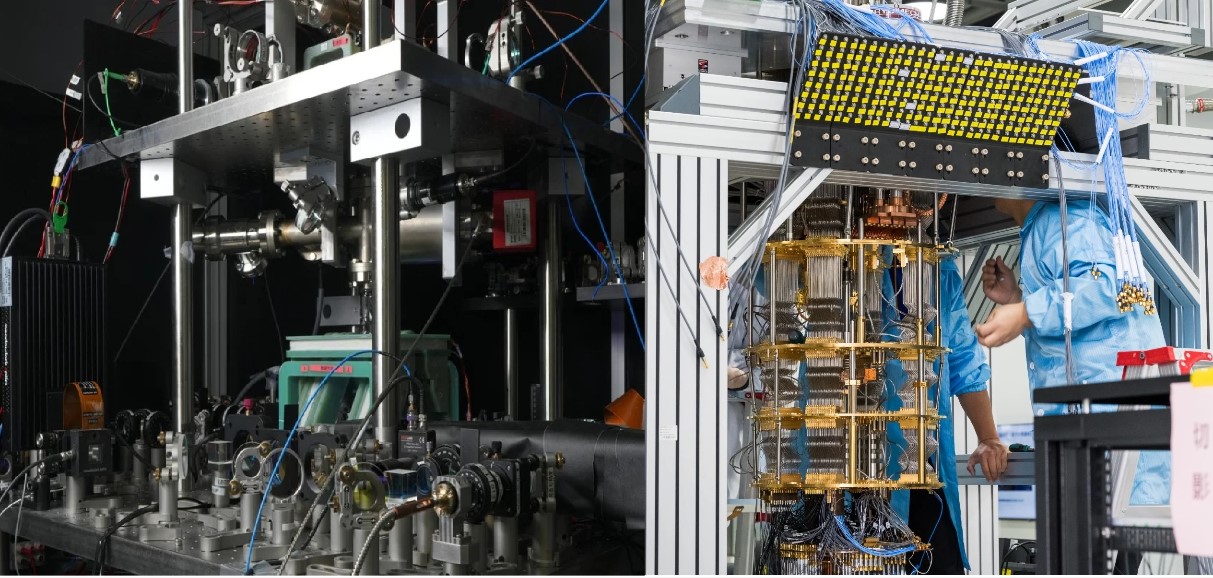
A research team led by renowned Chinese physicist Pan Jianwei has achieved a major milestone in quantum computing by developing an atom-arranging system capable of creating arrays 10 times larger than any previous atom-based quantum setup. The innovation, which can arrange more than 2,000 rubidium atoms into perfect patterns in just 60 milliseconds, could pave the way toward quantum computers with tens of thousands of qubits.
Pan’s team, from the University of Science and Technology of China (USTC), collaborated with the Shanghai Artificial Intelligence Laboratory to solve one of the biggest bottlenecks in neutral-atom quantum computing: the slow process of positioning each atom individually. Instead, they designed an artificial intelligence system that shifts all atoms simultaneously using advanced laser shaping technology.
The system employs a high-speed spatial light modulator to direct focused laser beams—known as optical tweezers—which trap and rearrange the atoms into two- or three-dimensional arrays. This approach maintained the same speed of arrangement regardless of the array’s size, a key indicator that it could be scaled to much larger systems without slowing down.
The team’s experiments reached world-class precision in quantum operations, performing single-qubit tasks with 99.97% accuracy and two-qubit operations with 99.5% accuracy, while detecting qubit states with 99.92% accuracy. These figures match the performance of top global research centers such as Harvard and MIT, but with a significantly larger atom array than most current systems.
Atom-based quantum computers are considered one of the most promising approaches in the field, thanks to their stability and scalability. Unlike superconducting circuits or trapped ions, neutral atoms can be controlled in large numbers with minimal interference, making them ideal for building large quantum processors. Until now, however, working systems were typically limited to a few hundred atoms due to technical constraints.
In a striking demonstration of their system’s capabilities, Pan’s group arranged about 550 rubidium atoms to recreate a physical version of the famous Schrödinger’s cat quantum thought experiment—something previously impossible at this scale with such speed and accuracy.
Despite the breakthrough, the researchers acknowledge current limitations. In three-dimensional configurations, atoms can only be moved within the same layer; moving them vertically risks losing them. The size of the array is also restricted by the available laser power and the precision of beam-shaping devices.
The next goal is to develop more powerful lasers and faster, more precise modulators, which could enable perfect arrangement of tens of thousands of atoms. If achieved, such a system could become the foundation for a truly practical quantum computer, capable of solving problems far beyond the reach of today’s most powerful supercomputers.
Experts believe that progress in this field could accelerate breakthroughs in cryptography, advanced material design, AI training, and large-scale simulations of physical systems. For China, which has invested heavily in quantum technologies, Pan’s achievement represents a significant step toward global leadership in next-generation computing.
✍️ This article is written by the team of The Defense News.