Chinese-Made MLRS Explodes In Cambodia–Thailand War, Killing Eight Cambodian Soldiers
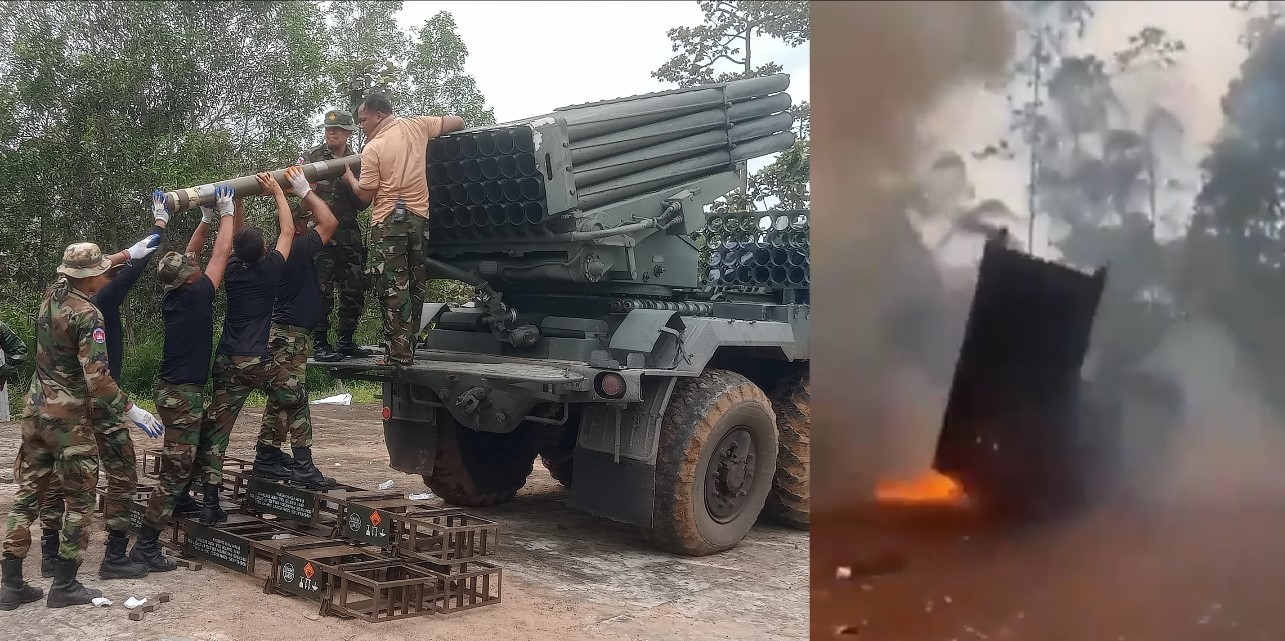
In the escalating border war between Cambodia and Thailand, a Chinese-made multiple-launch rocket system (MLRS) operated by Cambodian forces exploded on the battlefield, killing eight Cambodian soldiers, according to confirmed reports and frontline video evidence that circulated widely on social media and among defence analysts. The footage, reportedly captured near contested border zones between the two nations, shows the aftermath of the catastrophic malfunction, sparking renewed scrutiny of Chinese weapon systems deployed in regional conflicts.
Deadly Incident on the Front Lines
The explosion occurred during active exchanges of artillery fire between Cambodian and Thai military units in a sector of the disputed border region. Visual material from the scene shows heavy damage to the MLRS vehicle and bodies of soldiers in proximity to the wreckage. Multiple eyewitnesses and combat footage suggest that the blast resulted from a catastrophic failure in the rocket system’s launch mechanism, though independent verification remains incomplete.
Cambodian military officials have not yet released a formal public statement attributing the cause of the explosion. Thai military sources, while confirming intense engagements in the area, did not claim responsibility for the specific blast.
Chinese MLRS Deployment in Cambodian Forces
Cambodia’s armed forces operate a significant arsenal of Chinese-origin MLRS variants, which have been integral to its artillery strategy in the ongoing conflict against Thailand. According to defence equipment records, the Royal Cambodian Armed Forces (RCAF) possess:
-
About 100 units of Chinese PHL-81 122 mm MLRS and approximately 25 units of the upgraded PHL-90B variant, part of the same family of Chinese truck-mounted rocket systems.
-
Additionally, the RCAF fields 6 Chinese PHL-03 300 mm long-range multiple launch rocket systems capable of deep-strike missions up to 70–130 km.
These systems have been deployed alongside other Soviet-designed BM-21 launchers as Cambodia’s military seeks to offset Thailand’s comparatively larger ground and air capabilities.
Warfare Challenges and System Reliability Questions
The explosion comes amid growing scrutiny of Chinese military hardware performance in recent conflicts. Earlier in 2025, Chinese-made weapon systems supplied to Pakistan were reported to have suffered failures during the May 2025 India–Pakistan war, raising questions about their battlefield reliability in high-intensity engagements.
Now, the apparent malfunction of a Chinese-made MLRS in Cambodian service fuels further concerns among military analysts about the performance of such systems under combat stress. While no official assessment has been released, defence experts note that rocket artillery systems are inherently complex and sensitive to maintenance and handling practices — especially in harsh frontline conditions.
Broader Conflict Dynamics
Since mid-2025, the long-simmering Thailand–Cambodia border dispute has escalated into open warfare, with both sides exchanging artillery barrages, rocket salvos, and even airstrikes. A previously brokered ceasefire, facilitated by regional diplomatic efforts, including by Malaysia and China, collapsed in December, leading to renewed hostilities.
The fighting has involved heavy weapons on both sides — Cambodian forces with their mix of Chinese and Russian artillery and rocket systems, and Thai forces leveraging modern Western-supplied platforms such as F-16 jets.
Regional and Humanitarian Impact
The conflict has had severe humanitarian consequences, with civilians on both sides killed or displaced by violence. Reports indicate hundreds of thousands of civilians have fled border areas since the clashes intensified, while both governments accuse the other of violations of ceasefire agreements and international law.
International actors, including China, have reiterated calls for an immediate return to negotiations and a sustainable ceasefire, even as fighting continues.
✍️ This article is written by the team of The Defense News.