China’s First Reusable Rocket "Zhuque-3" Reaches Orbit but Fails Dramatic Landing Attempt
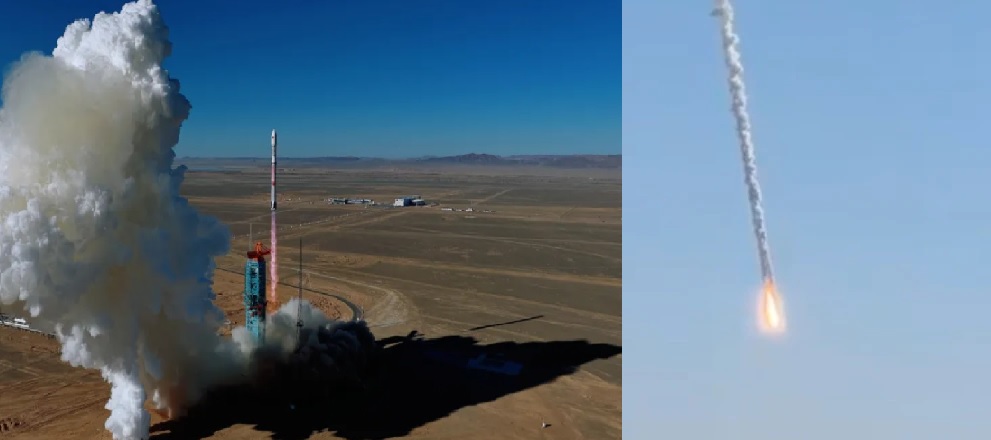
China’s commercial space ambitions took a mixed step forward on 3 December 2025, as LandSpace’s Zhuque-3 reusable rocket successfully reached orbit but failed its first-ever landing attempt, exploding near its desert recovery pad after an “abnormal combustion” during the final landing burn.
Despite the fiery end of the booster, the mission is widely being described as a “partial success” that confirms China’s entry into the club of nations and companies seriously attempting Falcon 9–class rocket reusability.
A Partial Success: Second Stage Nails Its Mission
Zhuque-3 lifted off from Jiuquan Satellite Launch Center’s Dongfeng commercial space innovation pilot zone in northwestern China at about 04:02 UTC on December 3, 2025, carrying a mass simulator payload instead of a customer satellite.
Key mission outcomes:
-
The first stage powered the rocket through ascent and separated as planned.
-
The second stage ignited normally and successfully delivered the payload into the pre-planned low Earth orbit, validating LandSpace’s new methane–liquid oxygen propulsion stack and flight control systems on an orbital mission.
Chinese space commentators and engineers have stressed that getting a new, heavy methalox rocket to orbit on the first try is itself a major achievement, even if the recovery attempt failed.
What Went Wrong During the Landing Attempt
After stage separation, the first-stage booster executed a return trajectory toward a designated landing pad in the Gobi Desert, near Alxa League in Inner Mongolia. Like SpaceX’s Falcon 9, Zhuque-3 attempted a propulsive vertical landing, using grid fins for control and a final engine relight to slow down just above the pad.
According to China’s official Xinhua agency and LandSpace’s statement, the critical final phase did not go as planned:
-
During the landing burn, an “abnormal combustion event” occurred in the booster’s engine system.
-
Video and eyewitness reports show the booster catching fire mid-air, then breaking apart and crashing very close to the planned landing point, scattering debris around the pad area.
Authorities have not reported any casualties, and the test took place in a controlled, remote desert zone designed specifically for such high-risk experiments.
What Is Zhuque-3? China’s Falcon 9–Class Challenger
Zhuque-3 (ZQ-3) is LandSpace’s flagship reusable orbital rocket, designed to compete in the same performance class as SpaceX’s Falcon 9 and Blue Origin’s New Glenn in the global commercial launch market.
Key technical features:
-
Configuration: Two-stage, partially reusable orbital launch vehicle
-
Height: About 66 m for the current version (future Zhuque-3E will be ~76 m)
-
Core structure: Stainless steel airframe, similar in philosophy to SpaceX’s Starship architecture
-
Propellants: Liquid oxygen + liquid methane (methalox), offering cleaner combustion and better reusability potential
-
First stage:
-
9 × TQ-12A engines burning methalox
-
Combined thrust tested at around 7,500+ kN in ground firings
-
Equipped with grid fins, attitude thrusters and landing legs for powered recovery
-
-
Second stage:
-
1 × TQ-15A vacuum engine, also methalox
-
-
Planned payload capacity (mature Zhuque-3E version):
-
Up to ~21 tonnes to LEO expendable
-
Around 18 tonnes with downrange recovery
-
Roughly 12–13 tonnes with full return-to-launch-site recovery
-
-
Reusability target: At least 20 flights per booster when fully matured.
This maiden flight used the base Zhuque-3 configuration, slightly less powerful than the final Zhuque-3E variant, but already in the Falcon-class performance range.
Years of Preparation: From Hop Tests to Orbital Trial
The failed landing attempt did not come out of nowhere. LandSpace has spent several years maturing reusability tech on sub-scale and ground tests:
-
2024: Two vertical takeoff and landing (VTVL) tests of a Zhuque-3 test stage at Jiuquan, including a 10 km “hop” with engine cut-off, coasting, re-ignition, and precision landing just a couple of meters off the pad center.
-
June 2025: A full-scale static-fire test of a nine-engine first stage, with all TQ-12A engines running in parallel for about 45 seconds and simulating flight conditions.
-
October 2025: Complete dress rehearsal with full propellant loading, stage integration and pad operations, clearing the rocket for maiden flight.
In parallel, LandSpace gained orbital experience with its Zhuque-2 rocket, which in July 2023 became the first methalox rocket in the world to reach orbit—beating both SpaceX and Blue Origin to that specific milestone.
Why This “Failure” Still Matters for China’s Space Program
Zhuque-3’s maiden flight remains an important milestone for China’s reusable launch development. The mission demonstrated the complete ascent profile of a heavy methalox rocket and confirmed that its engines, guidance system, structural design and orbital operations functioned as intended.
The test also provided full telemetry and landing-phase data, covering the boost-back trajectory, atmospheric descent, grid-fin control and the final landing burn. As reported by Global Times, this data will support engineering refinements for upcoming tests.
From a strategic viewpoint, the mission aligns with China’s broader plan to build large low-Earth-orbit broadband constellations, similar to SpaceX’s Starlink. As highlighted by Reuters, achieving cost-efficient reusable launch capability is essential for such long-term projects.
In the current commercial landscape, LandSpace now holds a lead over other Chinese private launch firms, including iSpace, Galactic Energy and Deep Blue Aerospace, according to StratNews Global. Analysts also note that iterative testing is a normal part of reusable-rocket development, just as SpaceX conducted several unsuccessful landing attempts before establishing routine booster recovery, a point also emphasized by Reuters.
Within China’s space community, the view remains that early setbacks are expected and valuable for technical progress, and Zhuque-3’s first flight is regarded as a solid foundation for further advancement in reusable orbital launch systems.
About the Author
Aditya Kumar:
Defense & Geopolitics Analyst
Aditya Kumar tracks military developments in South Asia, specializing in Indian missile technology and naval strategy.