China's Chang'e-6 Achieves Historic Lunar Mission with Far Side Sample Collection
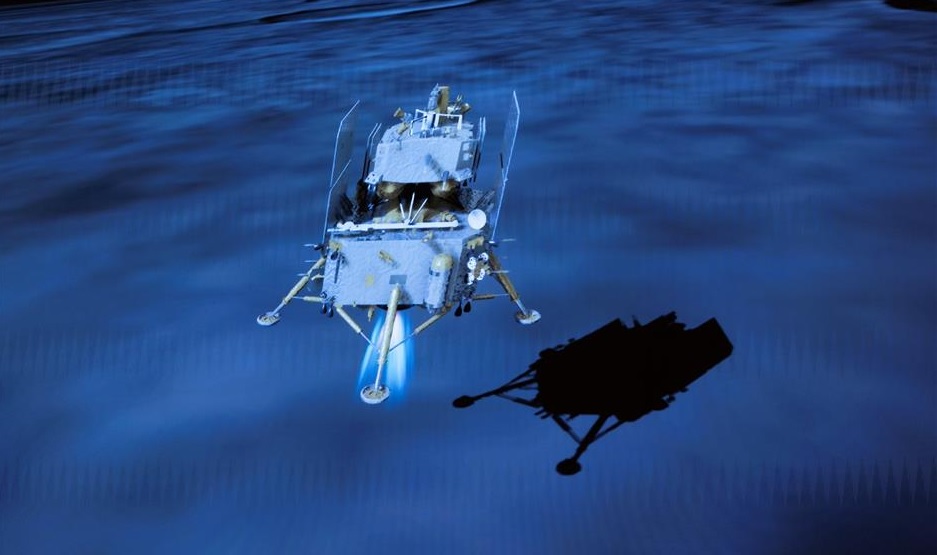
China's Chang'e-6 successfully lands on the Moon's far side, marking a historic first in lunar sample collection from this rarely explored region.
China's Chang'e-6 lunar probe has achieved a groundbreaking milestone by landing on the far side of the Moon and beginning a mission to collect samples from this rarely explored terrain. This marks the first time in human history that samples will be gathered from this enigmatic region of the lunar surface, according to Chinese state media.
The China National Space Administration (CNSA) announced this achievement, highlighting the significance of the Chang'e-6 mission. Supported by the Queqiao-2 relay satellite, the Chang'e-6 lander-ascender combination successfully touched down in the South Pole-Aitken (SPA) Basin, a unique and scientifically valuable area on the Moon's far side.
Launched on May 3, the Chang'e-6 mission consists of an orbiter, a returner, a lander, and an ascender. The mission followed a meticulously planned journey from Earth-Moon transfer, near-Moon braking, lunar orbiting, to its final descent to the lunar surface. Each step was executed with precision by the CNSA.
The chosen landing site, the Apollo Basin, was selected for its scientific importance and favorable landing conditions. Despite the rugged terrain typical of the Moon's far side, the relatively flat surface of the Apollo Basin offers an ideal location for landing and sampling operations.
Following the successful landing, Chang'e-6 is set to begin its sampling mission, which is expected to be completed within two days. The probe will collect samples from the lunar subsurface using a drill and from the surface using a robotic arm.
The Chang'e-6 development team prepared extensively for this mission. They established a simulation lab replicating the lunar environment to refine sampling strategies and equipment control procedures. This careful preparation ensures the accuracy and efficiency of the mission.
Communication with the far side of the Moon presents challenges due to the obstruction of direct signals. To address this, the Chang'e-6 mission incorporates advanced autonomous capabilities, allowing the probe to execute instructions and make decisions independently. This reduces the need for constant intervention from Earth-based controllers.
A significant advancement in the Chang'e-6 mission is the reduction of instructions sent from ground control, from approximately 1,000 to 400 throughout the sampling process. This exemplifies the progress in autonomous space exploration.
The Chang'e-6 mission not only demonstrates China's growing capabilities in space exploration but also contributes valuable scientific knowledge by collecting samples from a previously unexplored region of the Moon. This mission represents a significant step forward in our understanding of the Moon and the broader universe.
✍️ This article is written by the team of The Defense News.